Létinier Louis, Cossin Sébastien, Mansiaux Yohann, Arnaud Mickaël, Salvo Francesco, Bezin Julien, Thiessard Frantz, Pariente Antoine
Inserm, UMR 1219, Team Pharmacoepidemiology, Bordeaux Population Health Research Center, University of Bordeaux, Bordeaux, France.
Service de Pharmacologie Médicale, Pôle de Santé Publique, CHU de Bordeaux, Bordeaux, France.
Front Pharmacol. 2019 Mar 22;10:265. doi: 10.3389/fphar.2019.00265. eCollection 2019.
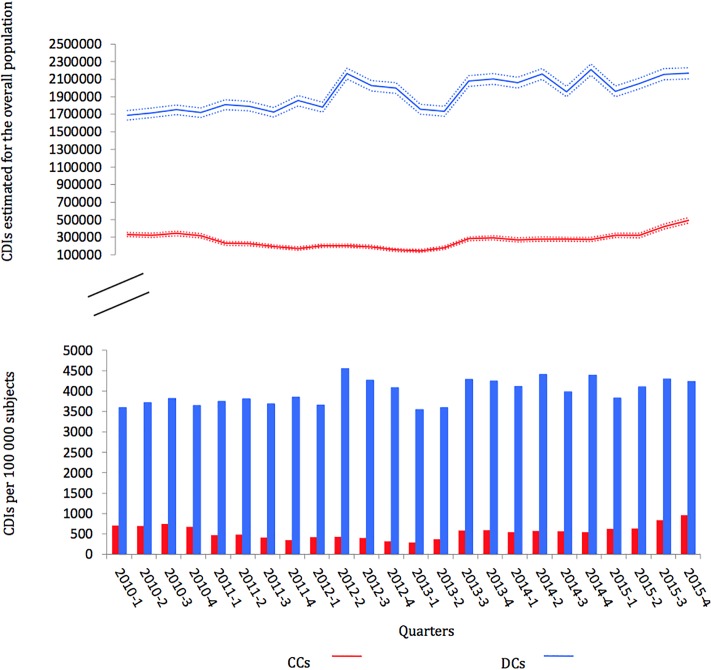
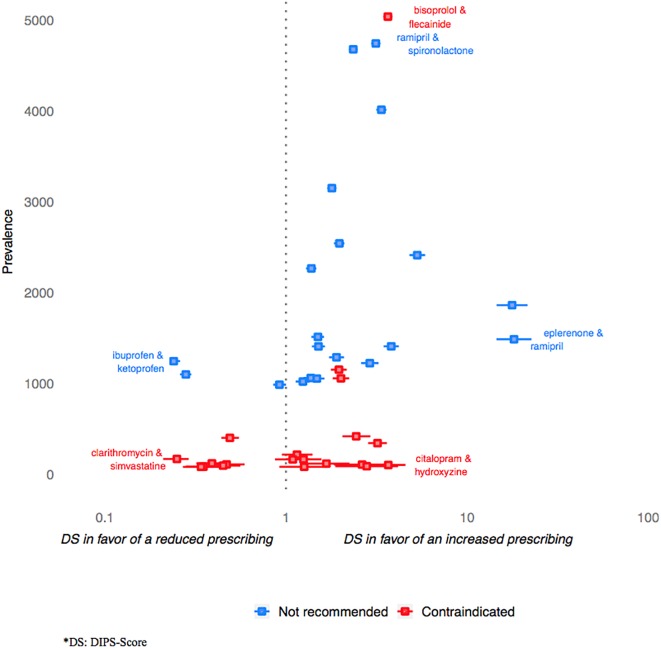
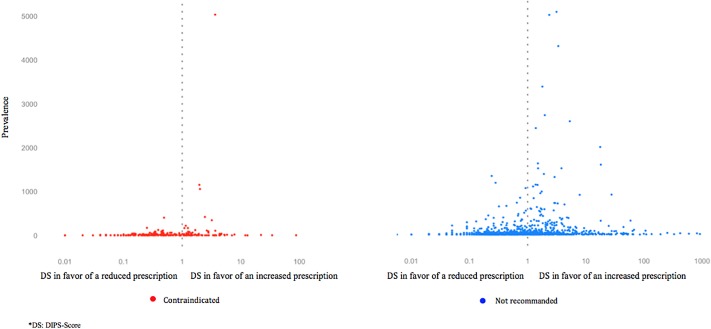
Drug interactions could account for 1% of hospitalizations in the general population and 2-5% of hospital admissions in the elderly. However, few data are available on the drugs concerned and the potential severity of the interactions encountered. We thus first aimed to estimate the prevalence of dispensings including drugs Contraindicated or Discommended because of Interactions (CDI codispensings) and to identify the most frequently involved drug pairs. Second, we aimed to investigate whether the frequency of CDI codispensings appeared higher or lower than the expected for the drugs involved. We carried out a study using a random sample of all drugs dispensings registered in a database of the French Health Insurance System between 2010 and 2015. The distribution of the drugs involved was described considering active principles, detailing the 20 most frequent ones for both contraindicated or discommended codispensings (DCs). To investigate whether the frequency of CDI codispensings appeared higher or lower than the expected for the drugs involved, we developed a specific indicator, the Drug-drug interaction prevalence study-score (DIPS-score), that compares for each drug pair the observed frequency of codispensing to its expected probability. The latter is determined considering the frequencies of dispensings of the individual drugs constituting a pair of interest. We analyzed 6,908,910 dispensings: 13,196 (0.2%) involved contraindicated codispensings (CCs), and 95,410 (1.4%) DCs. For CCS, the most frequently involved drug pair was "bisoprolol+flecainide" ( = 5,036); four out of five of the most represented pairs involved cardiovascular drugs. For DCS, the most frequently involved drug pair was "ramipril+spironolactone" ( = 4,741); all of the five most represented pairs involved cardiovascular drugs. The drug pair involved in the CC with the highest score value was "citalopram+hydroxyzine" (DIPS-score: 3.7; 2.9-4.6); that with the lowest score was "clarithromycin+simvastatin" (DIPS-score: 0.2; 0.2-0.3). DIPS-score median value was 0.4 for CCs and 0.6 for DCs. This high prevalence of CDI codispensings enforces the need for further risk-prevention actions regarding drug-drug interactions (DDIs), especially for arrhythmogenic or anti-arrhythmic drugs. In this perspective, the DIPS-score we develop could ease identifying the interactions that are poorly considered by clinicians/pharmacists and targeting interventions.
药物相互作用可能导致普通人群中1%的住院病例以及老年人中2%-5%的住院病例。然而,关于相关药物以及所遇到相互作用的潜在严重性的可用数据很少。因此,我们首先旨在估计因相互作用而禁忌或不推荐使用的药物配药(CDI配药)的发生率,并确定最常涉及的药物对。其次,我们旨在调查CDI配药的频率是否高于或低于所涉药物的预期频率。我们使用了2010年至2015年法国医疗保险系统数据库中登记的所有药物配药的随机样本进行了一项研究。考虑活性成分描述了所涉药物的分布情况,详细列出了禁忌或不推荐配药(DCs)中最常见的20种。为了调查CDI配药的频率是否高于或低于所涉药物的预期频率,我们开发了一个特定指标,即药物-药物相互作用发生率研究评分(DIPS评分),该评分针对每对药物比较观察到的配药频率与其预期概率。后者是根据构成一对感兴趣药物的个体药物的配药频率确定的。我们分析了6,908,910次配药:13,196次(0.2%)涉及禁忌配药(CCs),95,410次(1.4%)涉及DCs。对于CCs,最常涉及的药物对是“比索洛尔+氟卡尼”(=5,036);最常见的五对药物中有四对涉及心血管药物。对于DCs,最常涉及的药物对是“雷米普利+螺内酯”(=4,741);最常见的五对药物均涉及心血管药物。CC中得分最高的药物对是“西酞普兰+羟嗪”(DIPS评分:3.7;2.9-4.6);得分最低的是“克拉霉素+辛伐他汀”(DIPS评分:0.2;0.2-0.3)。CCs的DIPS评分中位数为0.4,DCs为0.6。CDI配药的高发生率强化了对药物-药物相互作用(DDIs)采取进一步风险预防措施的必要性,特别是对于致心律失常或抗心律失常药物。从这个角度来看,我们开发的DIPS评分可以便于识别临床医生/药剂师考虑不足的相互作用并确定干预目标。