Imaging Department of Tongji Hospital, Medical School of Tongji University, Shanghai 200065, P.R. China.
Department of Urology, Huashan Hospital, Fudan University, Shanghai 200040, P.R. China.
Int J Oncol. 2019 Apr;54(4):1221-1232. doi: 10.3892/ijo.2019.4721. Epub 2019 Feb 22.
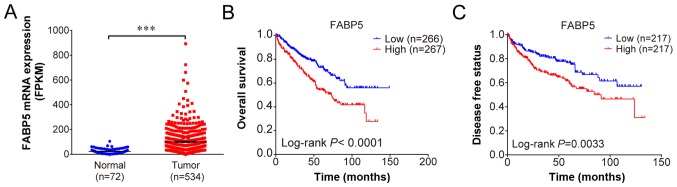
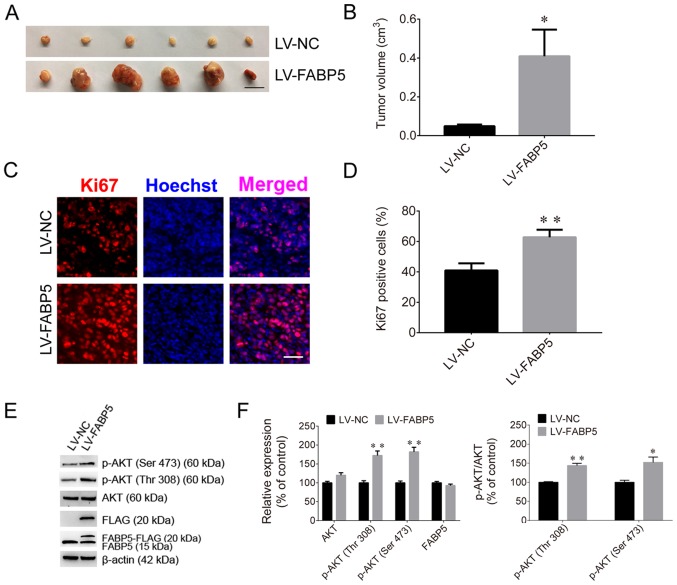
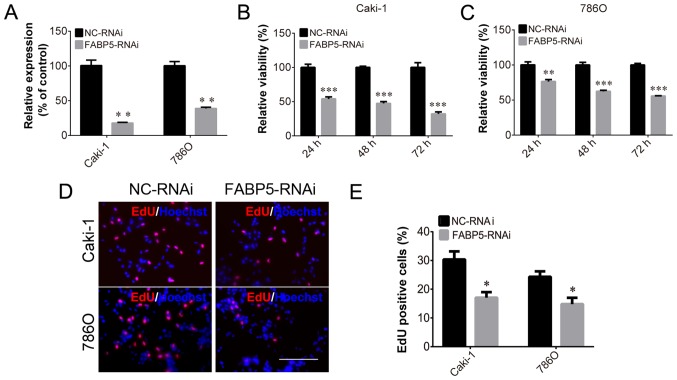
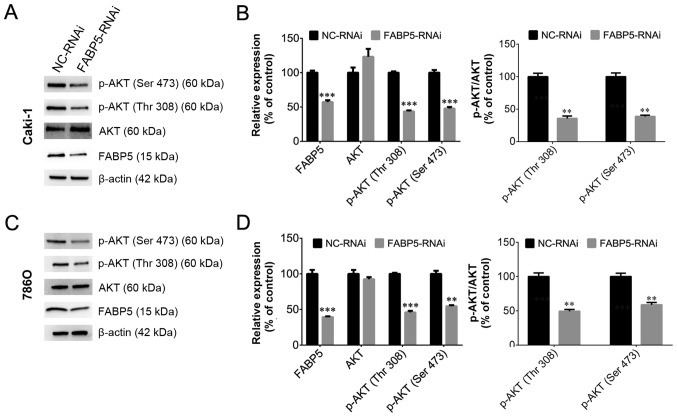
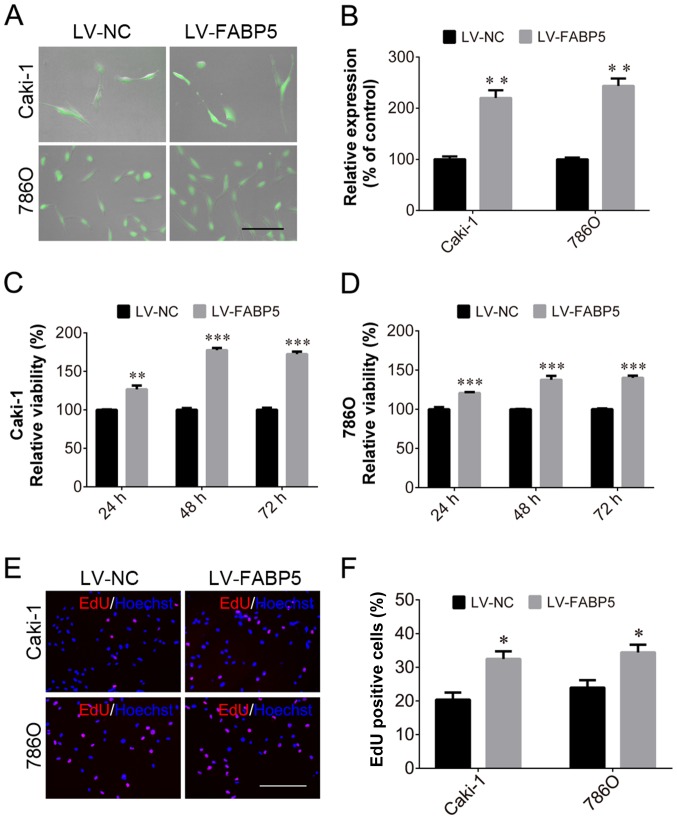
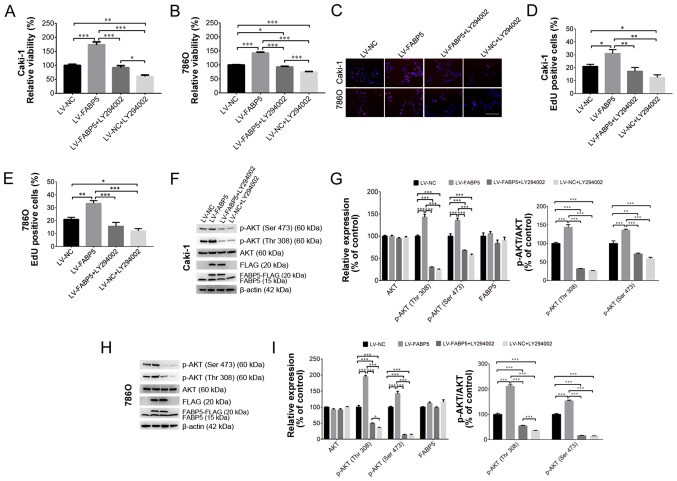
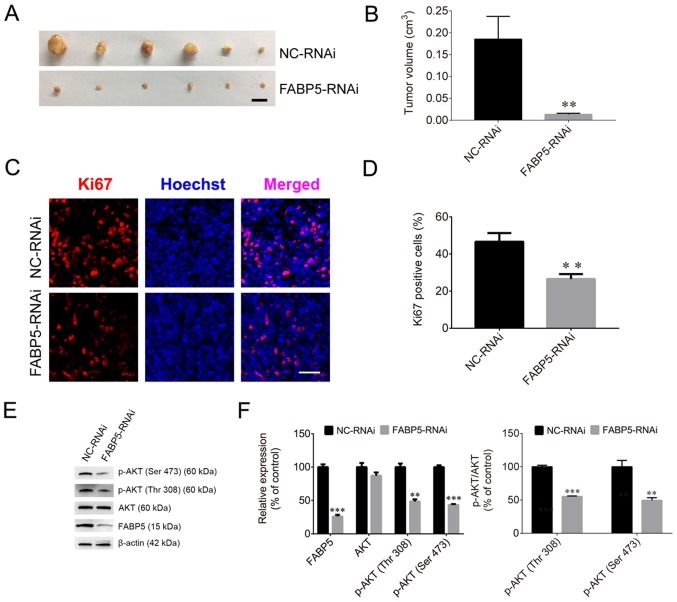
Clear cell renal cell carcinoma (ccRCC) has been associated with one of the highest mortality rates among all cancers. Fatty acid binding proteins (FABPs) are 14‑15 kDa proteins that are highly abundant in the cytosol of most tissues. FABP5, a member of the FABP family, has been observed to promote tumor cell growth in numerous cancer types. In order to investigate the function of FABP5 in ccRCC cells in the present study, RNA sequencing data from The Cancer Genome Atlas were analyzed to determine the expression levels of FABP5 in ccRCC patient samples. Survival and Cox regression analyses were performed to measure the association between FABP5 expression and clinicopathological features of patients with ccRCC. Subsequent in vitro experiments downregulated or overexpressed FABP5 in Caki‑1 and 786O ccRCC cells using lentiviral vectors to evaluate cell proliferation ability, and a xenograft transplantation model was established to examine the effect of FABP5 on tumorigenesis in vivo. The results demonstrated that FABP5 expression was significantly upregulated in samples from patients with ccRCC when compared with normal tissue samples. High FABP5 expression was also significantly correlated with tumor and metastasis classifications and predicted poor survival in patients with ccRCC. In ccRCC cells, silencing of FABP5 significantly inhibited cell proliferation, while overexpression of FABP5 promoted cell proliferation when compared to the respective controls. In addition, treatment with the phosphatidylinositol‑4,5‑bisphosphate 3‑kinase (PI3K)/AKT inhibitor, LY294002, attenuated the pro‑proliferative effects of exogenous FABP5 expression in Caki‑1 and 786O cells. This indicated that the PI3K/AKT signaling pathway may be partially involved in the FABP5‑mediated increase in ccRCC cell proliferation. Furthermore, FABP5 was observed to regulate tumor growth in nude mice in vivo. In conclusion, the results of the present study suggest that FABP5 may exert a pro‑proliferative role in ccRCC and may be associated with malignant progression and tumorigenesis.
透明细胞肾细胞癌 (ccRCC) 是所有癌症中死亡率最高的癌症之一。脂肪酸结合蛋白 (FABP) 是一种 14-15kDa 的蛋白质,在大多数组织的细胞质中含量丰富。FABP5 是 FABP 家族的成员之一,已观察到它在多种癌症类型中促进肿瘤细胞生长。为了研究 FABP5 在 ccRCC 细胞中的功能,本研究分析了来自癌症基因组图谱的 RNA 测序数据,以确定 FABP5 在 ccRCC 患者样本中的表达水平。进行生存和 Cox 回归分析,以测量 FABP5 表达与 ccRCC 患者临床病理特征之间的关联。随后使用慢病毒载体下调或过表达 Caki-1 和 786O ccRCC 细胞中的 FABP5,以评估细胞增殖能力,并建立异种移植移植模型以研究 FABP5 在体内对肿瘤发生的影响。结果表明,与正常组织样本相比,ccRCC 患者样本中 FABP5 的表达明显上调。高 FABP5 表达还与肿瘤和转移分类显著相关,并预测 ccRCC 患者的生存不良。在 ccRCC 细胞中,与各自的对照相比,沉默 FABP5 可显著抑制细胞增殖,而过表达 FABP5 可促进细胞增殖。此外,用磷脂酰肌醇-4,5-二磷酸 3-激酶 (PI3K)/AKT 抑制剂 LY294002 处理可减弱外源性 FABP5 表达在 Caki-1 和 786O 细胞中的促增殖作用。这表明 PI3K/AKT 信号通路可能部分参与了 FABP5 介导的 ccRCC 细胞增殖增加。此外,还观察到 FABP5 调节体内裸鼠肿瘤生长。总之,本研究的结果表明,FABP5 可能在 ccRCC 中发挥促增殖作用,并且可能与恶性进展和肿瘤发生有关。