1 The University of Sheffield, Sheffield, United Kingdom.
2 Sheffield Teaching Hospitals NHS Foundation Trust, Sheffield, United Kingdom.
J Clin Oncol. 2019 Jul 1;37(19):1617-1628. doi: 10.1200/JCO.18.01006. Epub 2019 Apr 10.
Salvage autologous stem-cell transplantation (sASCT) in patients with multiple myeloma (MM) relapsing after a prior autologous stem-cell transplantation leads to increased remission duration and overall survival. We report a comprehensive study on patient-reported outcomes, including quality of life (QoL) and pain in sASCT.
Patients were randomly assigned to either sASCT or nontransplantation consolidation (NTC). Pain and QoL were assessed as secondary outcomes using validated QoL instruments (European Organisation for Research and Treatment of Cancer QLQ-C30 and myeloma-specific module, QLQ-MY20; the Brief Pain Inventory [Short Form]; and the Leeds Assessment of Neuropathic Symptoms and Signs [Self-Assessment] scale).
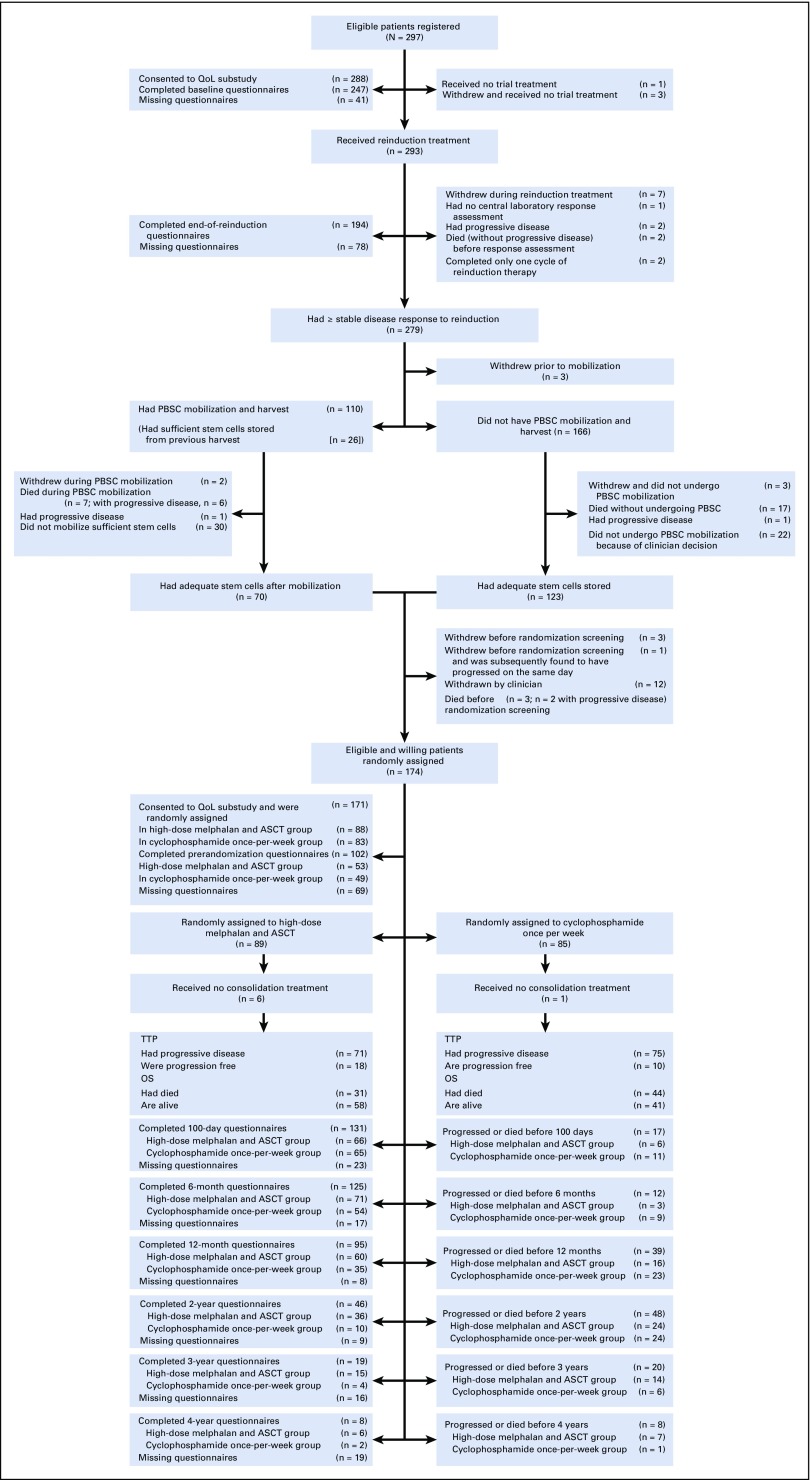
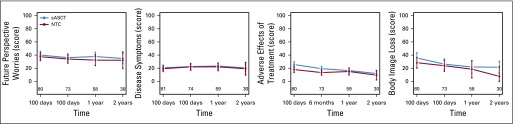
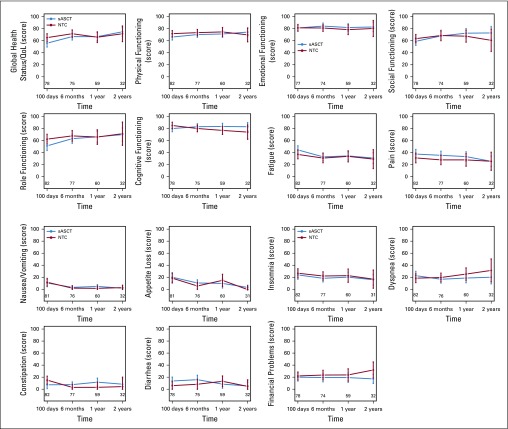
A total of 288 patients (> 96%) consented to the QoL substudy. The median follow-up was 52 months. The European Organisation for Research and Treatment of Cancer QLQ-C30 Global health status scores were higher (better) in the NTC group at 100 days after random assignment ( = .0496), but not at later time points. Pain interference was higher (worse) in the sASCT group than in the NTC group at 6 months after random assignment ( = .0267), with patients with sASCT reporting higher scores for Pain interference with daily living for up to 2 years after random assignment. Patients reporting lower concerns about adverse effects of treatment after sASCT had a time to progression advantage.
Patients with sASCT with relapsed MM demonstrated a comparative reduction in QoL and greater impact of treatment adverse effects lasting for 6 months and up to 2 years for pain, after which patients who had received sASCT reported better outcomes. Patients who experienced lower adverse effects after sASCT had longer time to progression and overall survival, showing the need to improve symptom management peritransplantation. To our knowledge, this study provides the most comprehensive picture of QoL before and after sASCT in patients with relapsed MM.
在先前接受过自体干细胞移植(ASCT)后复发的多发性骨髓瘤(MM)患者中进行挽救性自体干细胞移植(sASCT)可延长缓解持续时间和总生存期。我们报告了一项关于患者报告结局的综合研究,包括 sASCT 的生活质量(QoL)和疼痛。
患者被随机分配至 sASCT 组或非移植巩固治疗(NTC)组。使用经过验证的 QoL 工具(欧洲癌症研究与治疗组织 QLQ-C30 和骨髓瘤特异性模块 QLQ-MY20;简明疼痛量表[短式];以及利兹神经病症状和体征评估量表[自我评估])评估疼痛和 QoL 作为次要结局。
共有 288 例(超过 96%)患者同意进行 QoL 子研究。中位随访时间为 52 个月。欧洲癌症研究与治疗组织 QLQ-C30 全球健康状况评分在随机分组后 100 天更高(更好)( =.0496),但在后续时间点并未如此。随机分组后 6 个月时,sASCT 组的疼痛干扰更高(更差)( =.0267),sASCT 组的患者报告称,在随机分组后长达 2 年的时间里,他们的日常生活受到疼痛的干扰更大。报告 sASCT 后对治疗不良反应的担忧较低的患者具有进展时间优势。
在复发 MM 患者中,sASCT 组的 QoL 降低,疼痛的不良反应影响持续 6 个月,最长可达 2 年,此后接受 sASCT 的患者报告的结局更好。sASCT 后不良反应较轻的患者进展时间和总生存期更长,表明需要改善移植围手术期的症状管理。据我们所知,这项研究提供了 sASCT 前后复发 MM 患者 QoL 的最全面描述。