Salek Sam, Ionova Tatiana, Oliva Esther Natalie, Andreas Marike, Skoetz Nicole, Kreuzberger Nina, Laane Edward
School of Life and Medical Sciences, University of Hertfordshire, Hatfield AL10 9AB, UK.
Quality of Life Monitoring Department, Saint-Petersburg State University Hospital, 190103 Saint-Petersburg, Russia.
Cancers (Basel). 2022 Dec 6;14(23):6007. doi: 10.3390/cancers14236007.
Patient-reported outcomes (PROs) are becoming increasingly important in supporting clinical outcomes in clinical trials. In multiple myeloma (MM), PRO measurement is useful to reveal how treatment affects physical, psychosocial, and functional behaviour as well as symptoms and treatment-related adverse events to evaluate the benefit-risk ratio of a particular drug or drug combination. We report the types of PRO instruments used in MM, the frequency in which they are utilised in randomised controlled trials (RCTs), and the consistency of their reporting.
The European Hematology Association (EHA) supports the development of guidelines for the use of PROs in adult patients with haematological malignancies. The first step is the present systematic review of the literature. MEDLINE and CENTRAL were searched for RCTs in MM between 2015 and 2020. Study design, characteristics of MM and its treatment, the primary outcomes, and the types of PRO instrument(s) were extracted using a predefined template. Additionally, in a stepwise approach, it was assessed whether the identified instruments had been validated for multiple myeloma patients, patients with haematological malignancies, or cancer patients.
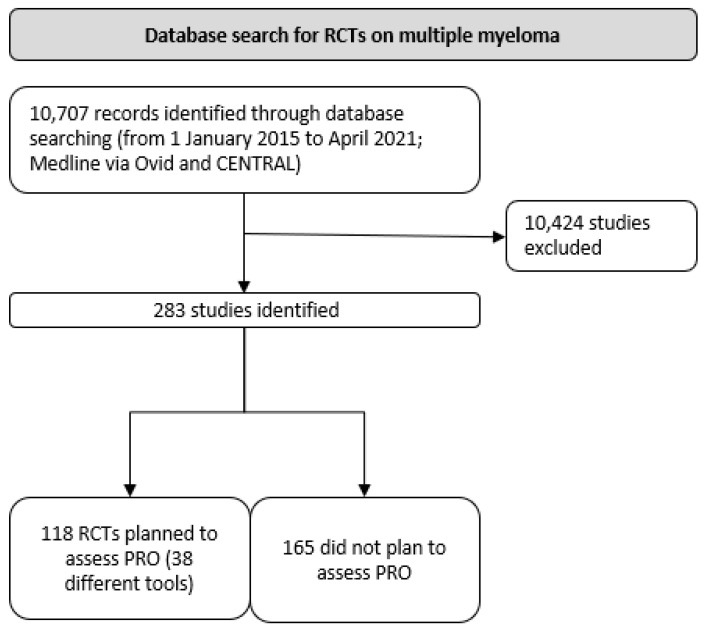
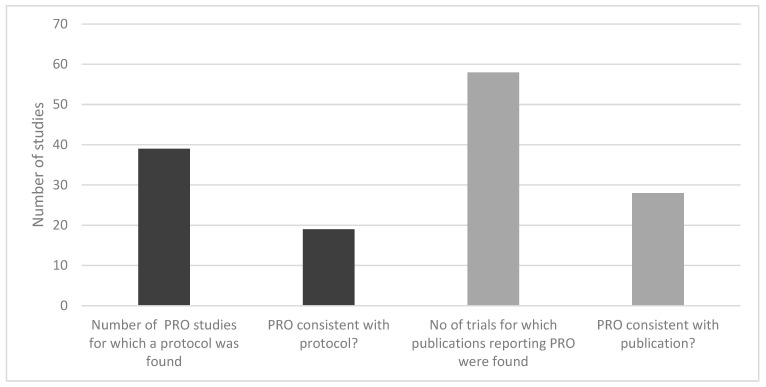
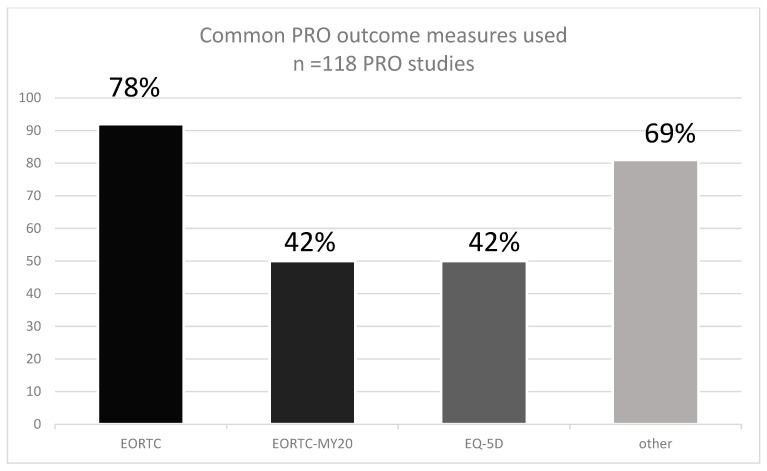
Following screening for RCTs, 283 studies were included for review from 10,707 records retrieved, and 118 of these planned the use of PRO measures. Thirty-eight PRO instruments were reported. The most frequently used instrument (92 studies) was the EORTC QLQ-30. The EORTC-MY20 MM-specific questionnaire was the second most frequently used (50 studies), together with the EQ-5D (50 studies). Only 19 PRO instruments reported were consistent with the trial registry. Furthermore, in 58 publications, the information on PRO instruments differed between the publication and the trial registry. Further, information on PRO in HTA reports was available for 26 studies, of which 18 reports were consistent with the trial registries. Out of the 38 instruments used, six had been validated for patients with multiple myeloma (the most frequently used), six for patients with haematological malignancies, and 10 for cancer patients in general.
The findings indicate that the measurement of PROs in RCTs for MM is underutilised, underreported, and often inconsistent. Guidelines for the appropriate use of PROs in MM are needed to ensure standardisation in selection and reporting. Furthermore, not all PRO instruments identified have been validated for myeloma patients or patients with haematological malignancies. Thus, guidelines for the appropriate use and reporting of PROs are needed in MM to ensure standardisation in the selection and reporting of PROs.
患者报告结局(PROs)在支持临床试验的临床结局方面正变得越来越重要。在多发性骨髓瘤(MM)中,PRO测量有助于揭示治疗如何影响身体、心理社会和功能行为以及症状和治疗相关不良事件,以评估特定药物或药物组合的获益风险比。我们报告了MM中使用的PRO工具类型、在随机对照试验(RCTs)中使用它们的频率以及报告的一致性。
欧洲血液学协会(EHA)支持制定血液系统恶性肿瘤成年患者使用PROs的指南。第一步是对文献进行当前的系统评价。检索MEDLINE和CENTRAL数据库,查找2015年至2020年间MM的RCTs。使用预定义模板提取研究设计、MM及其治疗的特征、主要结局以及PRO工具的类型。此外,采用逐步方法评估所识别的工具是否已针对多发性骨髓瘤患者、血液系统恶性肿瘤患者或癌症患者进行了验证。
在筛选RCTs后,从检索到的10707条记录中纳入283项研究进行综述,其中118项计划使用PRO测量。报告了38种PRO工具。使用最频繁的工具(92项研究)是欧洲癌症研究与治疗组织核心问卷(EORTC QLQ - 30)。欧洲癌症研究与治疗组织 - MY20 MM特异性问卷是第二常用的(50项研究),与欧洲五维度健康量表(EQ - 5D)并列(50项研究)。报告的PRO工具中只有19种与试验注册信息一致。此外,在58篇出版物中,PRO工具的信息在出版物和试验注册之间存在差异。此外,卫生技术评估(HTA)报告中有26项研究提供了PRO信息,其中18份报告与试验注册一致。在所使用的38种工具中,有6种已针对多发性骨髓瘤患者(使用最频繁)进行了验证,6种针对血液系统恶性肿瘤患者进行了验证,10种针对一般癌症患者进行了验证。
研究结果表明,MM的RCTs中PROs的测量未得到充分利用、报告不足且往往不一致。需要MM中PROs适当使用的指南,以确保选择和报告的标准化。此外,并非所有识别出的PRO工具都已针对骨髓瘤患者或血液系统恶性肿瘤患者进行了验证。因此,MM中需要PROs适当使用和报告的指南,以确保PROs选择和报告的标准化。