Wilson Clara, Morant Steve, Kane Sarah, Pesterfield Claire, Guest Claire, Rooney Nicola J
Animal Welfare and Behaviour Group, Bristol Veterinary School, Bristol, United Kingdom.
Medicines Monitoring Unit (MEMO), School of Medicine, The University of Dundee, Dundee, United Kingdom.
Front Vet Sci. 2019 Mar 27;6:91. doi: 10.3389/fvets.2019.00091. eCollection 2019.
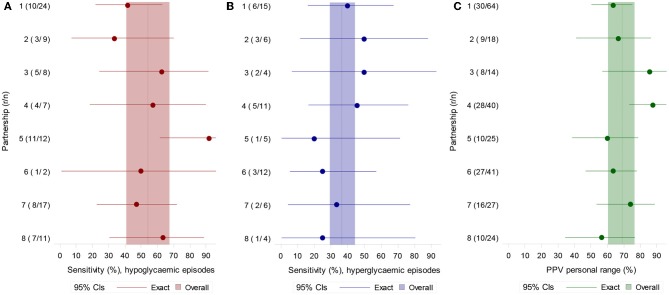
To quantify Diabetes Alert Dog (DAD) performance by using owner-independent measures. Eight owners of accredited DADs used a FreeStyle Libre Flash Glucose Monitoring System (FGMS). Concurrent Closed Circuit Television (CCTV) footage was collected for between 5 and 14 days in each owner's home or workplace. The footage was blind-coded for dogs' alerting behaviors. The sensitivity, False Positive Rate and Positive Predictive Values (PPV) of dogs' alerts to out-of-range (OOR) episodes were calculated. Ratings for 11 attributes describing participant's lifestyle and compliance (taken from each dog's instructor) and the percentage of DAD alerts responded to by the owner as per training protocol (taken from CCTV footage) were assessed for association with dog performance. Dogs alerted more often when their owners' glucose levels were outside . inside target range (hypoglycaemic 2.80-fold, = 0.001; hyperglycaemic 2.29-fold, = 0.005). Sensitivity to hypoglycaemic episodes ranged from 33.3 to 91.7%, the mean was 55.9%. Mean PPV for OOR episodes was 69.7%. Sensitivity and PPV were associated with aspects of the dog and owner's behavior, and the owner's adherence to training protocol. Owner-independent methods support that some dogs alert to hypo- and hyperglycaemic events accurately, but performance varies between dogs. We find that DAD performance is affected by traits and behaviors of both the dog and owner. Combined with existing research showing the perceived psychosocial value and reduced critical health care needs of DAD users, this study supports the value of a DAD as part of a diabetes care plan. It also highlights the importance of ongoing training and continued monitoring to ensure optimal performance.
通过使用独立于主人的测量方法来量化糖尿病警报犬(DAD)的表现。八只经过认证的DAD的主人使用了FreeStyle Libre闪光葡萄糖监测系统(FGMS)。在每位主人的家中或工作场所收集了5至14天的同步闭路电视(CCTV) footage。对录像进行盲编码以记录狗的警报行为。计算了狗对超出范围(OOR)事件的警报的敏感性、假阳性率和阳性预测值(PPV)。评估了描述参与者生活方式和依从性的11个属性的评分(取自每只狗的训练师)以及主人按照训练协议对DAD警报的响应百分比(取自CCTV录像)与狗的表现之间的关联。当主人的血糖水平超出目标范围时,狗发出警报的频率更高(低血糖时高2.80倍,P = 0.001;高血糖时高2.29倍,P = 0.005)。对低血糖事件的敏感性范围为33.3%至91.7%,平均为55.9%。OOR事件的平均PPV为69.7%。敏感性和PPV与狗和主人的行为方面以及主人对训练协议的遵守情况有关。独立于主人的方法支持一些狗能够准确地对低血糖和高血糖事件发出警报,但不同狗的表现有所不同。我们发现DAD的表现受到狗和主人的特征及行为的影响。结合现有研究表明DAD使用者所感知到的心理社会价值以及减少的关键医疗保健需求,本研究支持将DAD作为糖尿病护理计划一部分的价值。它还强调了持续训练和持续监测以确保最佳表现的重要性。