Institute of Cognitive Neuroscience.
Nuffield Department of Clinical Neurosciences, University of Oxford.
J Exp Psychol Gen. 2019 Apr;148(4):713-727. doi: 10.1037/xge0000514.
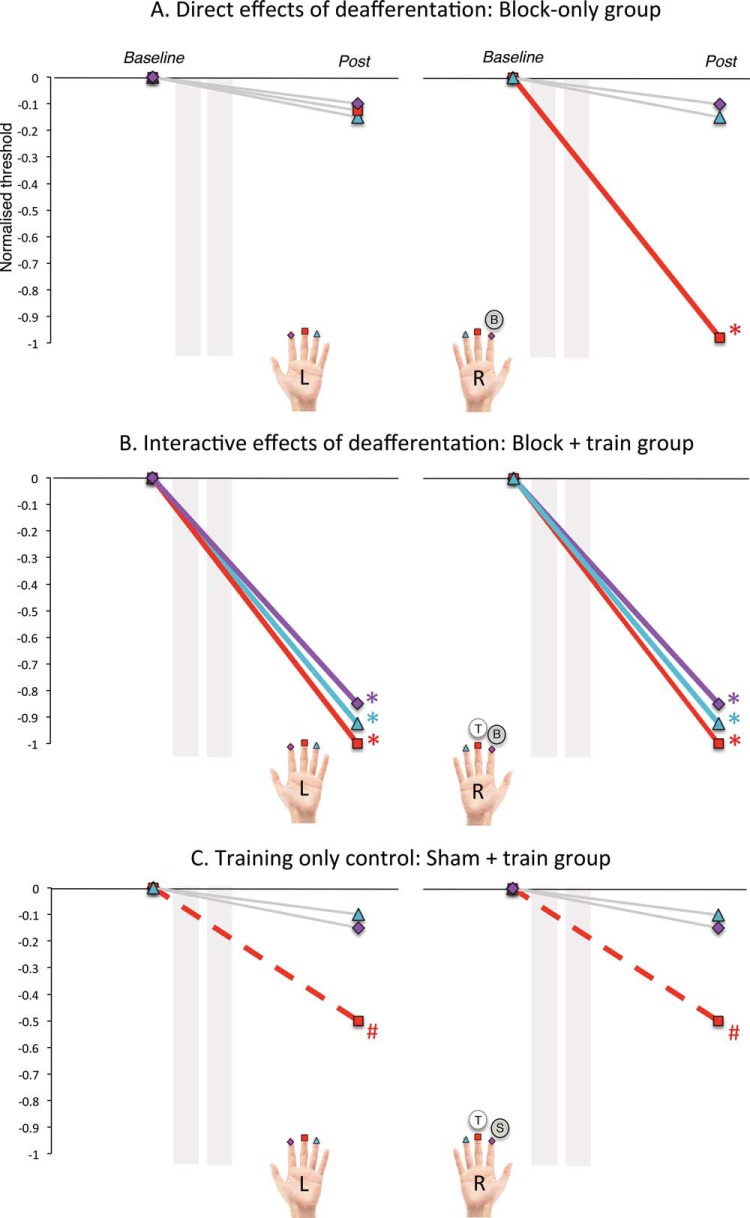
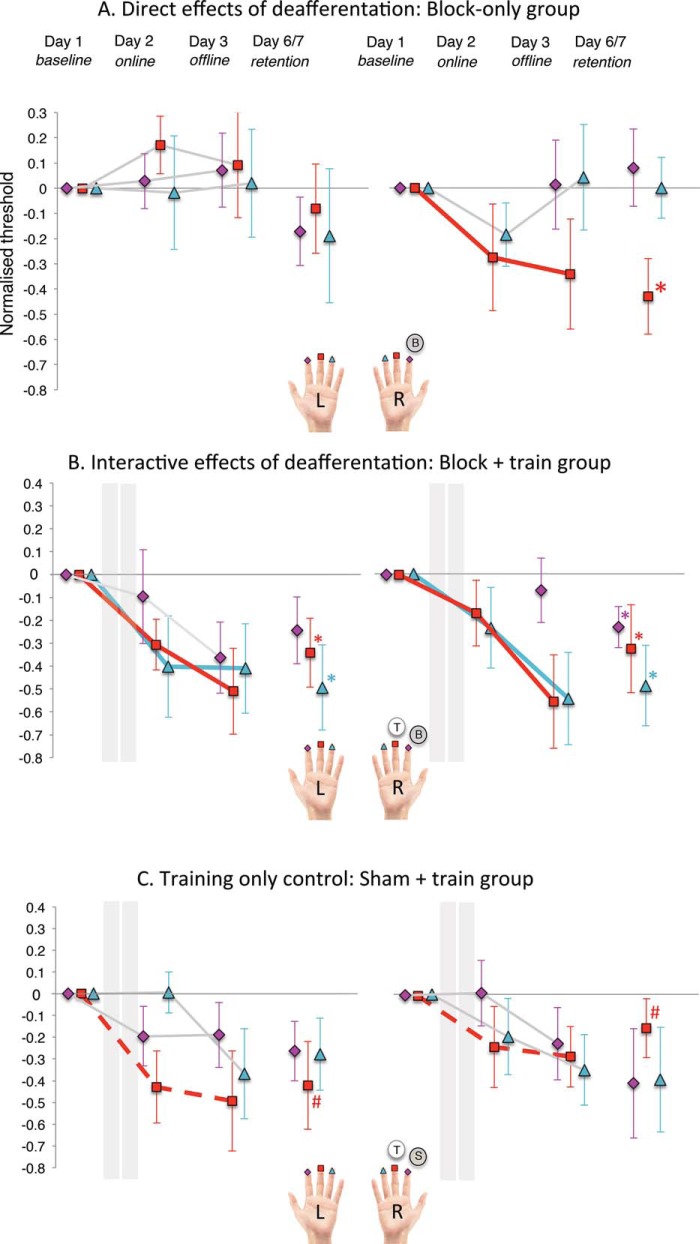
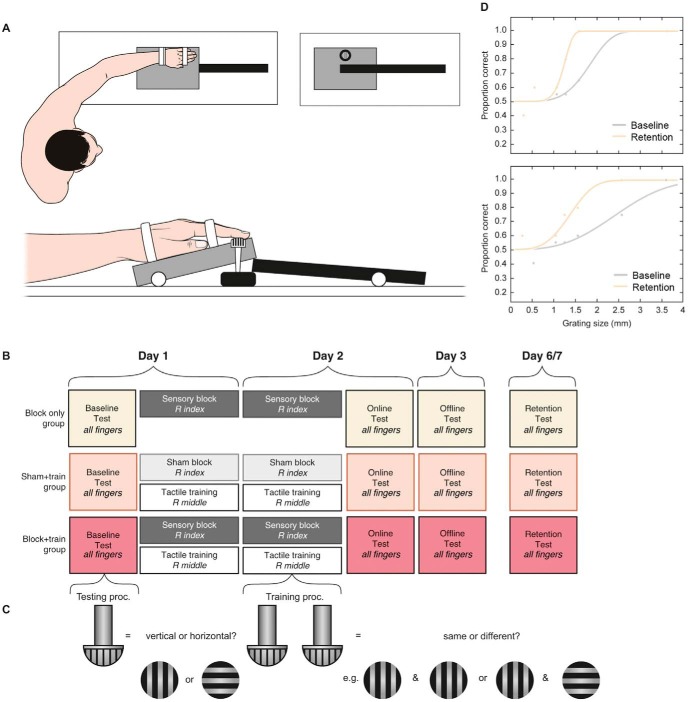
Brain plasticity is a key mechanism for learning and recovery. A striking example of plasticity in the adult brain occurs following input loss, for example, following amputation, whereby the deprived zone is "invaded" by new representations. Although it has long been assumed that such reorganization leads to functional benefits for the invading representation, the behavioral evidence is controversial. Here, we investigate whether a temporary period of somatosensory input loss to one finger, induced by anesthetic block, is sufficient to cause improvements in touch perception ("direct" effects of deafferentation). Further, we determine whether this deprivation can improve touch perception by enhancing sensory learning processes, for example, by training ("interactive" effects). Importantly, we explore whether direct and interactive effects of deprivation are dissociable by directly comparing their effects on touch perception. Using psychophysical thresholds, we found brief deprivation alone caused improvements in tactile perception of a finger adjacent to the blocked finger but not to non-neighboring fingers. Two additional groups underwent minimal tactile training to one finger either during anesthetic block of the neighboring finger or a sham block with saline. Deprivation significantly enhanced the effects of tactile perceptual training, causing greater learning transfer compared with sham block. That is, following deafferentation and training, learning gains were seen in fingers normally outside the boundaries of topographic transfer of tactile perceptual learning. Our results demonstrate that sensory deprivation can improve perceptual abilities, both directly and interactively, when combined with sensory learning. This dissociation provides novel opportunities for future clinical interventions to improve sensation. (PsycINFO Database Record (c) 2019 APA, all rights reserved).
大脑的可塑性是学习和恢复的关键机制。成年人大脑中的一个显著的可塑性例子发生在输入损失之后,例如,在截肢后,被剥夺的区域会被新的代表“入侵”。尽管人们长期以来一直认为这种重组会给入侵的代表带来功能上的好处,但行为证据存在争议。在这里,我们研究了短暂的感觉输入丧失是否足以引起触觉感知的改善(“直接”去传入的影响),即通过麻醉阻断一个手指的感觉输入。此外,我们确定这种剥夺是否可以通过增强感觉学习过程(例如训练)来改善触觉感知(“交互”效应)。重要的是,我们通过直接比较剥夺对触觉感知的影响来探索直接和交互影响是否可以分离。使用心理物理阈值,我们发现短暂的剥夺单独引起了被阻断手指相邻手指的触觉感知改善,但对非相邻手指没有影响。另外两组人在手指接受麻醉阻断或盐水假阻断的同时,接受了对一个手指的最小触觉训练。剥夺显著增强了触觉感知训练的效果,与假阻断相比,引起了更大的学习迁移。也就是说,在去传入和训练之后,在正常情况下位于触觉感知学习的拓扑转移范围之外的手指中可以看到学习增益。我们的结果表明,当与感觉学习结合使用时,感觉剥夺可以直接和交互地改善知觉能力。这种分离为未来改善感觉的临床干预提供了新的机会。(PsycINFO 数据库记录(c)2019 APA,保留所有权利)。