Key Laboratory of Trace Element Nutrition of National Health Commission, National Institute for Nutrition and Health, Chinese Center for Disease Control and Prevention, Beijing 100050, China.
Int J Environ Res Public Health. 2019 Apr 10;16(7):1290. doi: 10.3390/ijerph16071290.
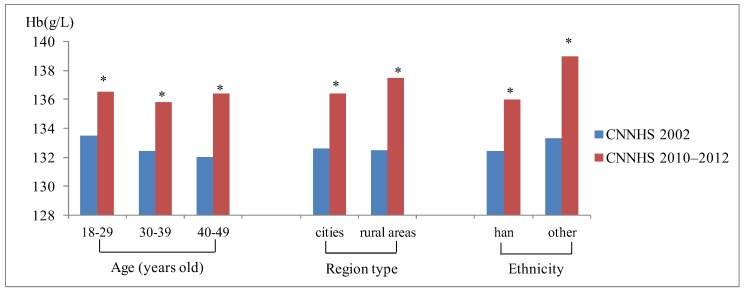
Anemia is a public health issue for developing countries, especially for women of childbearing age. The aim of this study was to assess the anemia status and analyze the risk factors for anemia in Chinese childbearing women aged 18-49 years. Hemoglobin concentration was measured by the HiCN method in the Fifth Chinese National Nutrition and Health Survey (CNNHS) in 2010-2012. Age, region type, ethnicity, bodyweight, height, education, season and smoke habit were recorded in unified questionnaires. Latitude was divided by China's Qinling Mountains and Huaihe River. Childbearing women (28,289) from the CNNHS 2010-2012 were included in this study. The median hemoglobin concentration was 136.2(126.6-145.0) g/L, and it was significantly higher than in CNNHS 2002 (132.5 (122.3-141.6) g/L). The prevalence of anemia was 15.0%, and it was significantly lower than 10 years ago. The logistic regression analysis showed anemia in Chinese childbearing women was specifically related to 30-39 age group ( = 0.004), in spring ( < 0.0001) or in winter ( = 0.006), small and medium-sized cities ( = 0.044) and middle school education level ( = 0.027). The results showed that anemia status among childbearing women was greatly improved over 10 years since 2002, but it was still more severe than the rest of the populations. The nutrition propaganda and education is recommended for childbearing women to help them to improve the nutritional status on their own.
贫血是发展中国家的一个公共卫生问题,尤其是育龄妇女。本研究旨在评估中国 18-49 岁育龄妇女的贫血状况,并分析其贫血的危险因素。在 2010-2012 年进行的第五次中国居民营养与健康状况调查(CNNHS)中,采用 HiCN 法测定血红蛋白浓度。在统一的问卷中记录了年龄、地区类型、民族、体重、身高、教育程度、季节和吸烟习惯。纬度以中国秦岭-淮河为界划分。本研究纳入了 CNNHS 2010-2012 年的 28289 名育龄妇女。血红蛋白浓度的中位数为 136.2(126.6-145.0)g/L,明显高于 CNNHS 2002 年的 132.5(122.3-141.6)g/L。贫血的患病率为 15.0%,明显低于 10 年前。logistic 回归分析显示,中国育龄妇女贫血与 30-39 岁年龄组( = 0.004)、春季( < 0.0001)或冬季( = 0.006)、中小城市( = 0.044)和中学教育水平( = 0.027)有关。结果表明,与 2002 年相比,10 年来育龄妇女的贫血状况有了很大改善,但仍比其他人群更为严重。建议对育龄妇女进行营养宣传教育,帮助她们改善营养状况。