Department of Engineering, Area of Pharmacy and Pharmaceutical Technology, Universidad Miguel Hernández, 03550 Alicante, Spain.
Department of Community Nursing, Preventive Medicine and Public Health and History of Science (Spain), University of Alicante, San Vicente del Raspeig, 03690 Alicante, Spain.
Nutrients. 2021 Dec 20;13(12):4560. doi: 10.3390/nu13124560.
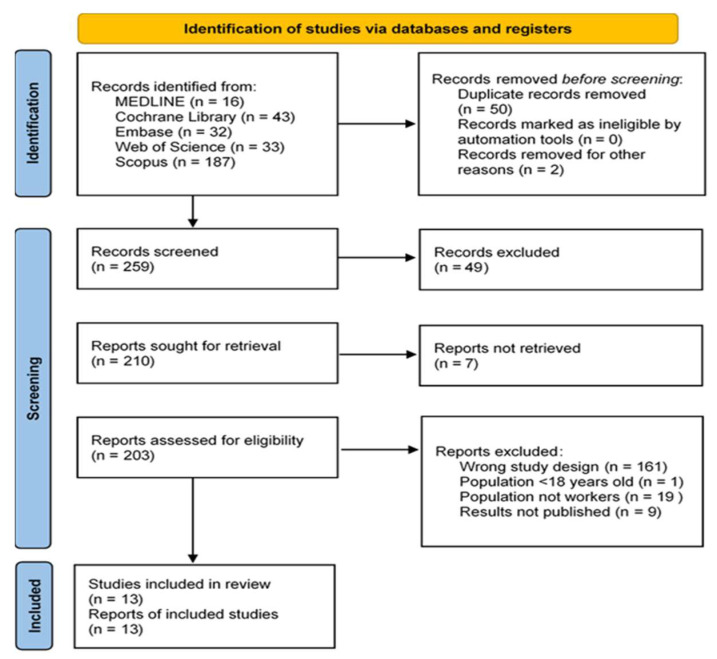
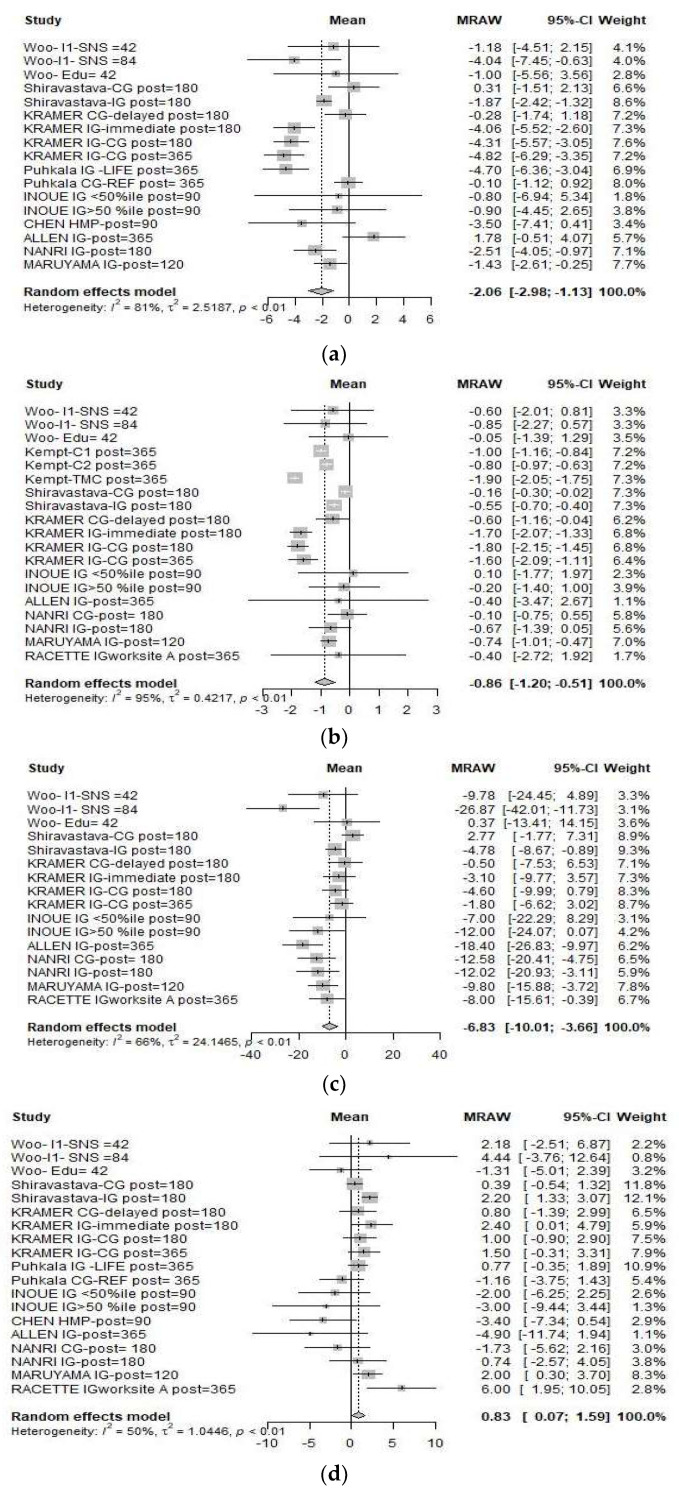
Workplace health interventions are essential to improve the health and well-being of workers and promote healthy lifestyle behaviours. We carried out a systematic review, meta-analysis and meta-regression of articles measuring the association between workplace dietary interventions and MetS risk. We recovered potentially eligible studies by searching MEDLINE, the Cochrane Library, Embase, Scopus and Web of Science, using the terms "Metabolic syndrome" and "Occupational Health". A total of 311 references were retrieved and 13 documents were selected after applying the inclusion and exclusion criteria. Dietary interventions were grouped into six main types: basic education/counselling; specific diet/changes in diet and food intake; behavioural change/coaching; physical exercise; stress management; and internet/social networks. Most programmes included several components. The interventions considered together are beneficial, but the clinical results reflect only a minimal impact on MetS risk. According to the metaregression, the interventions with the greatest impact were those that used coaching techniques and those that promoted physical activity, leading to increased HDL (effect size = 1.58, sig = 0.043; and 2.02, 0.015, respectively) and decreased BMI (effect size = -0.79, sig = -0.009; and -0.77, 0.034, respectively). In contrast, interventions offering information on healthy habits and lifestyle had the contrary effect, leading to increased BMI (effect size = 0.78, sig = 0.006), systolic blood pressure (effect size = 4.85, sig = 0.038) and diastolic blood pressure (effect size = 3.34, sig = 0.001). It is necessary to improve the efficiency of dietary interventions aimed at lowering MetS risk in workers.
工作场所健康干预对于改善工人的健康和福祉以及促进健康的生活方式行为至关重要。我们进行了一项系统评价、荟萃分析和荟萃回归研究,以评估工作场所饮食干预与代谢综合征风险之间的关联。我们使用“代谢综合征”和“职业健康”这两个术语,通过搜索 MEDLINE、Cochrane 图书馆、Embase、Scopus 和 Web of Science,检索了潜在的合格研究。共检索到 311 篇参考文献,经过纳入和排除标准的筛选,最终选择了 13 篇文献。饮食干预被分为六种主要类型:基础教育/咨询;特定饮食/改变饮食和食物摄入;行为改变/辅导;体育锻炼;压力管理;以及互联网/社交网络。大多数方案包含多个组成部分。综合考虑这些干预措施是有益的,但临床结果仅反映出对代谢综合征风险的微小影响。根据荟萃回归分析,影响最大的干预措施是使用辅导技术和促进体育活动的干预措施,导致 HDL 升高(效应量=1.58,sig=0.043;和 2.02,0.015,分别)和 BMI 降低(效应量=-0.79,sig=-0.009;和-0.77,0.034,分别)。相比之下,提供健康习惯和生活方式信息的干预措施则产生相反的效果,导致 BMI 增加(效应量=0.78,sig=0.006)、收缩压(效应量=4.85,sig=0.038)和舒张压(效应量=3.34,sig=0.001)升高。有必要提高针对降低工人代谢综合征风险的饮食干预措施的效率。