ARC Centre of Excellence for Engineered Quantum Systems, School of Physics, University of Sydney, Sydney, NSW, 2006, Australia.
ARC Centre of Excellence for Exciton Science, School of Physics, University of New South Wales, Sydney, NSW, 2052, Australia.
Sci Rep. 2019 Apr 11;9(1):5950. doi: 10.1038/s41598-019-42373-w.
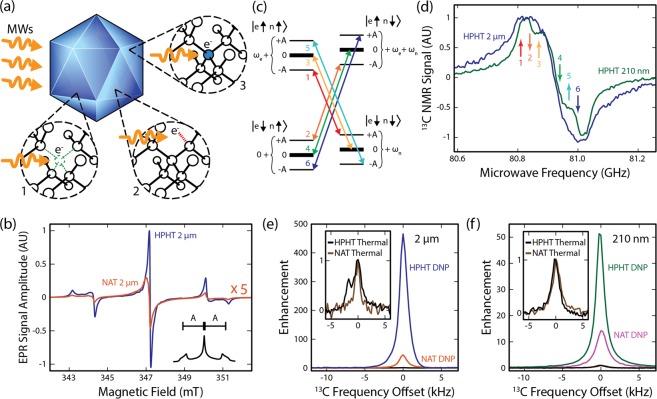
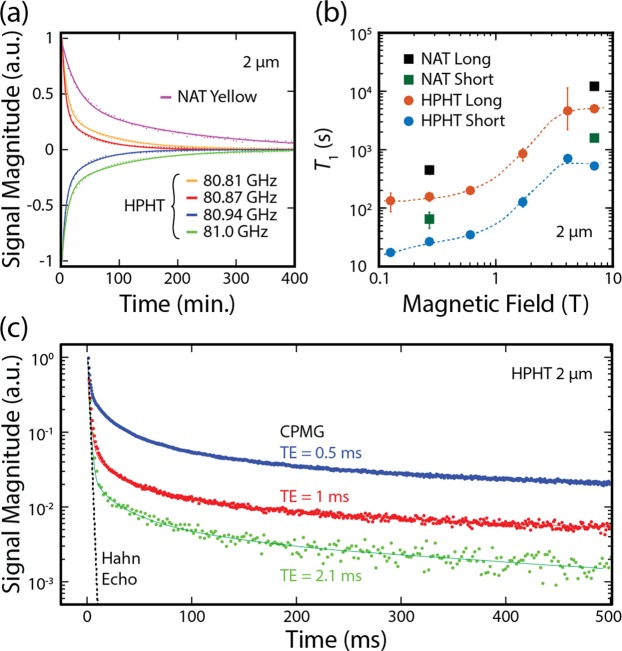
Surface-functionalized nanomaterials are of interest as theranostic agents that detect disease and track biological processes using hyperpolarized magnetic resonance imaging (MRI). Candidate materials are sparse however, requiring spinful nuclei with long spin-lattice relaxation (T) and spin-dephasing times (T), together with a reservoir of electrons to impart hyperpolarization. Here, we demonstrate the versatility of the nanodiamond material system for hyperpolarized C MRI, making use of its intrinsic paramagnetic defect centers, hours-long nuclear T times, and T times suitable for spatially resolving millimeter-scale structures. Combining these properties, we enable a new imaging modality, unique to nanoparticles, that exploits the phase-contrast between spins encoded with a hyperpolarization that is aligned, or anti-aligned with the external magnetic field. The use of phase-encoded hyperpolarization allows nanodiamonds to be tagged and distinguished in an MRI based on their spin-orientation alone, and could permit the action of specific bio-functionalized complexes to be directly compared and imaged.
表面功能化的纳米材料作为治疗诊断试剂很有前途,可用于通过超极化磁共振成像(MRI)检测疾病和跟踪生物过程。然而,候选材料稀缺,需要具有长自旋晶格弛豫(T)和自旋去相位时间(T)的自旋核,以及一个电子库来提供超极化。在这里,我们展示了纳米金刚石材料系统在超极化 C MRI 中的多功能性,利用其固有的顺磁缺陷中心、长达数小时的核 T 时间以及适合空间分辨率毫米级结构的 T 时间。通过结合这些特性,我们实现了一种新的成像模式,这是纳米颗粒特有的,利用与外磁场对齐或不对齐的超极化对自旋进行相位对比。相位编码超极化的使用允许纳米金刚石仅基于其自旋取向在 MRI 中进行标记和区分,并且可以直接比较和成像特定生物功能化复合物的作用。