He Xueting, Xue Tingli, Ma Yuanyuan, Zhang Junyan, Wang Zhiquan, Hong Jiefang, Hui Lanfeng, Qiao Jianjun, Song Hao, Zhang Minhua
1Biomass Conversion Laboratory, R&D Center for Petrochemical Technology, Tianjin University, Tianjin, 300072 People's Republic of China.
2Department of Biochemical Engineering, School of Chemical Engineering and Technology, Tianjin University, Tianjin, 300072 People's Republic of China.
Biotechnol Biofuels. 2019 Apr 1;12:73. doi: 10.1186/s13068-019-1405-z. eCollection 2019.
Butanol is an important biofuel and chemical. The development of butanol-tolerant strains and the identification of functional butanol-tolerant genes is essential for high-yield bio-butanol production due to the toxicity of butanol.
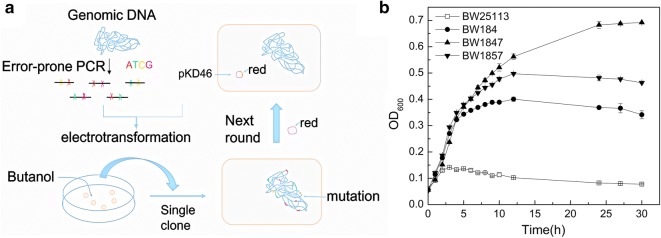
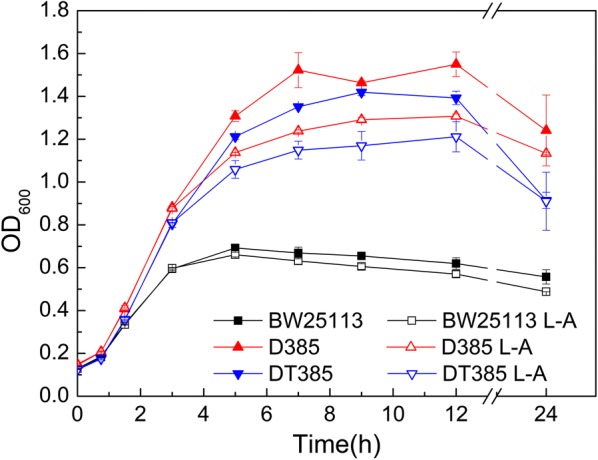
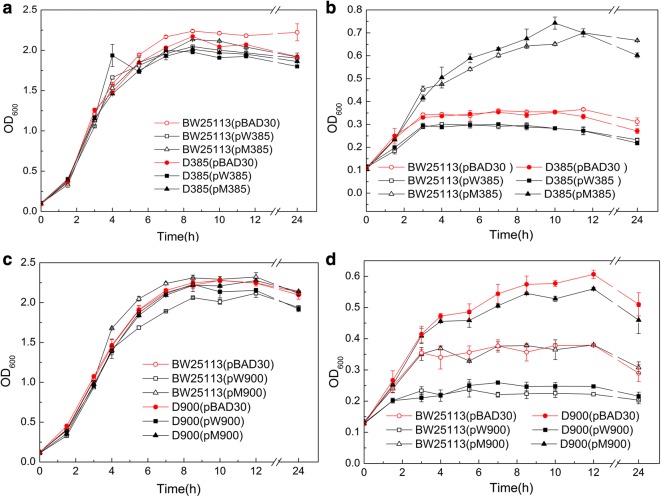
BW25113 was subjected for the first time to error-prone PCR-based whole-genome shuffling. The resulting mutants BW1847 and BW1857 were found to tolerate 2% (v/v) butanol and short-chain alcohols, including ethanol, isobutanol, and 1-pentanol. The mutants exhibited good stability under butanol stress, indicating that they are potential host strains for the construction of butanol pathways. BW1847 had better butanol tolerance than BW1857 under 0-0.75% (v/v) butanol stress, but showed a lower tolerance than BW1857 under 1.25-2% (v/v) butanol stress. Genome resequencing and PCR confirmation revealed that BW1847 and BW1857 had nine and seven single nucleotide polymorphisms, respectively, and a common 14-kb deletion. Functional complementation experiments of the SNPs and deleted genes demonstrated that the mutations of and gene and the deletion of increased the tolerance of the two mutants to butanol. Genome-wide site-specific mutated strains DT385 ( CT) and DT900 ( AT) also showed significant tolerance to butanol and had higher butanol efflux ability than the control, further demonstrating that their mutations yield an inactive protein that enhances butanol resistance characteristics.
Stable mutants with enhanced short alcohols and high concentrations of butanol tolerance were obtained through a rapid and effective method. The key genes of butanol tolerance in the two mutants were identified by comparative functional genomic analysis.
丁醇是一种重要的生物燃料和化学品。由于丁醇具有毒性,因此开发耐丁醇菌株并鉴定功能性耐丁醇基因对于高产生物丁醇生产至关重要。
首次对BW25113进行基于易错PCR的全基因组改组。发现所得突变体BW1847和BW1857能够耐受2%(v/v)的丁醇以及包括乙醇、异丁醇和1-戊醇在内的短链醇。这些突变体在丁醇胁迫下表现出良好的稳定性,表明它们是构建丁醇途径的潜在宿主菌株。在0-0.75%(v/v)丁醇胁迫下,BW1847比BW1857具有更好的丁醇耐受性,但在1.25-2%(v/v)丁醇胁迫下,其耐受性低于BW1857。基因组重测序和PCR验证表明,BW1847和BW1857分别有9个和7个单核苷酸多态性,以及一个共同的14kb缺失。对单核苷酸多态性和缺失基因的功能互补实验表明, 和 基因的突变以及 的缺失增加了这两个突变体对丁醇的耐受性。全基因组位点特异性突变菌株DT385( CT)和DT900( AT)也表现出对丁醇的显著耐受性,并且比对照具有更高的丁醇外排能力,进一步证明它们的突变产生了一种无活性蛋白,增强了丁醇抗性特征。
通过一种快速有效的方法获得了具有增强的短链醇和高浓度丁醇耐受性的稳定突变体。通过比较功能基因组分析鉴定了两个突变体中丁醇耐受性的关键基因。