Manchester Centre for Health Psychology, Division of Psychology and Mental Health, School of Health Sciences, Faculty of Biology, Medicine and Health, Manchester Academic Health Science Centre, The University of Manchester, UK.
Manchester Centre for Health Psychology, Division of Psychology and Mental Health, School of Health Sciences, Faculty of Biology, Medicine and Health, Manchester Academic Health Science Centre, and NIHR Manchester Biomedical Research Centre and Manchester University NHS Foundation Trust (MFT), and NIHR Greater Manchester Patient Safety Translational Research Centre, The University of Manchester, UK.
Br J Health Psychol. 2019 Sep;24(3):571-592. doi: 10.1111/bjhp.12368. Epub 2019 Apr 12.
Internationally, public health strategies encourage health care professionals to deliver opportunistic behaviour change interventions. The present study: (1) examines the barriers and enablers to delivering interventions during routine consultations, and (2) provides recommendations for the design of interventions to increase delivery of opportunistic behaviour change interventions.
Qualitative interview study.
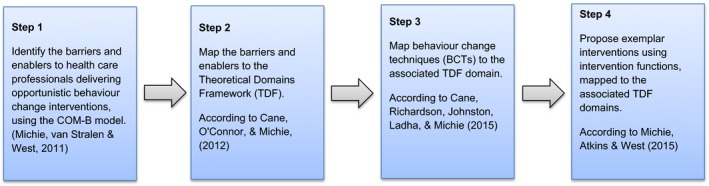
Twenty-eight semi-structured interviews were conducted with patient-facing health care professionals. The Behaviour Change Wheel informed a framework analysis in which findings were mapped onto the Theoretical Domains Framework (TDF). Intervention functions and behaviour change techniques (BCTs) targeting each TDF domain were identified.
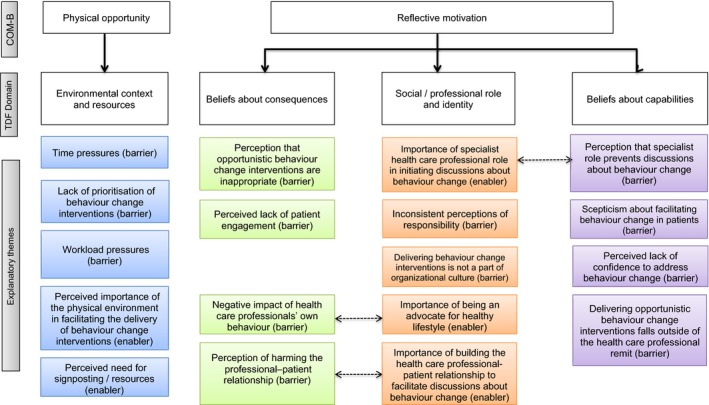
Health care professionals understood the importance of opportunistic behaviour change interventions (beliefs about consequences), but were sceptical about their capabilities to facilitate behaviour change with patients (beliefs about capabilities). Some clinicians were unwilling to discuss behaviours perceived as unrelated to the patient's visit (social/professional role and identity). Discipline-specific tasks were prioritized, and delivering interventions was perceived as psychologically burdensome. One-to-one contact was favoured over busy hospital settings (environmental context and resources). Seven intervention functions (training, restriction, environmental restructuring, enablement, education, persuasion, and modelling) and eight BCT groupings (antecedents, associations, comparison of outcomes, covert learning, feedback and monitoring, natural consequences, reward and threat, and self-belief) were identified.
Across disciplines, health care professionals see the value of opportunistic behaviour change interventions. Barriers related to workload, the clinical environment, competence, and perceptions of the health care professional role must be addressed, using appropriate intervention functions and BCTs, in order to support health care professionals to increase the delivery of interventions in routine practice. Statement of contribution What is already known on this subject? Brief, opportunistic interventions can be a cost effective way of addressing population health problems. Public health policies compel health care professionals to deliver behaviour change interventions opportunistically. Health care professionals do not always deliver interventions opportunistically during routine medical consultations; however the barriers and enablers are currently unclear. What does this study add? This is the first study to examine cross-disciplinary barriers and enablers to delivering opportunistic behaviour change interventions. Across diverse professional groups, working in different medical professions, participants saw the value of delivering opportunistic behaviour change interventions. Targeting key theoretical domains that are shared across professional groups may be useful for increasing the delivery of opportunistic behaviour change interventions.
国际上,公共卫生策略鼓励医疗保健专业人员提供机会性行为改变干预措施。本研究:(1)考察了在常规咨询中提供干预措施的障碍和促进因素,(2)为增加机会性行为改变干预措施的提供提供了干预措施设计的建议。
定性访谈研究。
对 28 名面向患者的医疗保健专业人员进行了半结构化访谈。行为改变车轮为框架分析提供了信息,该分析将研究结果映射到理论领域框架(TDF)上。确定了针对每个 TDF 领域的干预功能和行为改变技术(BCT)。
医疗保健专业人员理解机会性行为改变干预措施的重要性(对后果的信念),但对他们促进患者行为改变的能力持怀疑态度(对能力的信念)。一些临床医生不愿意讨论被认为与患者就诊无关的行为(社会/专业角色和身份)。特定于学科的任务被优先考虑,并且提供干预措施被认为是心理上的负担(心理过程)。与繁忙的医院环境相比,更喜欢一对一的接触(环境背景和资源)。确定了七种干预功能(培训、限制、环境重构、使能、教育、说服和示范)和八种 BCT 分组(前因、关联、结果比较、隐性学习、反馈和监测、自然后果、奖励和威胁以及自我信念)。
在不同学科中,医疗保健专业人员都看到了机会性行为改变干预措施的价值。必须解决与工作量、临床环境、能力和对医疗保健专业人员角色的看法相关的障碍,使用适当的干预功能和 BCT,以支持医疗保健专业人员在常规实践中增加干预措施的提供。
关于这个主题已经知道些什么?
简短的、机会性的干预措施可以是解决人口健康问题的一种具有成本效益的方法。公共卫生政策迫使医疗保健专业人员机会性地提供行为改变干预措施。医疗保健专业人员在常规医疗咨询中并非总是机会性地提供干预措施;然而,目前尚不清楚障碍和促进因素是什么。
这项研究有什么新发现?
这是第一项研究,考察了提供机会性行为改变干预措施的跨学科障碍和促进因素。在不同的专业群体中,从事不同医疗专业的参与者都看到了提供机会性行为改变干预措施的价值。针对跨专业群体共享的关键理论领域可能有助于增加机会性行为改变干预措施的提供。