Department of Neurology, Seoul St. Mary's Hospital, College of Medicine, The Catholic University of Korea, Seoul, Korea.
Department of Neurology, Seoul National University Bundang Hospital, Seoul National University College of Medicine, Seongnam, Korea.
J Korean Med Sci. 2019 Apr 15;34(14):e111. doi: 10.3346/jkms.2019.34.e111.
Korea has a periodic general health check-up program that uses the Korean Dementia Screening Questionnaire-Cognition (KDSQ-C) as a cognitive dysfunction screening tool. The Alzheimer Disease 8 (AD8) and Subjective Memory Complaints Questionnaire (SMCQ) are also used in clinical practice. We compared the diagnostic ability of these screening questionnaires for cognitive impairment when completed by participants and their caregivers. Hence, we aimed to evaluate whether the SMCQ or AD8 is superior to the KDSQ-C and can be used as its replacement.
A total of 420 participants over 65 years and their informants were recruited from 11 hospitals for this study. The patients were grouped into normal cognition, mild cognitive impairment, and dementia subgroups. The KDSQ-C, AD8, and SMCQ were completed separately by participants and their informants.
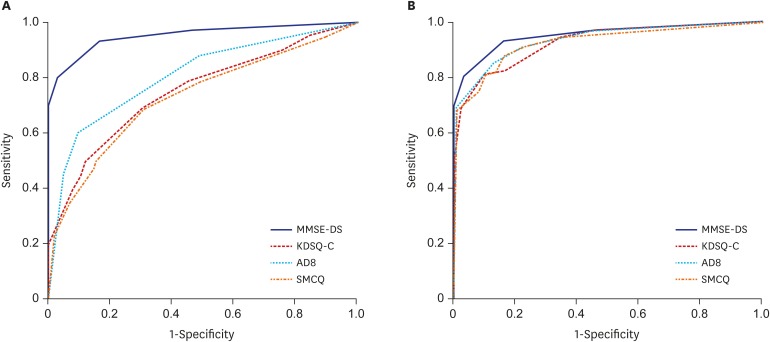
A receiver operating characteristic analysis of questionnaire scores completed by participants showed that the areas under the curve (AUCs) for the KDSQ-C, AD8, and SMCQ for diagnosing dementia were 0.75, 0.8, and 0.73, respectively. Regarding informant-completed questionnaires, the AD8 (AUC of 0.93), KDSQ-C (AUC of 0.92), and SMCQ (AUC of 0.92) showed good discriminability for dementia, with no differences in discriminability between the questionnaires.
When an informant-report is possible, we recommend that the KDSQ-C continues to be used in national medical check-ups as its discriminability for dementia is not different from that of the AD8 or SMCQ. Moreover, consistent data collection using the same questionnaire is important. When an informant is not available, either the KDSQ-C or AD8 may be used. However, in the cases of patient-reports, discriminability is lower than that for informant-completed questionnaires.
韩国有一项定期的健康检查计划,该计划使用韩国痴呆症筛查问卷-认知(KDSQ-C)作为认知功能障碍筛查工具。阿尔茨海默病 8 项(AD8)和主观记忆抱怨问卷(SMCQ)也在临床实践中使用。我们比较了这些筛查问卷在参与者及其护理人员完成时对认知障碍的诊断能力。因此,我们旨在评估 SMCQ 或 AD8 是否优于 KDSQ-C,并可作为其替代品。
本研究共招募了来自 11 家医院的 420 名 65 岁以上的参与者及其知情人。将患者分为正常认知、轻度认知障碍和痴呆亚组。参与者及其知情人分别完成 KDSQ-C、AD8 和 SMCQ。
参与者完成的问卷评分的受试者工作特征分析显示,KDSQ-C、AD8 和 SMCQ 诊断痴呆的曲线下面积(AUCs)分别为 0.75、0.8 和 0.73。关于知情人完成的问卷,AD8(AUC 为 0.93)、KDSQ-C(AUC 为 0.92)和 SMCQ(AUC 为 0.92)对痴呆的区分能力良好,问卷之间无区分能力差异。
当可以获得知情人报告时,我们建议在国家体检中继续使用 KDSQ-C,因为其对痴呆的区分能力与 AD8 或 SMCQ 无差异。此外,使用相同问卷进行一致的数据收集很重要。当没有知情人时,可以使用 KDSQ-C 或 AD8。但是,在患者报告的情况下,区分能力低于知情人完成的问卷。