Brain Plasticity and NeuroRecovery Laboratory, Louis Stokes Cleveland Department of Veterans Affairs Medical Center, Cleveland, Ohio, United States of America.
Department of Physical Medicine and Rehabilitation, Louis Stokes Cleveland Department of Veterans Affairs Medical Center, Cleveland, Ohio, United States of America.
PLoS One. 2019 Apr 12;14(4):e0215311. doi: 10.1371/journal.pone.0215311. eCollection 2019.
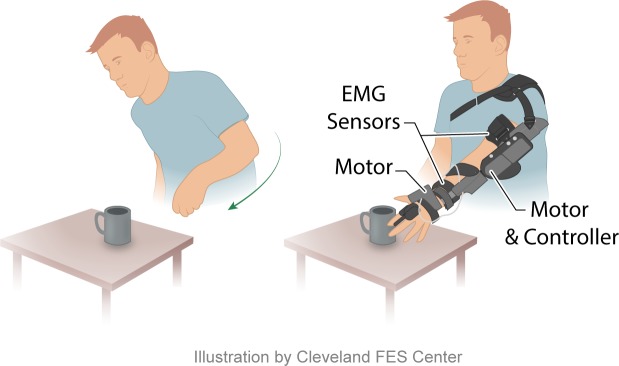
Individuals with stroke are often left with persistent upper limb dysfunction, even after treatment with traditional rehabilitation methods. The purpose of this retrospective study is to demonstrate feasibility of the implementation of an upper limb myoelectric orthosis for the treatment of persistent moderate upper limb impairment following stroke (>6 months).
Nine patients (>6 months post stroke) participated in treatment at an outpatient Occupational Therapy department utilizing the MyoPro myoelectric orthotic device. Group therapy was provided at a frequency of 1-2 sessions per week (60-90 minutes per session). Patients were instructed to perform training with the device at home on non-therapy days and to continue with use of the device after completion of the group training period. Outcome measures included Fugl-Meyer Upper Limb Assessment (FM) and modified Ashworth Scale (MAS).
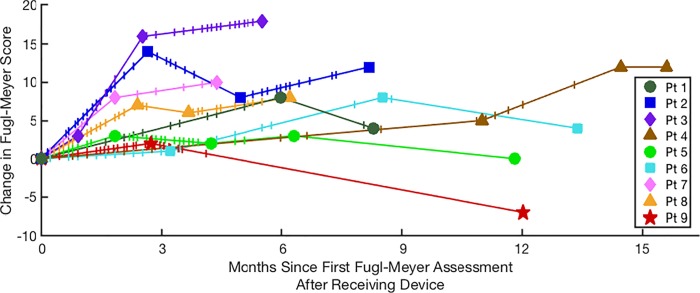
Patients demonstrated clinically important and statistically significant improvement of 9.0±4.8 points (p = 0.0005) on a measure of motor control impairment (FM) during participation in group training. It was feasible to administer the training in a group setting with the MyoPro, using a 1:4 ratio (therapist to patients). Muscle tone improved for muscles with MAS >1.5 at baseline.
Myoelectric orthosis use is feasible in a group clinic setting and in home-use structure for chronic stroke survivors. Clinically important motor control gains were observed on FM in 7 of 9 patients who participated in training.
未加标签:个体发生中风后,常遗留持久的上肢功能障碍,即使经过传统的康复方法治疗也是如此。本回顾性研究的目的在于展示实施上肢肌电矫形器治疗中风后(>6 个月)持续中度上肢损伤的可行性。
方法:9 名患者(中风后>6 个月)在门诊职业治疗部门使用 MyoPro 肌电矫形器接受治疗。每周接受 1-2 次小组治疗(每次 60-90 分钟)。患者被指导在非治疗日使用该设备进行家庭训练,并在小组训练期结束后继续使用该设备。结果测量包括 Fugl-Meyer 上肢评估(FM)和改良 Ashworth 量表(MAS)。
结果:在参加小组训练期间,患者的运动控制障碍(FM)测量值平均提高了 9.0±4.8 分(p=0.0005),具有临床重要意义且具有统计学显著性。使用 1:4 的治疗师与患者比例,在 MyoPro 中实施小组训练是可行的。基线 MAS>1.5 的肌肉张力有所改善。
讨论:肌电矫形器的使用在小组诊所环境中和慢性中风幸存者的家庭使用结构中是可行的。在参加训练的 9 名患者中,有 7 名患者在 FM 上观察到了具有临床重要意义的运动控制增益。