Tobaldini Eleonora, Toschi-Dias Edgar, Appratto de Souza Liliane, Rabello Casali Karina, Vicenzi Marco, Sandrone Giulia, Cogliati Chiara, La Rovere Maria Teresa, Pinna Gian Domenico, Montano Nicola
Department of Internal Medicine, Fondazione IRCSS Ca' Granda, Ospedale Maggiore Policlinico, 20122 Milan, Italy.
Department of Clinical Sciences and Community Health, University of Milan, 20122 Milan, Italy.
J Clin Med. 2019 Apr 11;8(4):496. doi: 10.3390/jcm8040496.
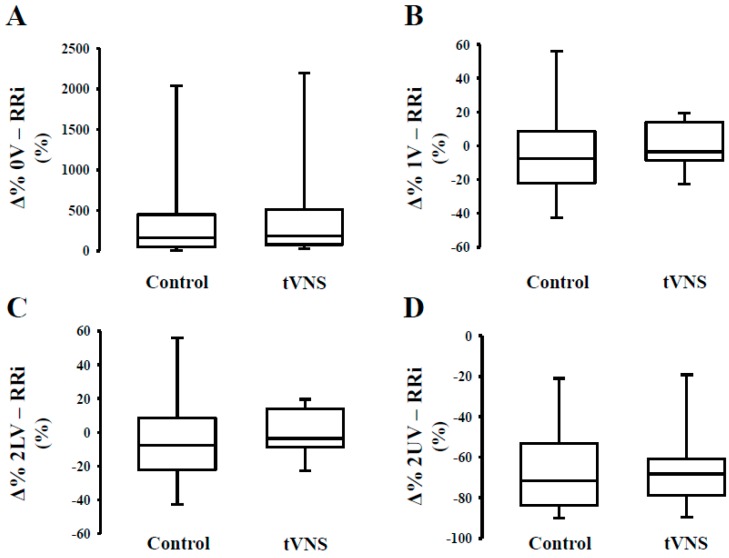
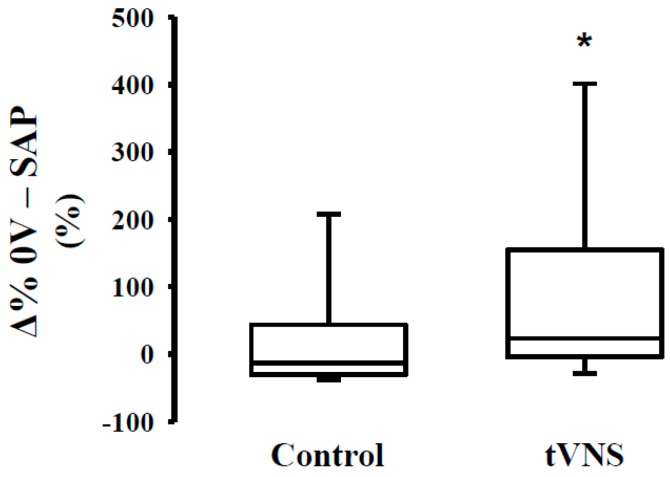
Previous studies showed that transcutaneous vagus nerve stimulation (tVNS) modulates the autonomic nervous system (ANS) in resting condition. However, the autonomic regulation in response to an orthostatic challenge during tVNS in healthy subjects remains unknown. We tested the hypothesis that tVNS reduces heart rate (HR) and alters the responsivity of ANS to orthostatic stress in healthy subjects. In a randomized and cross-over trial, thirteen healthy subjects underwent two experimental sessions on different days: (1) tVNS and (2) control. Using a tVNS device, an auricular electrode was placed on the left of the external ear; an electric current with a pulse frequency of 25 Hz and amplitude between 1 and 6 mA was applied. For the assessment of ANS, the beat-to-beat HR and systolic arterial pressure (SAP) were analyzed using linear and nonlinear approaches during clinostatic and orthostatic conditions. In clinostatic conditions, tVNS reduced HR ( < 0.01), SAP variability ( < 0.01), and cardiac and peripheral sympathetic modulation ( < 0.01). The responsivity of the peripheral sympathetic modulation to orthostatic stress during tVNS was significantly higher when compared to the control session ( = 0.03). In conclusion, tVNS reduces the HR and affects cardiac and peripheral autonomic control and increases the responses of peripheral autonomic control to orthostatic stress in healthy subjects.
先前的研究表明,经皮迷走神经刺激(tVNS)在静息状态下可调节自主神经系统(ANS)。然而,健康受试者在tVNS期间对直立性应激的自主调节仍不清楚。我们测试了这样一个假设,即tVNS可降低健康受试者的心率(HR)并改变ANS对直立性应激的反应性。在一项随机交叉试验中,13名健康受试者在不同日期进行了两个实验阶段:(1)tVNS和(2)对照。使用tVNS设备,将一个耳电极置于外耳左侧;施加频率为25Hz、幅度在1至6mA之间的电流。为了评估ANS,在卧位和直立位期间使用线性和非线性方法分析逐搏心率(HR)和收缩期动脉压(SAP)。在卧位条件下,tVNS降低了心率(<0.01)、SAP变异性(<0.01)以及心脏和外周交感神经调制(<0.01)。与对照阶段相比,tVNS期间外周交感神经调制对直立性应激的反应性显著更高(=0.03)。总之,tVNS可降低健康受试者的心率,影响心脏和外周自主神经控制,并增加外周自主神经控制对直立性应激的反应。