Department of Psychiatry and Behavioral Sciences, University of California, Davis, CA, USA.
California National Primate Research Center, University of California, Davis, CA, USA.
Transl Psychiatry. 2019 Apr 12;9(1):135. doi: 10.1038/s41398-019-0449-y.
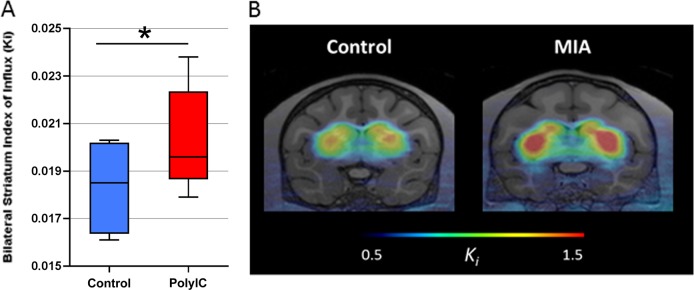
Women exposed to a variety of viral and bacterial infections during pregnancy have an increased risk of giving birth to a child with autism, schizophrenia or other neurodevelopmental disorders. Preclinical maternal immune activation (MIA) models are powerful translational tools to investigate mechanisms underlying epidemiological links between infection during pregnancy and offspring neurodevelopmental disorders. Our previous studies documenting the emergence of aberrant behavior in rhesus monkey offspring born to MIA-treated dams extends the rodent MIA model into a species more closely related to humans. Here we present novel neuroimaging data from these animals to further explore the translational potential of the nonhuman primate MIA model. Nine male MIA-treated offspring and 4 controls from our original cohort underwent in vivo positron emission tomography (PET) scanning at approximately 3.5-years of age using [F] fluoro-l-m-tyrosine (FMT) to measure presynaptic dopamine levels in the striatum, which are consistently elevated in individuals with schizophrenia. Analysis of [F]FMT signal in the striatum of these nonhuman primates showed that MIA animals had significantly higher [F]FMT index of influx compared to control animals. In spite of the modest sample size, this group difference reflects a large effect size (Cohen's d = 0.998). Nonhuman primates born to MIA-treated dams exhibited increased striatal dopamine in late adolescence-a hallmark molecular biomarker of schizophrenia. These results validate the MIA model in a species more closely related to humans and open up new avenues for understanding the neurodevelopmental biology of schizophrenia and other neurodevelopmental disorders associated with prenatal immune challenge.
孕妇在怀孕期间暴露于多种病毒和细菌感染中,其生出自闭症、精神分裂症或其他神经发育障碍儿童的风险会增加。临床前母体免疫激活 (MIA) 模型是研究感染与妊娠期间后代神经发育障碍之间的流行病学联系的潜在机制的强大转化工具。我们之前的研究记录了 MIA 处理的母鼠所生恒河猴后代出现异常行为,将啮齿动物 MIA 模型扩展到与人类更接近的物种。在这里,我们呈现了这些动物的新神经影像学数据,以进一步探索非人类灵长类动物 MIA 模型的转化潜力。我们原始队列中的 9 名雄性 MIA 处理后代和 4 名对照动物在大约 3.5 岁时接受了体内正电子发射断层扫描 (PET) 扫描,使用 [F] fluoro-l-m-tyrosine (FMT) 来测量纹状体中的前突触多巴胺水平,精神分裂症患者的多巴胺水平一直升高。对这些非人类灵长类动物纹状体中 [F]FMT 信号的分析表明,MIA 动物的 [F]FMT 流入指数明显高于对照动物。尽管样本量较小,但这种组间差异反映了较大的效应量 (Cohen's d = 0.998)。MIA 处理的母鼠所生的非人类灵长类动物在青春期后期表现出纹状体多巴胺增加——这是非精神分裂症的标志性分子生物标志物。这些结果在与人类更接近的物种中验证了 MIA 模型,并为理解与产前免疫挑战相关的精神分裂症和其他神经发育障碍的神经发育生物学开辟了新途径。