Department of Cardiology, Rui Jin Hospital, Shanghai Jiao-Tong University School of Medicine, Shanghai, P.R. China.
Institute of Cardiovascular Diseases, Shanghai Jiao-Tong University School of Medicine, Shanghai, P.R. China.
Sci Rep. 2019 Apr 12;9(1):5979. doi: 10.1038/s41598-019-42518-x.
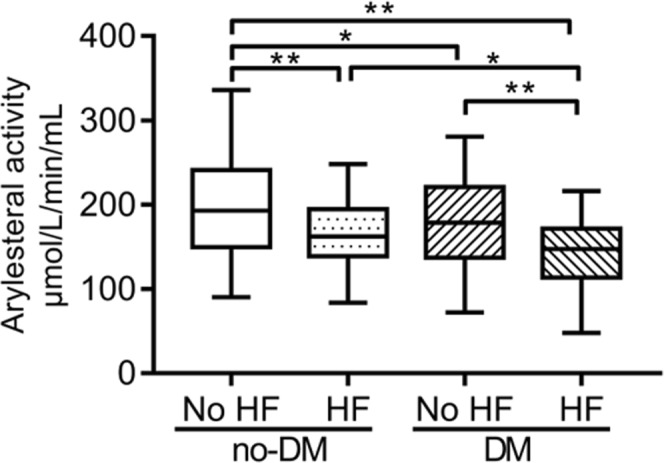
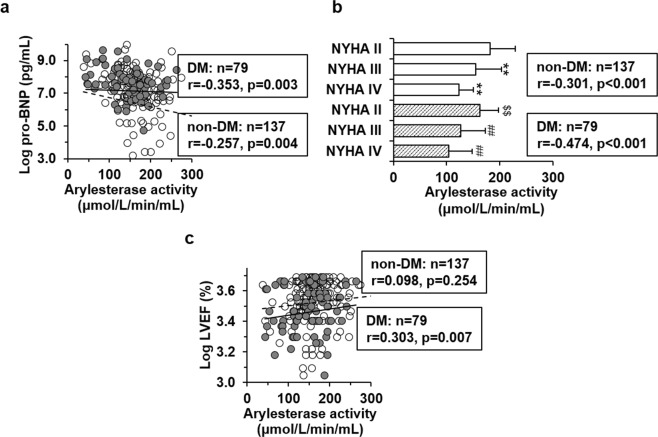
High-density lipoprotein (HDL) confers protection against cardiovascular disease partly attributable to its robust anti-oxidant activities, which is largely impaired in diabetic conditions. In this study, we analyzed the anti-oxidant activity of HDL, as represented by the arylesterase activity of paraoxonase 1 (PON1) in HDL particles, in 216 consecutive HF patients with (n = 79) or without (n = 137) type 2 diabetes, and age- and gender-matched 112 diabetic and 189 non-diabetic non-HF controls. We found arylesterase activity was significantly decreased in patients with than without HF, and was further decreased when comorbid with diabetes. After adjusting for conventional risk factors and apolipoprotein A-I levels, arylesterase activity remained correlated positively with left ventricular ejection fraction in diabetic (r = 0.325, P = 0.020) but not non-diabetic patients (r = 0.089, P = 0.415), and negatively with NT-proBNP and NYHA functional class in both subgroups. In regression analyses, a higher risk of HF was observed in diabetic than non-diabetic patients when having low arylesterase activities. In conclusion, our data demonstrate that impaired serum arylesterase activity in patients with HF is further reduced when comorbid with diabetes. The relationship of impaired arylesterase activity to HF is especially enhanced in diabetic patients.
高密度脂蛋白(HDL)通过其强大的抗氧化活性对心血管疾病提供保护作用,但在糖尿病情况下这种活性会大大受损。在这项研究中,我们分析了高密度脂蛋白的抗氧化活性,即高密度脂蛋白颗粒中对氧磷酶 1(PON1)的芳基酯酶活性。我们纳入了 216 名连续的 HF 患者(n=79 例)和无 HF 的患者(n=137 例),并与年龄和性别匹配的 112 例糖尿病患者和 189 例非糖尿病非 HF 对照者进行了比较。我们发现,与无 HF 的患者相比,HF 患者的芳基酯酶活性显著降低,当合并糖尿病时则进一步降低。在调整了常规危险因素和载脂蛋白 A-I 水平后,芳基酯酶活性仍与糖尿病患者(r=0.325,P=0.020)的左心室射血分数呈正相关,而与非糖尿病患者(r=0.089,P=0.415)无相关性,且与两个亚组的 NT-proBNP 和 NYHA 心功能分级呈负相关。在回归分析中,与非糖尿病患者相比,糖尿病患者的芳基酯酶活性较低时,HF 的发生风险更高。总之,我们的数据表明,HF 患者的血清芳基酯酶活性受损,当合并糖尿病时则进一步降低。芳基酯酶活性受损与 HF 的关系在糖尿病患者中更为显著。