Benussi Alberto, Alberici Antonella, Buratti Emanuele, Ghidoni Roberta, Gardoni Fabrizio, Di Luca Monica, Padovani Alessandro, Borroni Barbara
Neurology Unit, Department of Clinical and Experimental Sciences, University of Brescia, Brescia, Italy.
International Centre for Genetic Engineering and Biotechnology, ICGEB, Trieste, Italy.
Front Neurosci. 2019 Mar 29;13:304. doi: 10.3389/fnins.2019.00304. eCollection 2019.
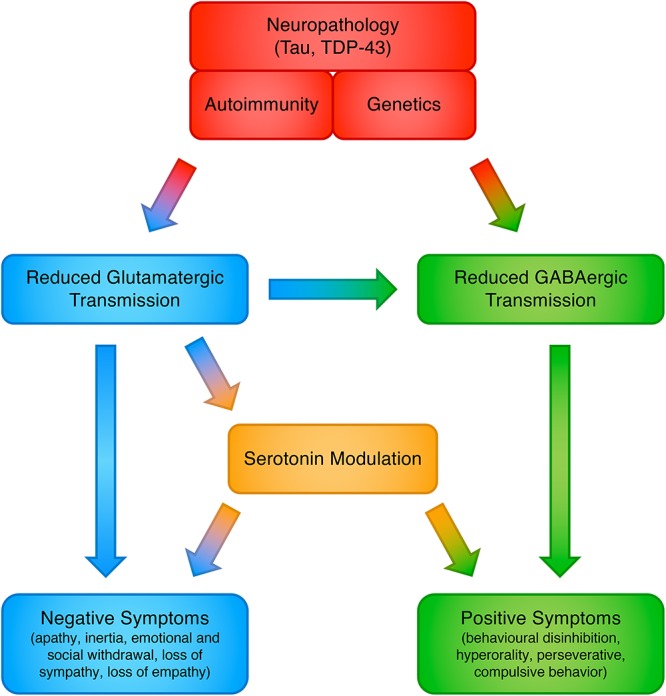
Frontotemporal dementia (FTD) is a heterogenous neurodegenerative disorder, characterized by diverse clinical presentations, neuropathological characteristics and underlying genetic causes. Emerging evidence has shown that FTD is characterized by a series of changes in several neurotransmitter systems, including serotonin, dopamine, GABA and, above all, glutamate. Indeed, several studies have now provided preclinical and clinical evidence that glutamate is key in the pathogenesis of FTD. Animal models of FTD have shown a selective hypofunction in -methyl -aspartate (NMDA) and α-amino-3-hydroxyl-5-methyl-4-isoxazolepropionic acid (AMPA) receptors, while in patients, glutamatergic pyramidal neurons are depleted in several areas, including the frontal and temporal cortices. Recently, a selective involvement of the AMPA GluA3 subunit has been observed in patients with autoimmune anti-GluA3 antibodies, which accounted for nearly 25% of FTD patients, leading to a decrease of the GluA3 subunit synaptic localization of the AMPA receptor and loss of dendritic spines. Other evidence of the involvement of the glutamatergic system in FTD derives from non-invasive brain stimulation studies using transcranial magnetic stimulation, in which specific stimulation protocols have indirectly identified a selective and prominent impairment in glutamatergic circuits in patients with both sporadic and genetic FTD. In view of limited disease modifying therapies to slow or revert disease progression in FTD, an important approach could consist in targeting the neurotransmitter deficits, similarly to what has been achieved in Parkinson's disease with dopaminergic therapy or Alzheimer's disease with cholinergic therapy. In this review, we summarize the current evidence concerning the involvement of the glutamatergic system in FTD, suggesting the development of new therapeutic strategies.
额颞叶痴呆(FTD)是一种异质性神经退行性疾病,其临床症状、神经病理学特征及潜在遗传病因各不相同。新出现的证据表明,FTD的特征是多种神经递质系统发生一系列变化,包括血清素、多巴胺、γ-氨基丁酸(GABA),尤其是谷氨酸。事实上,目前多项研究已提供临床前和临床证据,表明谷氨酸在FTD发病机制中起关键作用。FTD动物模型显示N-甲基-D-天冬氨酸(NMDA)受体和α-氨基-3-羟基-5-甲基-4-异恶唑丙酸(AMPA)受体存在选择性功能减退,而在患者中,包括额叶和颞叶皮质在内的多个区域的谷氨酸能锥体神经元减少。最近,在自身免疫性抗GluA3抗体的患者中观察到AMPA GluA3亚基有选择性受累,这些患者占FTD患者近25%,导致AMPA受体的GluA3亚基突触定位减少和树突棘丢失。谷氨酸能系统参与FTD的其他证据来自使用经颅磁刺激的非侵入性脑刺激研究,其中特定刺激方案间接确定散发性和遗传性FTD患者谷氨酸能回路存在选择性和显著损害。鉴于FTD中减缓或逆转疾病进展的疾病修饰疗法有限,一种重要方法可能是针对神经递质缺陷,这与帕金森病采用多巴胺能疗法或阿尔茨海默病采用胆碱能疗法所取得的成果类似。在本综述中,我们总结了目前关于谷氨酸能系统参与FTD的证据,并提出新治疗策略的发展方向。