Flodman Kiersten, Tsai Rebecca, Xu Michael Y, Corrêa Ivan R, Copelas Alyssa, Lee Yan-Jiun, Xu Ming-Qun, Weigele Peter, Xu Shuang-Yong
New England Biolabs, Inc., Ipswich, MA, United States.
Front Microbiol. 2019 Mar 29;10:584. doi: 10.3389/fmicb.2019.00584. eCollection 2019.
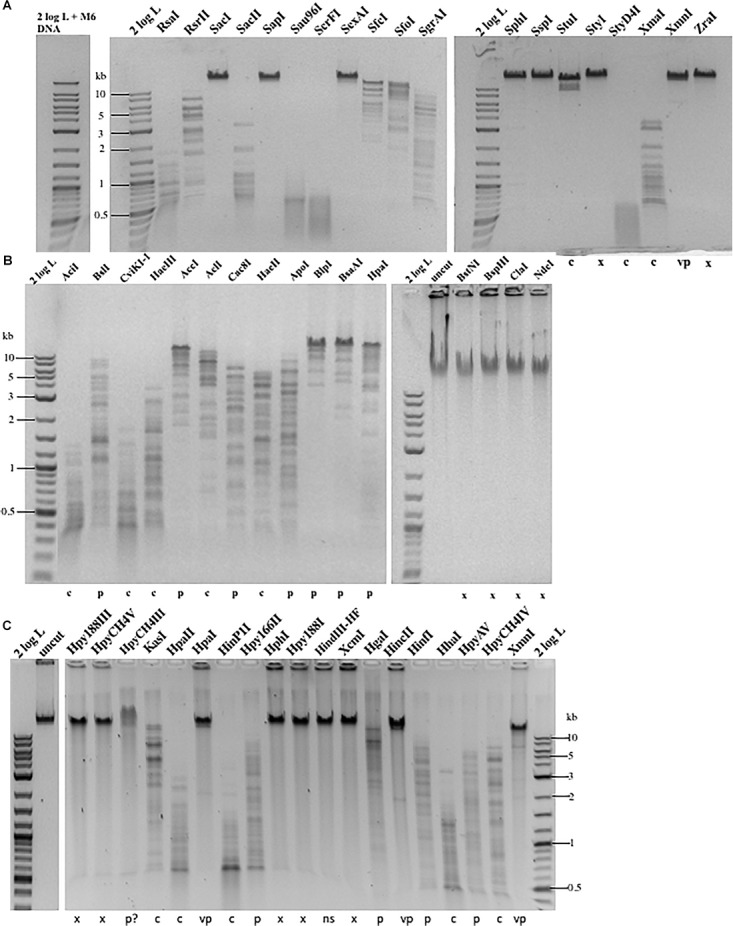
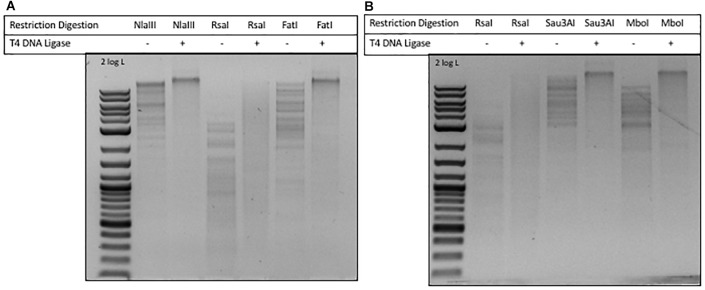
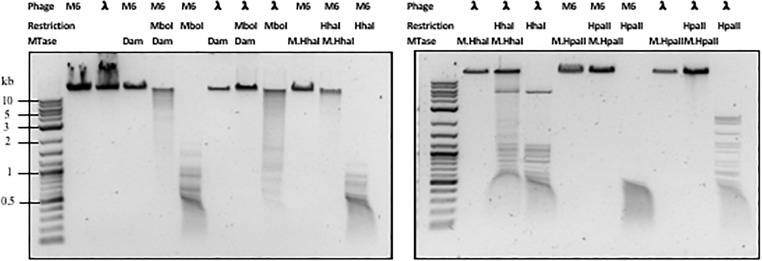
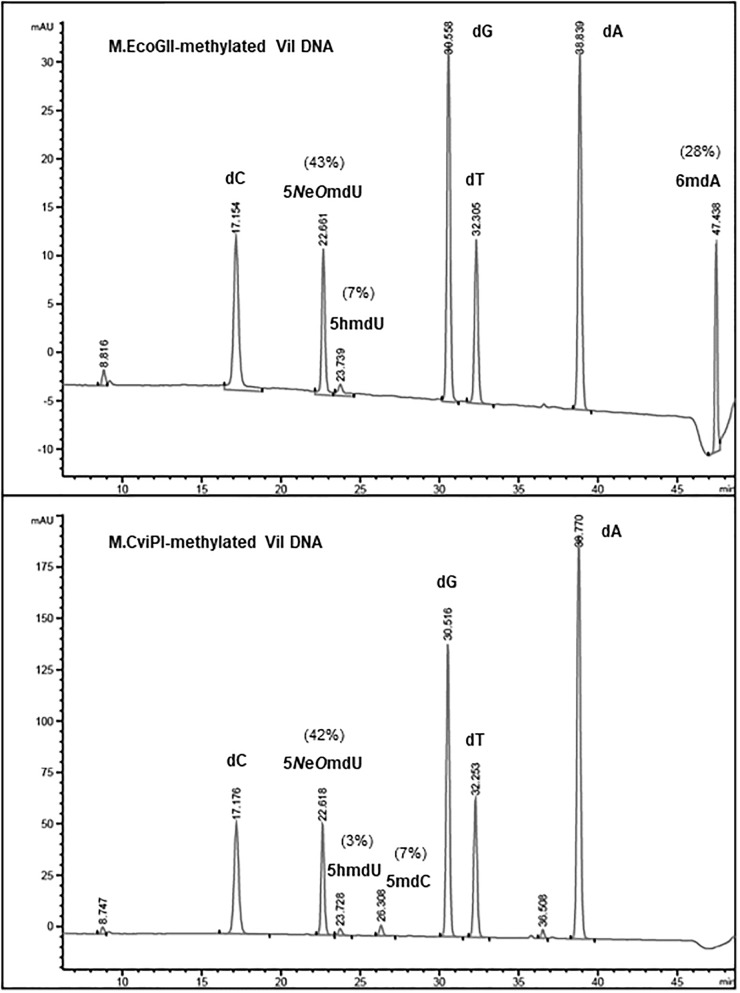
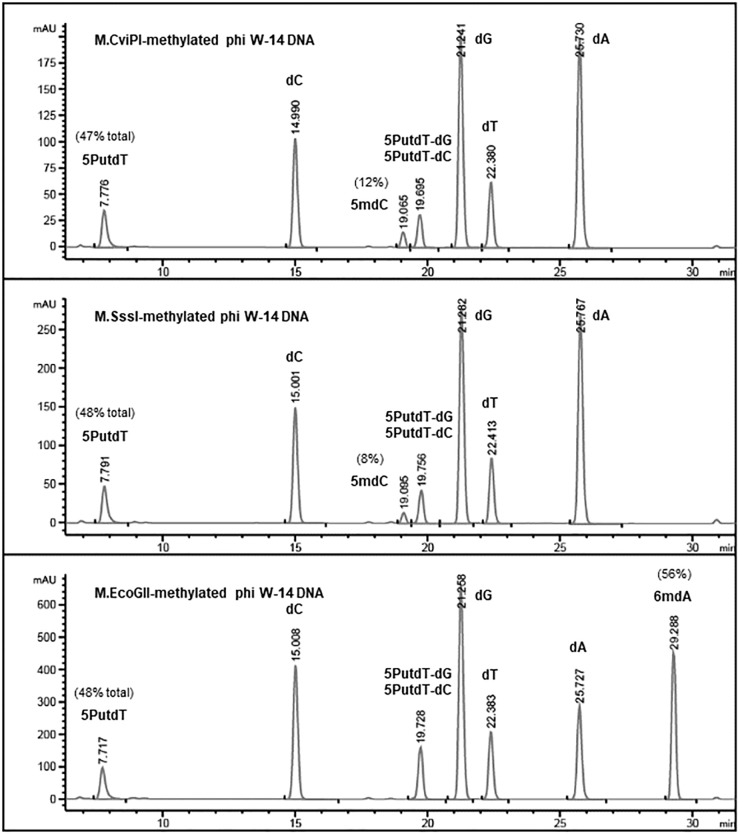
To counteract bacterial defense systems, bacteriophages (phages) make extensive base modifications (substitutions) to block endonuclease restriction. Here we evaluated Type II restriction of three thymidine (T or 5-methyldeoxyuridine, 5mdU) modified phage genomes: phage M6 with 5-(2-aminoethyl)deoxyuridine (5-edU), phage ViI (Vi1) with 5-(2-aminoethoxy)methyldeoxyuridine (5-emdU) and phage phi W-14 (a.k.a. ΦW-14) with α-putrescinylthymidine (putT). Among >200 commercially available restriction endonucleases (REases) tested, phage M6, ViI, and phi W-14 genomic DNAs (gDNA) show resistance against 48.4, 71.0, and 68.8% of Type II restrictions, respectively. Inspection of the resistant sites indicates the presence of conserved dinucleotide TG or TC (TS, S=C, or G), implicating the specificity of TS sequence as the target that is converted to modified base in the genomes. We also tested a number of DNA methyltransferases (MTases) on these phage DNAs and found some MTases can fully or partially modify the DNA to confer more resistance to cleavage by REases. Phage M6 restriction fragments can be efficiently ligated by T4 DNA ligase. Phi W-14 restriction fragments show apparent reduced rate in exonuclease III degradation. This work extends previous studies that hypermodified T derived from 5hmdU provides additional resistance to host-encoded restrictions, in parallel to modified cytosines, guanine, and adenine in phage genomes. The results reported here provide a general guidance to use REases to map and clone phage DNA with hypermodified thymidine.
为了对抗细菌防御系统,噬菌体对碱基进行广泛修饰(替换)以阻断核酸内切酶的限制作用。在此,我们评估了三种经胸苷(T或5-甲基脱氧尿苷,5mdU)修饰的噬菌体基因组的II型限制作用:含有5-(2-氨基乙基)脱氧尿苷(5-edU)的噬菌体M6、含有5-(2-氨基乙氧基)甲基脱氧尿苷(5-emdU)的噬菌体ViI(Vi1)以及含有α-腐胺基胸苷(putT)的噬菌体phi W-14(又名ΦW-14)。在测试的200多种市售限制性核酸内切酶(REases)中,噬菌体M6、ViI和phi W-14的基因组DNA(gDNA)分别对48.4%、71.0%和68.8%的II型限制具有抗性。对抗性位点的检查表明存在保守的二核苷酸TG或TC(TS,S = C或G),这表明TS序列的特异性是基因组中被转化为修饰碱基的靶标。我们还对这些噬菌体DNA测试了多种DNA甲基转移酶(MTases),发现一些MTases可以完全或部分修饰DNA,使其对REases的切割具有更强的抗性。噬菌体M6的限制片段可以被T4 DNA连接酶有效连接。phi W-14的限制片段在外切核酸酶III降解中的速率明显降低。这项工作扩展了先前的研究,即源自5hmdU的高度修饰的T与噬菌体基因组中修饰的胞嘧啶、鸟嘌呤和腺嘌呤一样,为宿主编码的限制提供了额外的抗性。本文报道的结果为使用REases绘制和克隆具有高度修饰胸苷的噬菌体DNA提供了一般性指导。