Nikolova Galina, Karamalakova Yanka, Gadjeva Veselina
Department of chemistry and biochemistry, Medical Faculty, Trakia University, 11 Armeiska Str., 6000 Stara Zagora, Bulgaria.
Toxicol Rep. 2019 Mar 22;6:267-271. doi: 10.1016/j.toxrep.2019.03.006. eCollection 2019.
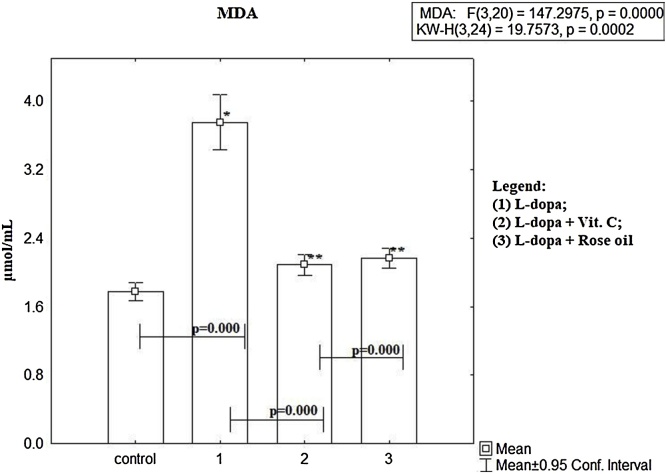
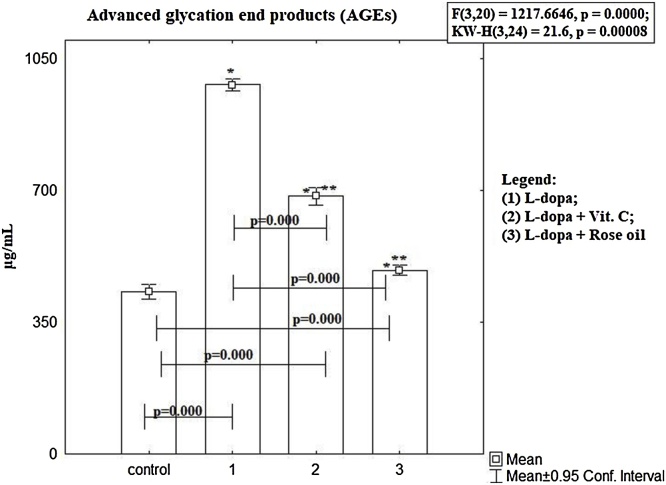
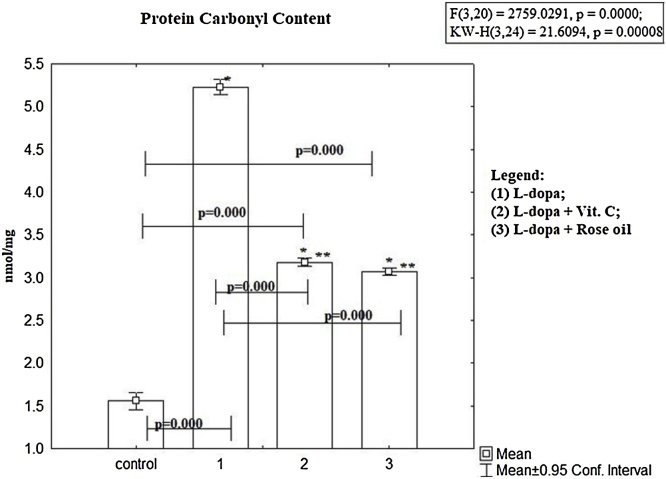
Parkinson disease (PD) is a multifactorial disease that takes a leading place among contemporary frequent diseases of the central nervous system (CNS) with not well-established mechanism. One of the most popular and effective therapy for patients with PD is Levodopa (L-dopa), but clinical effect of the drug diminished by motor complications resulting from prolonged treatment. Due to the L-dopa neurotoxic effect in the disease treatment, the L-dopa administration is delayed as long as possible in order to avoid side effects. In addition, combining L-dopa therapy with antioxidants, may decrease side-effects and provide symptomatic relief. The aim of the current research was to explore the possibility to reduce the oxidative stress (OS) induced by the L-dopa after its combining with two different antioxidants an essential oil isolated from Rosa damascena Mill., and vitamin C through experimental model of healthy mice. For this purpose, some oxidative stress indicators were evaluated - the lipid and protein oxidation end products - such as lipid peroxidation products measured as malondialdehyde (MDA) levels, protein carbonyl content (PCC), and advanced glycation end products (AGEs) in blood plasma of the experimental mice. For this purpose, was studied blood isolated from healthy mice after i.p. treatment with L-dopa (100 mg/kg). The groups with combining therapy were pre-treated first with Ascorbic acid (400 mg/kg), Rose oil (400 mg/kg). Statistically significant increased MDA levels, PCC and AGEs were found in the blood L-dopa treated mice compared to the controls, while the same parameters were significantly decreased in group pre-treated with antioxidants compared to the same controls. As a conclusion, the studied antioxidants can protect organisms from induced L-dopa oxidative toxicity and may play a key role in end products protection.
帕金森病(PD)是一种多因素疾病,在当代常见的中枢神经系统(CNS)疾病中占据主导地位,其发病机制尚未完全明确。左旋多巴(L-多巴)是治疗帕金森病患者最常用且有效的药物之一,但长期治疗会导致运动并发症,从而降低该药物的临床疗效。由于L-多巴在疾病治疗中具有神经毒性作用,为避免副作用,L-多巴的给药时间会尽可能延迟。此外,将L-多巴疗法与抗氧化剂联合使用,可能会减少副作用并缓解症状。本研究的目的是通过健康小鼠实验模型,探讨L-多巴与两种不同抗氧化剂(从大马士革蔷薇中分离出的精油和维生素C)联合使用后,降低其诱导的氧化应激(OS)的可能性。为此,评估了一些氧化应激指标——脂质和蛋白质氧化终产物——如以丙二醛(MDA)水平衡量的脂质过氧化产物、蛋白质羰基含量(PCC)以及实验小鼠血浆中的晚期糖基化终产物(AGEs)。为此,研究了经腹腔注射L-多巴(100mg/kg)处理后的健康小鼠的血液。联合治疗组首先用抗坏血酸(400mg/kg)、玫瑰油(400mg/kg)进行预处理。与对照组相比,L-多巴处理的小鼠血液中MDA水平、PCC和AGEs显著升高,而与相同对照组相比,抗氧化剂预处理组的相同参数显著降低。综上所述,所研究的抗氧化剂可保护生物体免受L-多巴诱导的氧化毒性,并且可能在终产物保护中起关键作用。