Onywera Harris, Williamson Anna-Lise, Mbulawa Zizipho Z A, Coetzee David, Meiring Tracy L
Institute of Infectious Disease and Molecular Medicine, University of Cape Town, Cape Town, South Africa; Division of Medical Virology, Department of Pathology, Faculty of Health Sciences, University of Cape Town, South Africa.
Institute of Infectious Disease and Molecular Medicine, University of Cape Town, Cape Town, South Africa; Division of Medical Virology, Department of Pathology, Faculty of Health Sciences, University of Cape Town, South Africa; SAMRC Gynaecological Cancer Research Centre, University of Cape Town, Cape Town, South Africa.
Papillomavirus Res. 2019 Jun;7:154-163. doi: 10.1016/j.pvr.2019.04.006. Epub 2019 Apr 13.
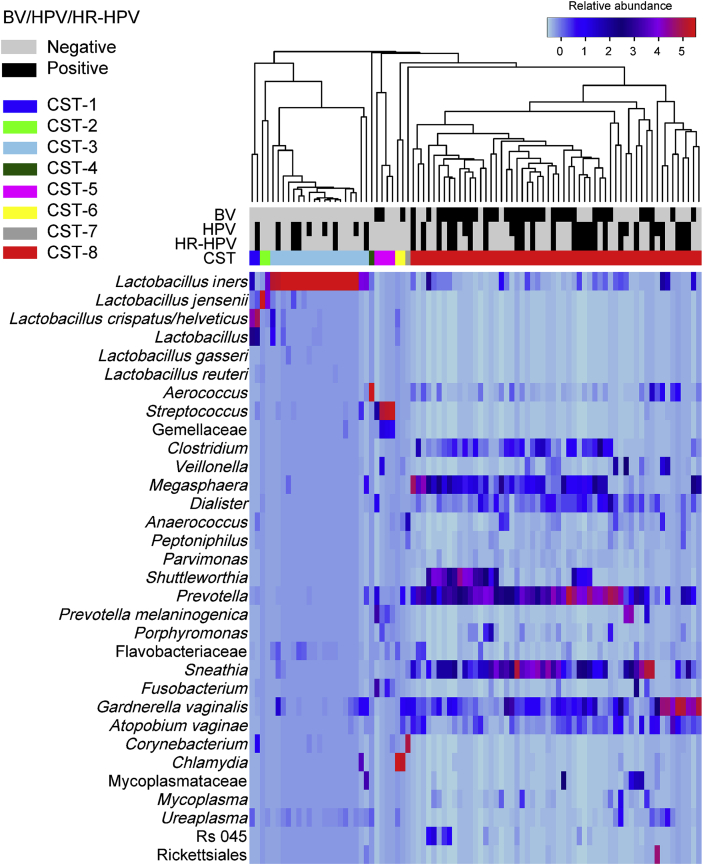
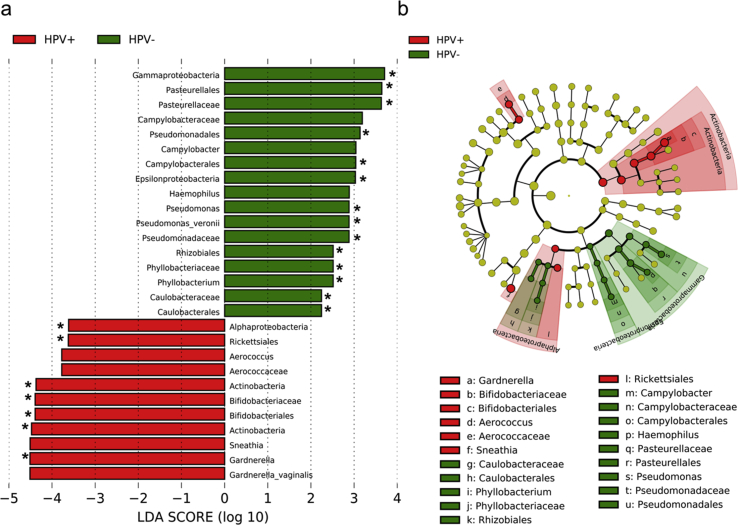
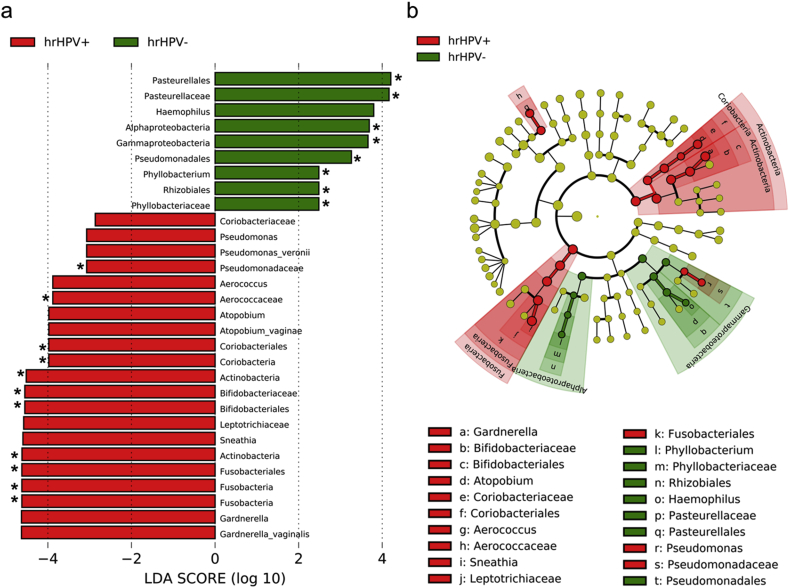
In this study we examined potential associations of HPV infection with the cervical microbiota. Cervical samples were collected from 87 HIV-seronegative reproductive-age Black South African women. Microbiota were characterized by Illumina sequencing of the V3-V4 hypervariable regions of the bacterial 16S rRNA gene. Thirty seven (42.5%) and 30 (34.5%) of the women had prevalent HPV and high-risk (HR)-HPV, respectively. Only 23 women (26.4%) had cervical microbiota dominated by a single Lactobacillus species (L. crispatus (2/87 (2.3%)), L. jensenii (2/87 (2.3%)), and L. iners (19/87 (21.8%)). The majority of the women (56/87 (64.4%)) had diverse cervical microbiota consisting of mainly bacterial vaginosis-associated bacteria. The remaining women (8/87 (9.2%)) had microbiota dominated by Aerococcus, Streptococcus, Chlamydia or Corynebacterium. Women with HR-HPV had significantly higher relative abundances of Aerococcaceae, Pseudomonadaceae and Bifidobacteriaceae compared to those with low-risk (LR)-HPV or no HPV-infection (LDA score >2.0, p < 0.05, q < 0.2). Gardnerella, Sneathia, and Atopobium were also found at greater relative abundances in HR-HPV-infected women compared to those with low-risk (LR)-HPV or no HPV-infection (LDA score >2.0, p < 0.05), although the difference was not significant after FDR-adjustment (q > 0.2). Further investigations of the bacterial taxa significantly enriched in HR-HPV-infected women are warranted.
在本研究中,我们检测了人乳头瘤病毒(HPV)感染与宫颈微生物群之间的潜在关联。从87名血清HIV阴性的南非黑人育龄妇女中采集宫颈样本。通过对细菌16S rRNA基因V3 - V4高变区进行Illumina测序来鉴定微生物群。分别有37名(42.5%)和30名(34.5%)妇女存在HPV感染和高危(HR)-HPV感染。仅有23名妇女(26.4%)的宫颈微生物群以单一乳酸杆菌属菌种为主(卷曲乳酸杆菌(2/87(2.3%))、詹氏乳酸杆菌(2/87(2.3%))和惰性乳酸杆菌(19/87(21.8%))。大多数妇女(56/87(64.4%))的宫颈微生物群多样,主要由与细菌性阴道病相关的细菌组成。其余妇女(8/87(9.2%))的微生物群以气球菌属、链球菌属、衣原体属或棒状杆菌属为主。与低危(LR)-HPV感染或无HPV感染的妇女相比,HR-HPV感染的妇女中气球菌科、假单胞菌科和双歧杆菌科的相对丰度显著更高(线性判别分析得分>2.0,p<0.05,q<0.2)。与低危(LR)-HPV感染或无HPV感染的妇女相比,在HR-HPV感染的妇女中也发现加德纳菌属、斯内特菌属和阿托波菌属的相对丰度更高(线性判别分析得分>2.0,p<0.05),尽管在错误发现率(FDR)校正后差异不显著(q>0.2)。有必要对HR-HPV感染妇女中显著富集的细菌类群进行进一步研究。