Leonard Davis School of Gerontology, University of Southern California, Los Angeles, CA 90089, USA.
Department of Translational Genomics and Institute for Translational Genomics, Keck School of Medicine of the University of Southern California, Los Angeles, CA 90033, USA.
Cells. 2019 Apr 3;8(4):306. doi: 10.3390/cells8040306.
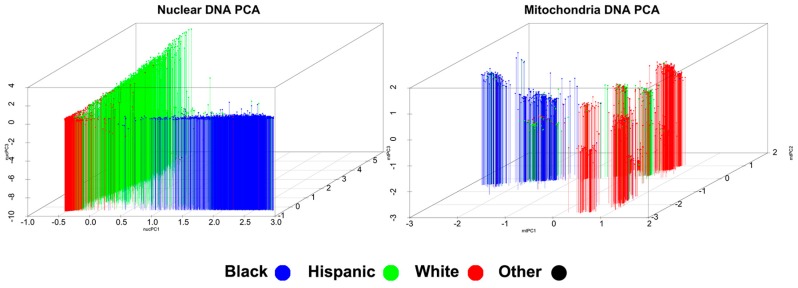
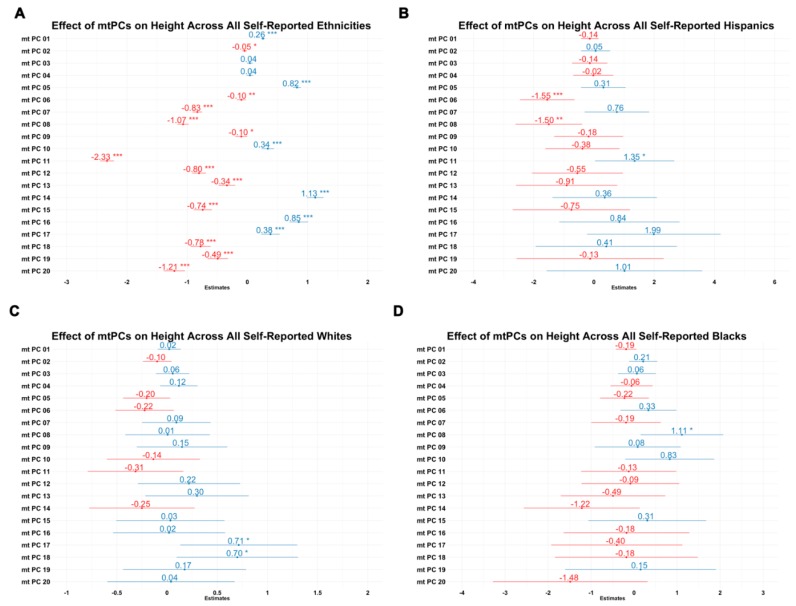
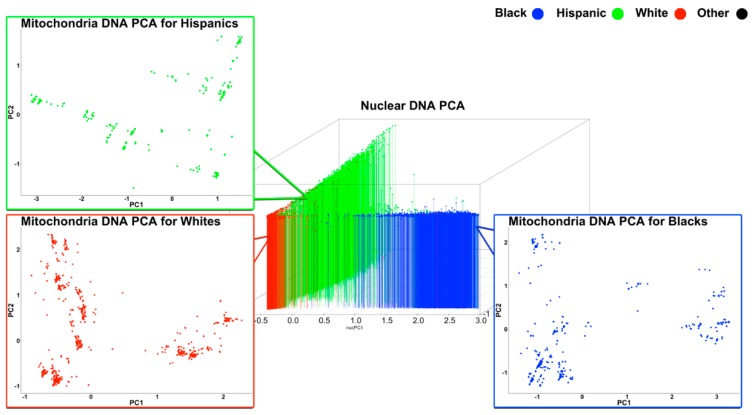
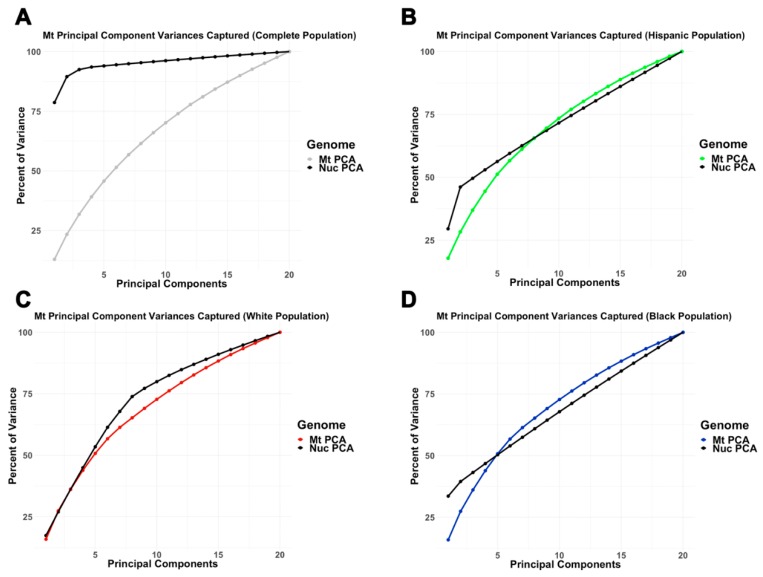
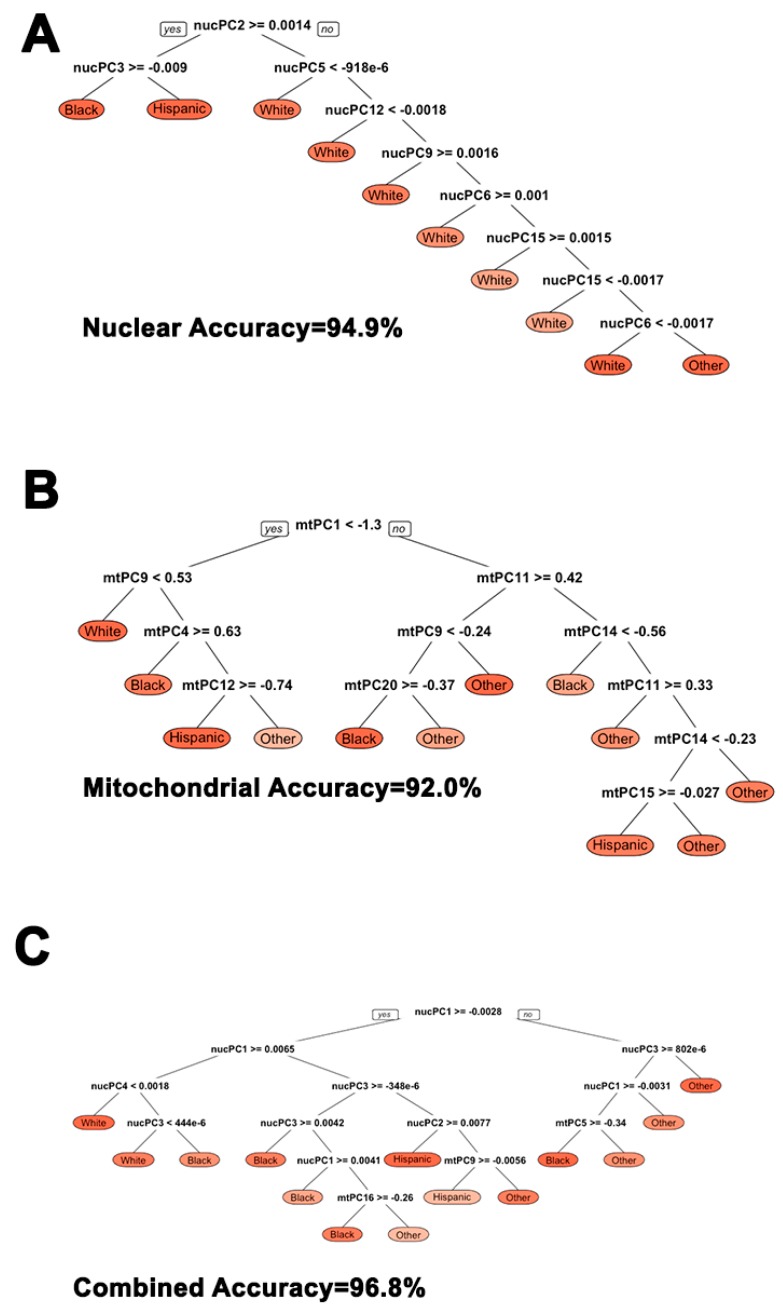
Mitochondrial genome-wide association studies identify mitochondrial single nucleotide polymorphisms (mtSNPs) that associate with disease or disease-related phenotypes. Most mitochondrial and nuclear genome-wide association studies adjust for genetic ancestry by including principal components derived from nuclear DNA, but not from mitochondrial DNA, as covariates in statistical regression analyses. Furthermore, there is no standard when controlling for genetic ancestry during mitochondrial and nuclear genetic interaction association scans, especially across ethnicities with substantial mitochondrial genetic heterogeneity. The purpose of this study is to (1) compare the degree of ethnic variation captured by principal components calculated from microarray-defined nuclear and mitochondrial DNA and (2) assess the utility of mitochondrial principal components for association studies. Analytic techniques used in this study include a principal component analysis for genetic ancestry, decision-tree classification for self-reported ethnicity, and linear regression for association tests. Data from the Health and Retirement Study, which includes self-reported White, Black, and Hispanic Americans, was used for all analyses. We report that (1) mitochondrial principal component analysis (PCA) captures ethnic variation to a similar or slightly greater degree than nuclear PCA in Blacks and Hispanics, (2) nuclear and mitochondrial DNA classify self-reported ethnicity to a high degree but with a similar level of error, and 3) mitochondrial principal components can be used as covariates to adjust for population stratification in association studies with complex traits, as demonstrated by our analysis of height-a phenotype with a high heritability. Overall, genetic association studies might reveal true and robust mtSNP associations when including mitochondrial principal components as regression covariates.
线粒体全基因组关联研究确定了与疾病或疾病相关表型相关的线粒体单核苷酸多态性(mtSNP)。大多数线粒体和核全基因组关联研究通过将来自核 DNA 的主成分作为协变量纳入统计回归分析来调整遗传背景,但不包括来自线粒体 DNA 的主成分。此外,在进行线粒体和核遗传相互作用关联扫描时,特别是在具有大量线粒体遗传异质性的种族之间,没有控制遗传背景的标准。本研究的目的是:(1)比较基于微阵列定义的核和线粒体 DNA 计算的主成分捕获的遗传变异程度;(2)评估线粒体主成分在关联研究中的效用。本研究中使用的分析技术包括遗传背景的主成分分析、基于自我报告的种族的决策树分类以及关联检验的线性回归。所有分析均使用包括自我报告的白种人、黑人和西班牙裔美国人的健康与退休研究的数据。我们报告:(1)线粒体主成分分析(PCA)在黑人和西班牙裔人群中捕获遗传变异的程度与核 PCA 相似或稍高;(2)核和线粒体 DNA 对自我报告的种族进行高度分类,但存在相似的错误水平;(3)线粒体主成分可作为协变量用于复杂性状的关联研究中的群体分层调整,我们对身高这一遗传高度相关的表型的分析证明了这一点。总体而言,当将线粒体主成分作为回归协变量纳入遗传关联研究时,可能会揭示真正稳健的 mtSNP 关联。