School of Postgraduate Studies, International Medical University, Kuala Lumpur, Malaysia.
Mechanisms of Carcinogenesis Section (MCA), Epigenetics Group (EGE) International Agency for Research on Cancer, World Health Organization, Lyon, France.
J Exp Clin Cancer Res. 2019 Apr 15;38(1):162. doi: 10.1186/s13046-019-1153-8.
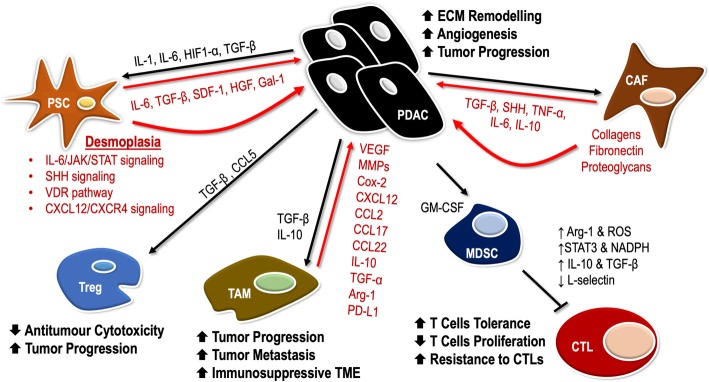
Pancreatic cancer is one of the most lethal type of cancers, with an overall five-year survival rate of less than 5%. It is usually diagnosed at an advanced stage with limited therapeutic options. To date, no effective treatment options have demonstrated long-term benefits in advanced pancreatic cancer patients. Compared with other cancers, pancreatic cancer exhibits remarkable resistance to conventional therapy and possesses a highly immunosuppressive tumor microenvironment (TME).
In this review, we summarized the evidence and unique properties of TME in pancreatic cancer that may contribute to its resistance towards immunotherapies as well as strategies to overcome those barriers. We reviewed the current strategies and future perspectives of combination therapies that (1) promote T cell priming through tumor associated antigen presentation; (2) inhibit tumor immunosuppressive environment; and (3) break-down the desmoplastic barrier which improves tumor infiltrating lymphocytes entry into the TME.
It is imperative for clinicians and scientists to understand tumor immunology, identify novel biomarkers, and optimize the position of immunotherapy in therapeutic sequence, in order to improve pancreatic cancer clinical trial outcomes. Our collaborative efforts in targeting pancreatic TME will be the mainstay of achieving better clinical prognosis among pancreatic cancer patients. Ultimately, pancreatic cancer will be a treatable medical condition instead of a death sentence for a patient.
胰腺癌是最致命的癌症之一,总体五年生存率不足 5%。它通常在晚期诊断,治疗选择有限。迄今为止,没有有效的治疗方法在晚期胰腺癌患者中显示出长期获益。与其他癌症相比,胰腺癌对常规治疗具有显著的耐药性,并且具有高度免疫抑制的肿瘤微环境(TME)。
在这篇综述中,我们总结了 TME 在胰腺癌中的证据和独特特性,这些特性可能导致其对免疫疗法的抵抗,以及克服这些障碍的策略。我们回顾了联合治疗的当前策略和未来展望,这些策略包括:(1)通过肿瘤相关抗原呈递促进 T 细胞的初始激活;(2)抑制肿瘤免疫抑制环境;(3)破坏细胞外基质屏障,从而改善肿瘤浸润淋巴细胞进入 TME。
临床医生和科学家必须了解肿瘤免疫学,确定新的生物标志物,并优化免疫疗法在治疗序列中的位置,以改善胰腺癌临床试验结果。我们在靶向胰腺癌 TME 方面的合作努力将是实现胰腺癌患者更好临床预后的主要支柱。最终,胰腺癌将成为一种可治疗的疾病,而不是患者的死亡判决。