Gebrechorkos Solomon H, Hülsmann Stephan, Bernhofer Christian
United Nations University Institute for Integrated Management of Material Fluxes and of Resources (UNU-FLORES), 01067, Dresden, Germany.
Faculty of Environmental Sciences, Institute of Hydrology and Meteorology, Technische Universität Dresden, 01062, Dresden, Germany.
Sci Data. 2019 Apr 15;6(1):31. doi: 10.1038/s41597-019-0038-1.
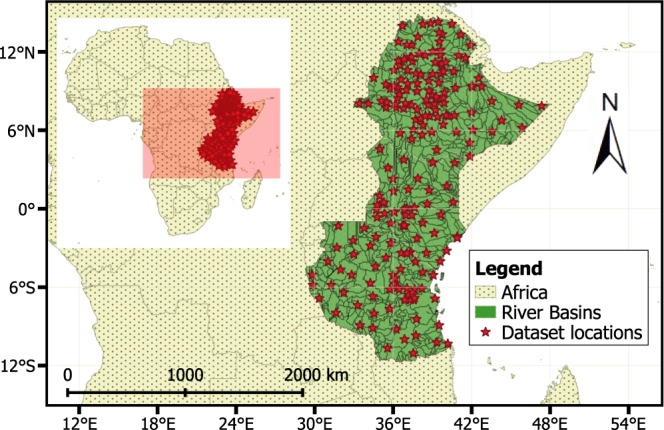
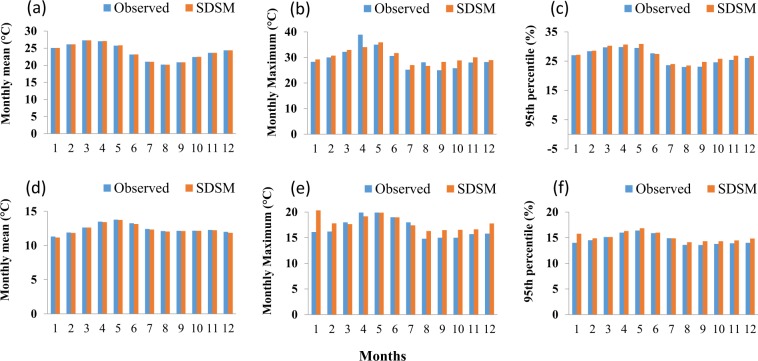
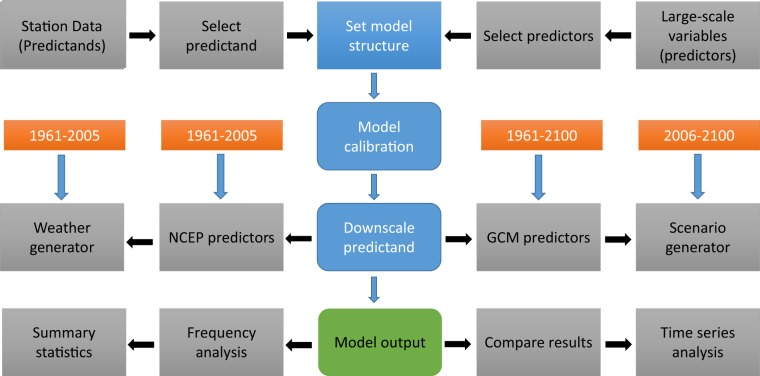
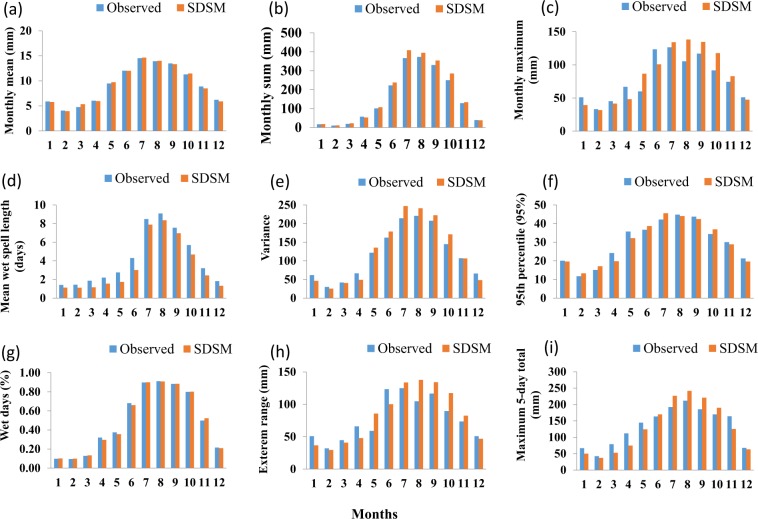
For many regions of the world, current climate change projections are only available at coarser spatial resolution from Global Climate Models (GCMs) that cannot directly be used in impact assessment and adaptation studies at regional and local scale. Impact assessment studies require high-resolution climate data to drive impact assessment models. To overcome this data challenge, we produced a station based climate projection (precipitation and maximum and minimum temperature) for Ethiopia, Kenya, and Tanzania using observed daily data from 211 stations obtained from the National Meteorological Agency of Ethiopia and international databases. Moreover, 26 large-scale climate variables derived from the National Centers for Environmental Prediction reanalysis data (1961-2005) and second generation Canadian Earth System Model (CanESM2, 1961-2100) are used. Statistical Down-Scaling Model (SDSM) is used to produce the required high-resolution climate projection by developing a statistical relationship between the large- and local-scale climate variables. The predictors are analysed more than 16458 times and we provided 20 ensembles for the current (1961-2005) and future (2006-2100, under RCP2.6, RCP4.5, and RCP8.5) climate.
对于世界上许多地区而言,目前的气候变化预测仅能从全球气候模型(GCMs)中以较粗的空间分辨率获取,而这些模型无法直接用于区域和地方尺度的影响评估与适应研究。影响评估研究需要高分辨率的气候数据来驱动影响评估模型。为了克服这一数据挑战,我们利用从埃塞俄比亚国家气象局和国际数据库获取的211个站点的每日观测数据,生成了埃塞俄比亚、肯尼亚和坦桑尼亚基于站点的气候预测(降水以及最高和最低温度)。此外,还使用了从美国国家环境预测中心再分析数据(1961 - 2005年)和第二代加拿大地球系统模型(CanESM2,1961 - 2100年)得出的26个大尺度气候变量。统计降尺度模型(SDSM)通过建立大尺度和局地尺度气候变量之间的统计关系来生成所需的高分辨率气候预测。对预测因子进行了超过16458次分析,我们提供了当前(1961 - 2005年)和未来(2006 - 2100年,在RCP2.6、RCP4.5和RCP8.5情景下)气候的20个集合。