Yamamoto Gustavo Jum, Ocampos Guilherme Pereira, Luzo Maria Candidade Miranda, da Silva Cleidnéia Aparecida Clemente, de Farias Fabiane Elize Sabino, de Rezende Marcia Uchoa
Universidade de São Paulo, Faculdade de Medicina, Hospital das Clínicas, Department of Orthopedics and Traumatology, São Paulo, Brazil.
Acta Ortop Bras. 2019 Mar-Apr;27(2):85-91. doi: 10.1590/1413-785220192702208131.
To compare the effect of a brace designed to stabilize the patellofemoral joint to that of a patella-shaped neoprene sleeve with patella cut out in patients with patellofemoral osteoarthritis.
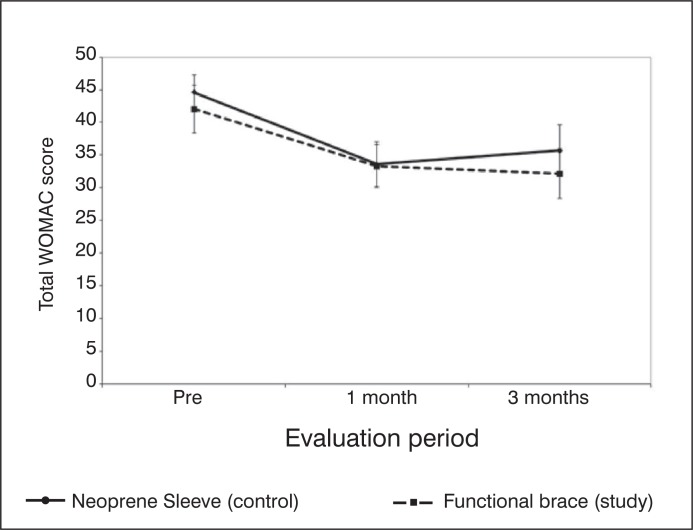
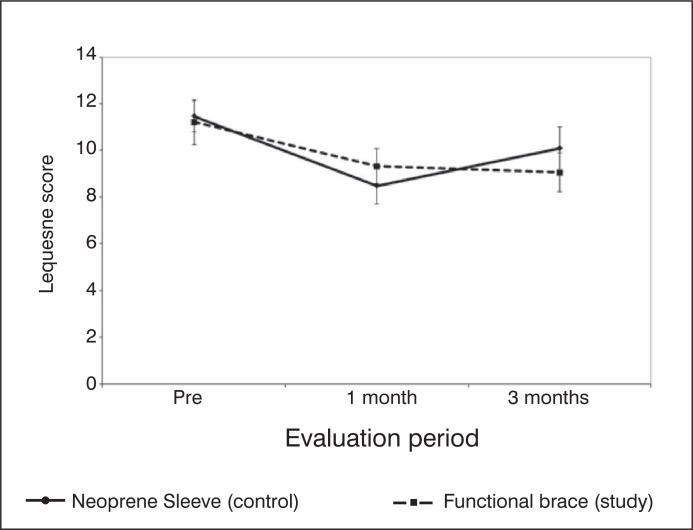
Fifty-seven patients with femoro-patellar osteoarthritis were allocated to two groups: patients with femoro-patellar functional brace and those with a neoprene knee with a patellar orifice. Both groups underwent clinical treatment of osteoarthritis and used medications daily 1 month before and up to 3 months after brace placement. They were evaluated with the WOMAC and Lequesne questionnaires and performed five times sit to stand test, Timed Up and Go test, and six minutes walk test immediately before and 1 and 3 months after brace placement.
Both groups had improved pain, stiffness, and function with no difference between groups. Drug use decreased in both groups in the first month but increased in the third month. Naproxen use was progressively higher in the control group.
Both knee orthoses improved pain and function and altered drug use only in the first month. Functional knee brace provided analgesia without increased use of naproxen. .
比较一种旨在稳定髌股关节的支具与一种髌骨部位镂空的氯丁橡胶髌骨套对髌股骨关节炎患者的治疗效果。
57例股髌骨关节炎患者被分为两组:一组使用股髌功能性支具,另一组使用带髌骨孔的氯丁橡胶护膝。两组均接受骨关节炎的临床治疗,并在佩戴支具前1个月至佩戴后3个月每天使用药物。在佩戴支具前、佩戴后1个月和3个月时,使用WOMAC和Lequesne问卷对患者进行评估,并进行五次坐立试验、计时起立行走试验和六分钟步行试验。
两组患者的疼痛、僵硬和功能均有改善,组间无差异。两组在第一个月的药物使用量均减少,但在第三个月增加。对照组萘普生的使用量逐渐增加。
两种膝关节矫形器均能改善疼痛和功能,且仅在第一个月改变药物使用情况。功能性膝关节支具可提供镇痛效果,且不会增加萘普生的使用量。