State Key Laboratory of Membrane Biology, Beijing Advanced Innovation Center for Structural Biology, School of Life Sciences, Tsinghua University, Beijing 100084, China.
National Institute of Biological Sciences, Beijing 102206, China.
Sci Adv. 2019 Apr 10;5(4):eaau8164. doi: 10.1126/sciadv.aau8164. eCollection 2019 Apr.
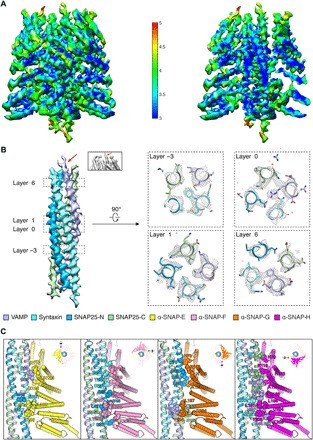
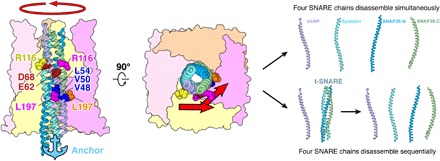
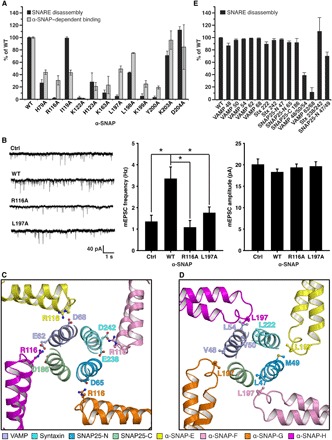
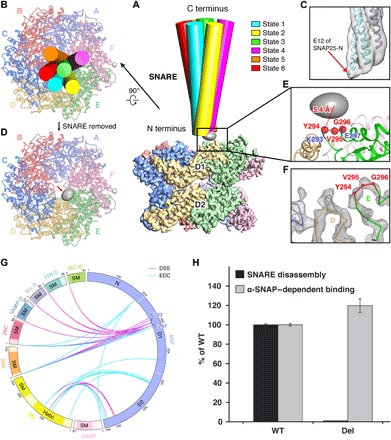
NSF (-ethylmaleimide-sensitive factor) and α-SNAP (α-soluble NSF attachment protein) bind to the SNARE (soluble NSF attachment protein receptor) complex, the minimum machinery to mediate membrane fusion, to form a 20S complex, which disassembles the SNARE complex for reuse. We report the cryo-EM structures of the α-SNAP-SNARE subcomplex and the NSF-D1D2 domain in the 20S complex at 3.9- and 3.7-Å resolutions, respectively. Combined with the biochemical and electrophysiological analyses, we find that α-SNAPs use R116 through electrostatic interactions and L197 through hydrophobic interactions to apply force mainly on two positions of the VAMP protein to execute disassembly process. Furthermore, we define the interaction between the amino terminus of the SNARE helical bundle and the pore loop of the NSF-D1 domain and demonstrate its essential role as a potential anchor for SNARE complex disassembly. Our studies provide a rotation model of α-SNAP-mediated disassembly of the SNARE complex.
NSF(N-乙基马来酰亚胺敏感因子)和 α-SNAP(α-可溶性 NSF 附着蛋白)与 SNARE(可溶性 NSF 附着蛋白受体)复合物结合,形成一个 20S 复合物,该复合物将 SNARE 复合物拆开以供重复使用。我们报道了 α-SNAP-SNARE 亚复合物和 NSF-D1D2 结构域在 20S 复合物中的冷冻电镜结构,分辨率分别为 3.9 和 3.7Å。结合生化和电生理分析,我们发现 α-SNAP 主要通过静电相互作用利用 R116 和疏水相互作用利用 L197 对 VAMP 蛋白的两个位置施加力来执行拆卸过程。此外,我们定义了 SNARE 螺旋束的氨基末端与 NSF-D1 结构域的孔环之间的相互作用,并证明其作为 SNARE 复合物拆卸的潜在锚点的重要作用。我们的研究提供了 α-SNAP 介导的 SNARE 复合物拆卸的旋转模型。