Department of Epidemiology and Health Statistics, Xiangya School of Public Health, Central South University. Changsha, China.
Joint first authors.
J Glob Health. 2019 Jun;9(1):010603. doi: 10.7189/jogh.09.010603.
To examine trends in unintentional falls mortality from 2006 to 2016 in China by location (urban/rural), sex, age group and mechanism.
Mortality data were retrieved from the National Disease Surveillance Points system (DSPs) of China, a nationally representative data source. Percent change in mortality between 2006 and 2016 was calculated as "mortality rate ratio - 1" based on a negative binomial regression model.
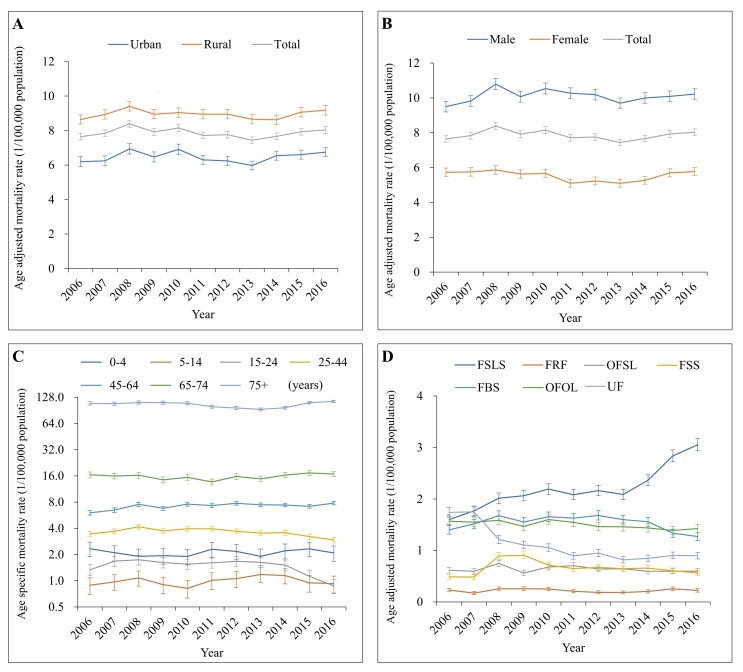
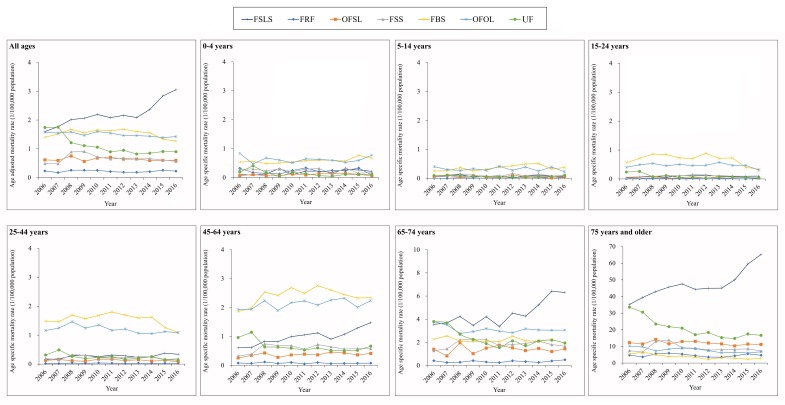
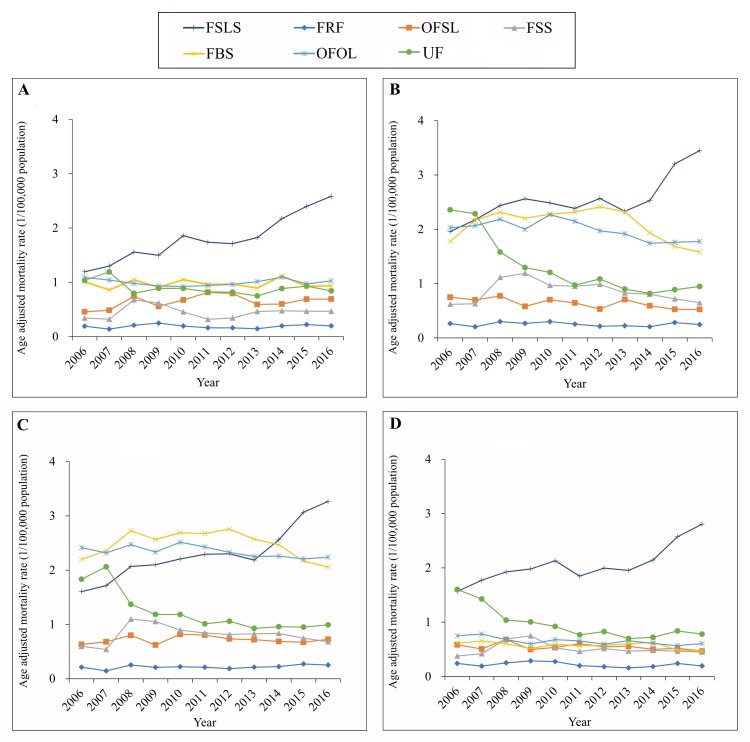
The crude unintentional falls mortality was 9.55 per 100 000 population in 2016. From 2006 to 2016, the age-adjusted unintentional falls mortality increased by 5% (95% confidence interval (CI) = 1%-9%), rising from 7.65 to 8.03 per 100 000 population. Males, rural residents and older age groups consistently had higher falls mortality rates than females, urban residents and younger age groups. Falls on the same level from slipping, tripping and stumbling (W01) was the most common mechanisms of falls mortality, accounting for 29% of total mortality.
Unintentional falls continued to be a major cause of death in China from 2006 to 2016. Empirically-supported interventions should be implemented to reduce unintentional falls mortality.
本研究旨在通过位置(城市/农村)、性别、年龄组和机制来检查 2006 年至 2016 年中国非故意伤害性跌倒死亡率的趋势。
死亡率数据来自中国国家疾病监测点系统(DSPs),这是一个具有全国代表性的数据来源。根据负二项回归模型,计算 2006 年至 2016 年死亡率的变化百分比为“死亡率比率-1”。
2016 年未经调整的非故意伤害性跌倒死亡率为每 10 万人 9.55 人。2006 年至 2016 年,年龄调整后的非故意伤害性跌倒死亡率上升了 5%(95%置信区间(CI)= 1%-9%),从每 10 万人 7.65 人上升至每 10 万人 8.03 人。男性、农村居民和年龄较大的年龄组的跌倒死亡率始终高于女性、城市居民和年龄较小的年龄组。从滑倒、绊倒和蹒跚(W01)引起的同一水平的跌倒仍然是非故意伤害性死亡的最常见机制,占总死亡率的 29%。
2006 年至 2016 年,非故意伤害性跌倒仍是中国主要的死亡原因。应实施经验支持的干预措施,以降低非故意伤害性跌倒死亡率。