Department of Biomedical Engineering, College of Science and Engineering, University of Minnesota, Minneapolis, Minnesota.
Department of Orthopaedic Surgery, Medical School, University of Minnesota, Minneapolis, Minnesota.
Spine (Phila Pa 1976). 2019 Sep;44(18):1270-1278. doi: 10.1097/BRS.0000000000003061.
Experimental and computational study of posterior spinal instrumentation and growing rod constructs per ASTM F1717-15 vertebrectomy methodology for static compressive bending.
Assess mechanical performance of standard fusion instrumentation and growing rod constructs.
Growing rod instrumentation utilizes fewer anchors and spans longer distances, increasing shared implant loads relative to fusion. There is a need to evaluate growing rod's mechanical performance. ASTM F1717-15 standard assesses performance of spinal instrumentation; however, effects of growing rods with side-by-side connectors have not been evaluated.
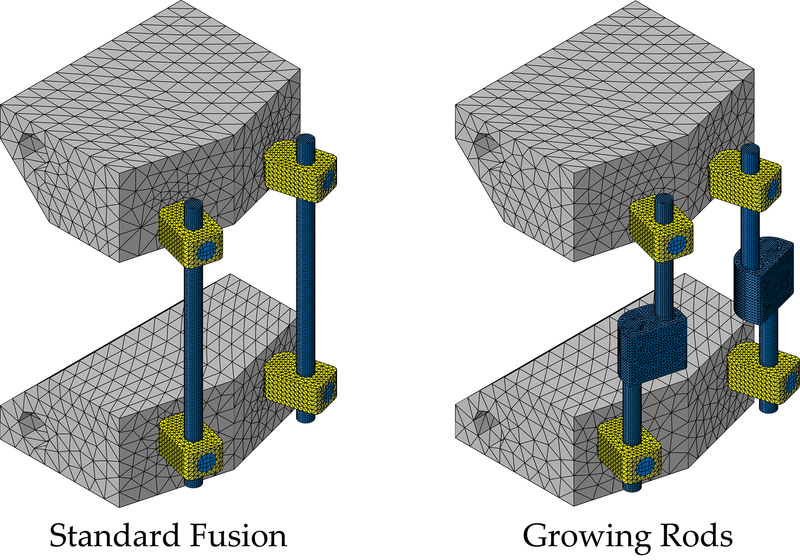
Standard and growing rod constructs were tested per ASTM F1717-15 methodology; setup was modified for growing rod constructs to allow for connector offset. Three experimental groups (standard with active length 76 mm, and growing rods with active lengths 76 and 376 mm; n = 5/group) were tested; stiffness, yield load, and load at maximum displacement were calculated. Computational models were developed and used to locate stress concentrations.
For both constructs at 76 mm active length, growing rod stiffness (49 ± 0.8 N/mm) was significantly greater than standard (43 ± 0.4 N/mm); both were greater than growing rods at 376 mm (10 ± 0.3 N/mm). No significant difference in yield load was observed between growing rods (522 ± 12 N) and standard (457 ± 19 N) constructs of 76 mm. Growing rod constructs significantly decreased from 76 mm (522 ± 12 N) to 376 mm active length (200 ± 2 N). Maximum load of growing rods at 76 mm (1084 ± 11 N) was significantly greater than standard at 76 mm (1007 ± 7 N) and growing rods at 376 mm active length (392 ± 5 N). Simulations with active length of 76 mm were within 10% of experimental mechanical characteristics; stress concentrations were at the apex and cranial to connector-rod interaction for standard and growing rod models, respectively.
Growing rod constructs are stronger and stiffer than spinal instrumentation constructs; with an increased length accompanied a decrease in strength. Growing rod construct stress concentration locations observed during computational simulation are consistent with clinically observed failure locations.
根据 ASTM F1717-15 椎切除术方法,对后路脊柱内固定物和生长棒结构进行实验和计算研究,用于静态压缩弯曲。
评估标准融合器械和生长棒结构的机械性能。
生长棒器械使用的固定器和连接杆更少,但连接杆跨越的距离更长,与融合术相比,分担的植入物负荷更大。因此需要评估生长棒的机械性能。ASTM F1717-15 标准评估脊柱内固定物的性能;然而,尚未评估具有并排连接器的生长棒的效果。
根据 ASTM F1717-15 方法对标准和生长棒结构进行测试;为生长棒结构修改设置,以允许连接器偏移。对三个实验组(标准,主动长度 76mm;生长棒,主动长度 76mm 和 376mm;每组 n=5)进行测试;计算刚度、屈服载荷和最大位移时的载荷。开发了计算模型,并用于定位应力集中点。
在主动长度为 76mm 的两种结构中,生长棒的刚度(49±0.8N/mm)明显大于标准(43±0.4N/mm);两者均大于主动长度为 376mm 的生长棒(10±0.3N/mm)。在主动长度为 76mm 时,生长棒(522±12N)和标准(457±19N)结构的屈服载荷没有显著差异。生长棒结构从 76mm 主动长度(522±12N)显著下降至 376mm 主动长度(200±2N)。在主动长度为 76mm 时,生长棒的最大载荷(1084±11N)明显大于标准在 76mm 时(1007±7N)和生长棒在 376mm 时(392±5N)。在主动长度为 76mm 时的模拟结果与实验力学特性相差在 10%以内;标准和生长棒模型的应力集中点分别在顶点和连接器-杆连接处的上方。
生长棒结构比脊柱内固定结构更强、更硬;长度增加的同时强度下降。在计算模拟中观察到的生长棒结构的应力集中位置与临床观察到的失效位置一致。
5 级。