Department of Internal Medicine.
Department of Radiation Oncology, and.
Blood Adv. 2019 Apr 23;3(8):1272-1284. doi: 10.1182/bloodadvances.2018025569.
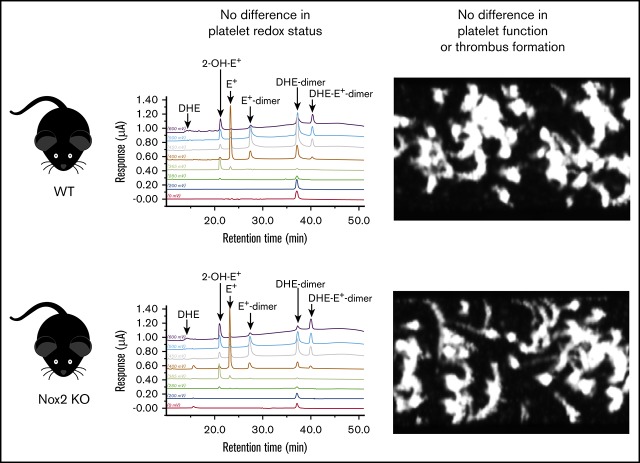
Deficiency of the Nox2 (gp91phox) catalytic subunit of nicotinamide adenine dinucleotide phosphate (NADPH) oxidase is a genetic cause of X-linked chronic granulomatous disease, a condition in which patients are prone to infection resulting from the loss of oxidant production by neutrophils. Some studies have suggested a role for superoxide derived from Nox2 NADPH oxidase in platelet activation and thrombosis, but data are conflicting. Using a rigorous and comprehensive approach, we tested the hypothesis that genetic deficiency of Nox2 attenuates platelet activation and arterial thrombosis. Our study was designed to test the genotype differences within male and female mice. Using chloromethyl-dichlorodihydrofluorescein diacetate, a fluorescent dye, as well as high-performance liquid chromatography analysis with dihydroethidium as a probe to detect intracellular reactive oxygen species (ROS), we observed no genotype differences in ROS levels in platelets. Similarly, there were no genotype-dependent differences in levels of mitochondrial ROS. In addition, we did not observe any genotype-associated differences in platelet activation, adhesion, secretion, or aggregation in male or female mice. Platelets from chronic granulomatous disease patients exhibited similar adhesion and aggregation responses as platelets from healthy subjects. Susceptibility to carotid artery thrombosis in a photochemical injury model was similar in wild-type and Nox2-deficient male or female mice. Our findings indicate that Nox2 NADPH oxidase is not an essential source of platelet ROS or a mediator of platelet activation or arterial thrombosis in large vessels, such as the carotid artery.
NADPH 氧化酶的 Nox2(gp91phox)催化亚基缺乏是 X 连锁慢性肉芽肿病的遗传原因,这种疾病使中性粒细胞丧失产生氧化剂的能力,从而导致患者易受感染。一些研究表明,Nox2 NADPH 氧化酶产生的超氧化物在血小板激活和血栓形成中起作用,但数据存在矛盾。我们采用严格和全面的方法,检验了 Nox2 基因缺失是否会减弱血小板激活和动脉血栓形成的假设。我们的研究旨在检验雄性和雌性小鼠中 Nox2 基因型差异。我们使用氯甲基二氯二氢荧光素二乙酸酯作为荧光染料,以及二氢乙啶作为探针进行高效液相色谱分析,以检测细胞内活性氧(ROS),我们发现血小板内 ROS 水平没有基因型差异。同样,线粒体 ROS 水平也没有基因型依赖性差异。此外,我们在雄性或雌性小鼠中均未观察到血小板激活、黏附、分泌或聚集的基因型相关差异。慢性肉芽肿病患者的血小板与健康受试者的血小板表现出相似的黏附和聚集反应。在光化学损伤模型中,颈动脉血栓形成的易感性在野生型和 Nox2 缺陷型雄性或雌性小鼠中相似。我们的研究结果表明,Nox2 NADPH 氧化酶不是血小板 ROS 的必需来源,也不是血小板激活或大血管(如颈动脉)动脉血栓形成的介质。