Tang Fang, Chu Liwei, Shu Wenbo, He Xuejiao, Wang Lijuan, Lu Mengzhu
1State Key Laboratory of Tree Genetics and Breeding, Key Laboratory of Tree Breeding and Cultivation of the National Forestry and Grassland Administration, Research Institute of Forestry, Chinese Academy of Forestry, Beijing, 100091 China.
2Co-Innovation Center for Sustainable Forestry in Southern China, Nanjing Forestry University, Nanjing, 210037 China.
Plant Methods. 2019 Apr 6;15:35. doi: 10.1186/s13007-019-0420-1. eCollection 2019.
Quantitative reverse transcriptase polymerase chain reaction (qRT-PCR) is a rapid and sensitive approach to identify miRNA and protein-coding gene expression in plants. However, because of the specially designated reverse transcription and shorter PCR products, very few reference genes have been identified for the quantitative analysis of miRNA expression in plants, and different internal reference genes are needed to normalize the expression of miRNAs and mRNA genes respectively. Therefore, it is particularly important to select the suitable common reference genes for normalization of quantitative PCR of miRNA and mRNA.
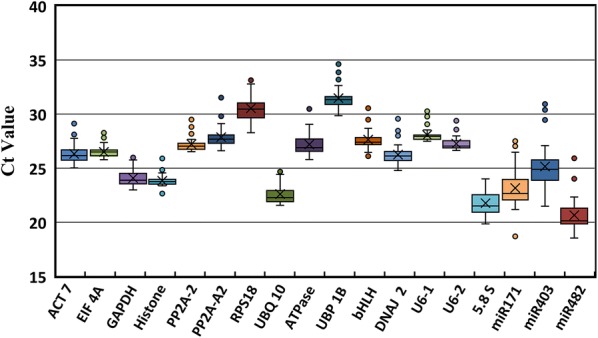
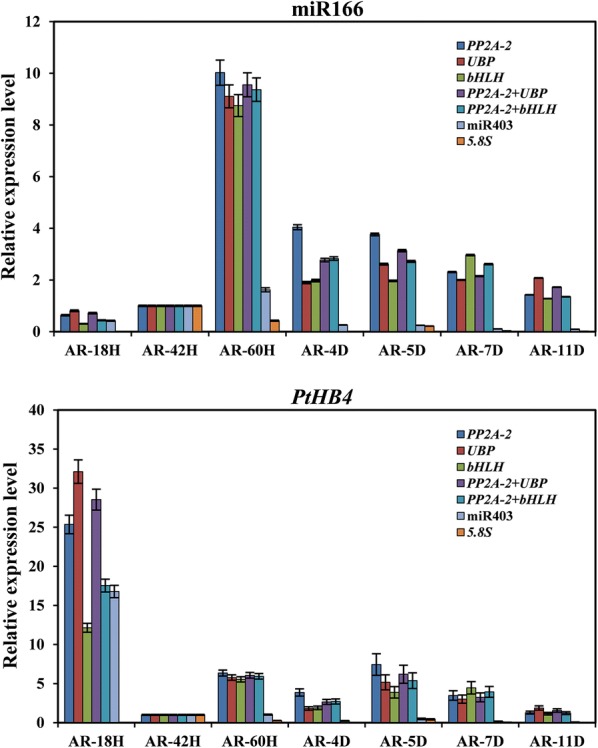
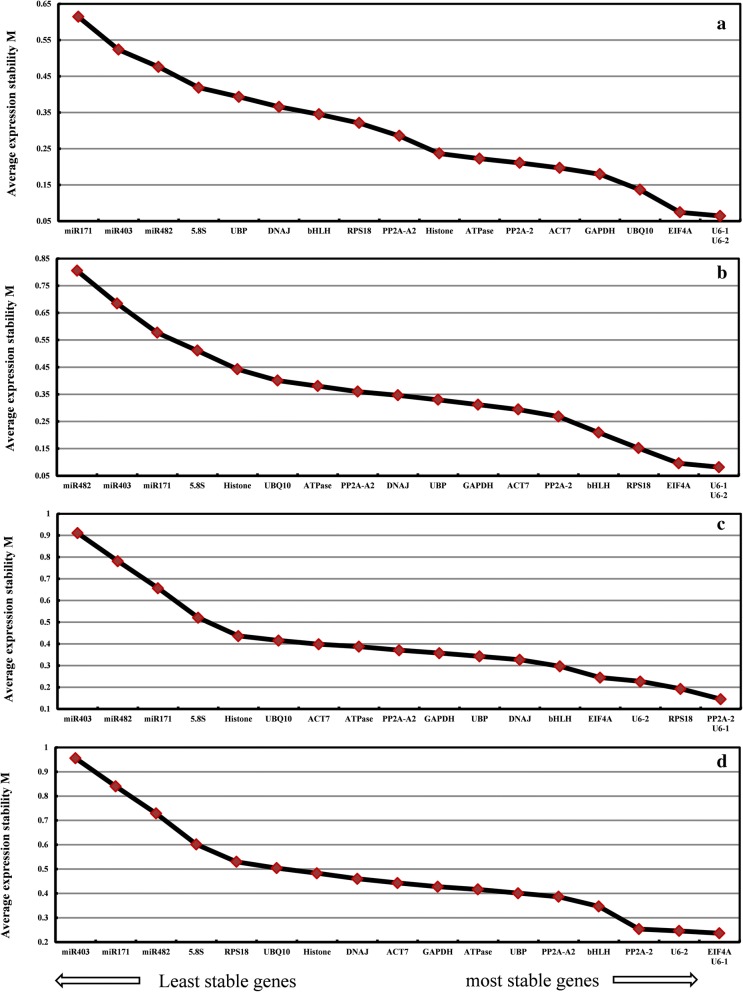
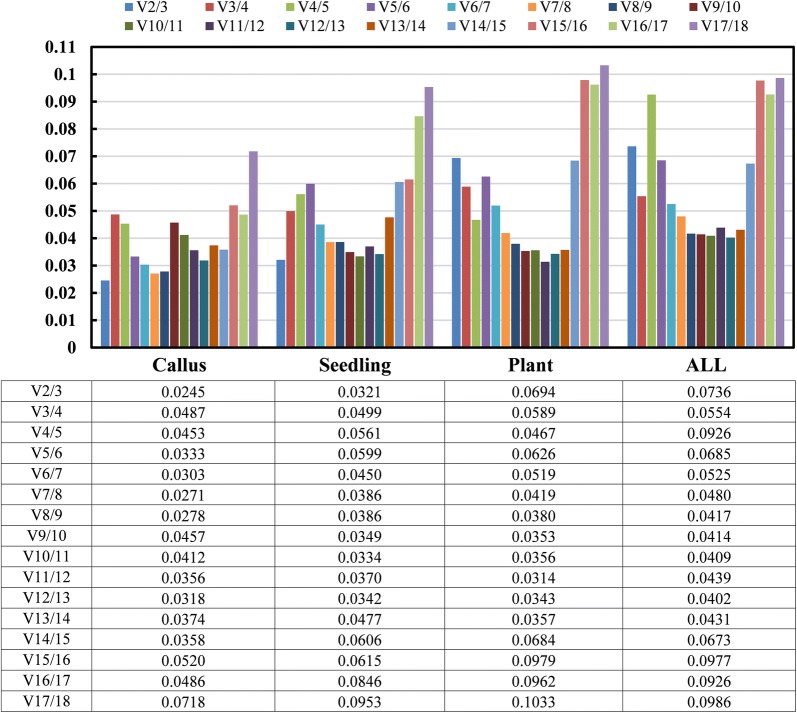
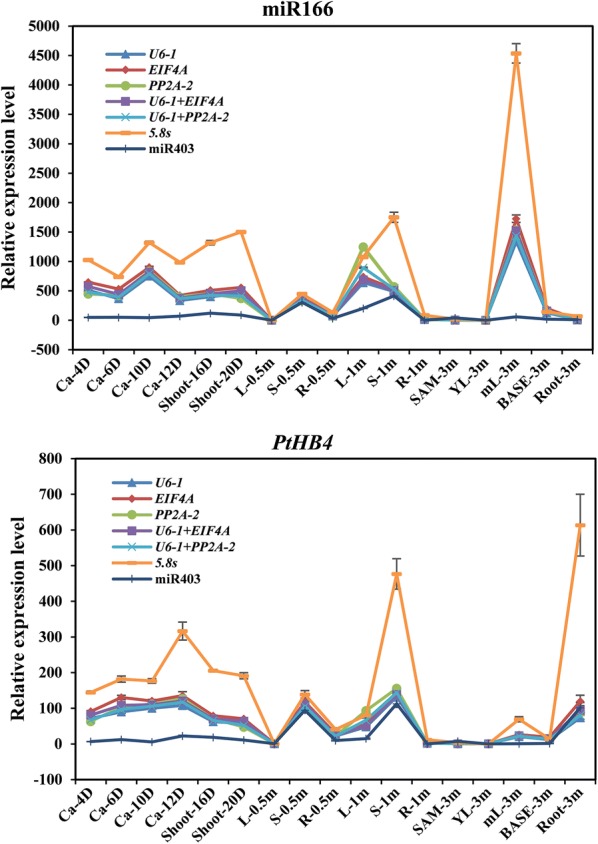
In this study, a modified reverse transcription PCR protocol was adopted for selecting and validating universal internal reference genes of mRNAs and miRNAs. Eight commonly used reference genes, four stably expressed novel genes in , three small noncoding RNAs and three conserved miRNAs were selected as candidate genes, and the stability of their expression was examined across a set of 38 tissue samples from four developmental stages of poplar clone 84K ( × ). The expression stability of these candidate genes was evaluated systematically by four algorithms: geNorm, NormFinder, Bestkeeper and DeltaCt. The results showed that III () and - were suitable for samples of the callus stage; - and - were best for the seedling stage; - (-) and - were best for the plant stage; and - (-) and () were the best reference genes in the adventitious root (AR) regeneration stage.
The purpose of this study was to identify the most appropriate reference genes for qRT-PCR of miRNAs and mRNAs in different tissues at several developmental stages in poplar. -, and - were the three most appropriate reference genes for qRT-PCR normalization of miRNAs and mRNAs during the plant regeneration process, and - and represent the best reference genes in the AR regeneration stage of poplar. This work will benefit future studies of expression and function analysis of miRNAs and their target genes in poplar.
定量逆转录聚合酶链反应(qRT-PCR)是一种快速且灵敏的方法,用于鉴定植物中miRNA和蛋白质编码基因的表达。然而,由于其特定的逆转录过程和较短的PCR产物,用于植物miRNA表达定量分析的内参基因很少被鉴定出来,并且分别需要不同的内参基因来标准化miRNA和mRNA基因的表达。因此,选择合适的通用内参基因用于miRNA和mRNA的定量PCR标准化尤为重要。
在本研究中,采用了一种改良的逆转录PCR方案来选择和验证mRNA和miRNA的通用内参基因。选择了八个常用的内参基因、四个在[具体物种]中稳定表达的新基因、三个小非编码RNA和三个保守的miRNA作为候选基因,并在杨树无性系84K([具体杂交组合])四个发育阶段的38个组织样本中检测了它们表达的稳定性。通过四种算法:geNorm、NormFinder、Bestkeeper和DeltaCt系统地评估了这些候选基因的表达稳定性。结果表明,[基因名称III([具体基因编号])]和[基因名称-]适用于愈伤组织阶段的样本;[基因名称-]和[基因名称-]最适合幼苗阶段;[基因名称-([具体基因编号])]和[基因名称-]最适合植株阶段;而[基因名称-([具体基因编号])]和[基因名称([具体基因编号])]是不定根(AR)再生阶段的最佳内参基因。
本研究的目的是鉴定杨树几个发育阶段不同组织中miRNA和mRNA的qRT-PCR最合适的内参基因。[基因名称-]、[基因名称]和[基因名称-]是植物再生过程中miRNA和mRNA的qRT-PCR标准化最合适的三个内参基因,而[基因名称-]和[基因名称]代表杨树AR再生阶段的最佳内参基因。这项工作将有利于未来杨树中miRNA及其靶基因的表达和功能分析研究。