Tavakolpour Soheil, Mahmoudi HamidReza, Abedini Robabeh, Kamyab Hesari Kambiz, Kiani Amin, Daneshpazhooh Maryam
Autoimmune Bullous Diseases Research Center, Tehran University of Medical Sciences, Tehran, Iran.
Int J Womens Dermatol. 2019 Jan 23;5(2):116-123. doi: 10.1016/j.ijwd.2018.11.003. eCollection 2019 Jun.
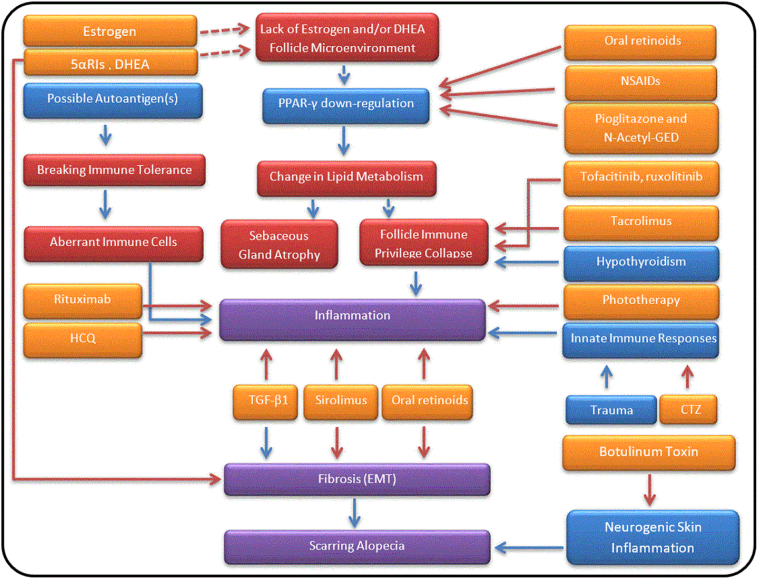
Frontal fibrosing alopecia (FFA) is a relatively new scarring alopecia that is considered a variant of lichen planopilaris (LPP) with no recognized promising treatments. In this study, we tried to clarify the underlying signaling pathways and their roles in the pathogenesis and progression of FFA. Because of several differences in clinical manifestations, response to treatments, and pathological findings, these two conditions could be differentiated from each other. Taking into account the already discussed signaling pathways and involved players such as T cells, mast cells, and sebaceous glands, different possible therapeutic options could be suggested. In addition to treatments supported by clinical evidence, such as 5 alpha-reductase inhibitors, topical calcineurin inhibitors, hydroxychloroquine, peroxisome proliferator-activated receptor gamma agonists, and oral retinoid agents, various other treatment strategies and drugs, such as phototherapy, Janus kinase inhibitors, dehydroepiandrosterone, sirolimus, cetirizine, and rituximab, could be suggested to mitigate disease progression. Of course, such lines of treatment need further evaluation in clinical trials.
额部纤维性秃发(FFA)是一种相对较新的瘢痕性秃发,被认为是扁平苔藓样毛发扁平苔藓(LPP)的一种变体,目前尚无公认的有效治疗方法。在本研究中,我们试图阐明FFA发病机制和进展过程中的潜在信号通路及其作用。由于这两种疾病在临床表现、对治疗的反应和病理表现上存在一些差异,因此可以相互区分。考虑到已经讨论过的信号通路以及涉及的细胞,如T细胞、肥大细胞和皮脂腺,我们可以提出不同的可能治疗方案。除了有临床证据支持的治疗方法,如5α还原酶抑制剂、外用钙调神经磷酸酶抑制剂、羟氯喹、过氧化物酶体增殖物激活受体γ激动剂和口服维甲酸类药物外,还可以建议采用其他各种治疗策略和药物,如光疗、Janus激酶抑制剂、脱氢表雄酮、西罗莫司、西替利嗪和利妥昔单抗,以减轻疾病进展。当然,这些治疗方案需要在临床试验中进一步评估。