Royal Belgian Institute of Natural Sciences, Rue Vautier 29, B-1000, Brussels, Belgium.
Evolutionary Ecology Group, University of Antwerp, Universiteitsplein 1, B-2610, Antwerp, Belgium.
BMC Evol Biol. 2019 Apr 18;19(1):92. doi: 10.1186/s12862-019-1414-3.
Hyperdiverse mtDNA with more than 5% of variable synonymous nucleotide sites can lead to erroneous interpretations of population genetic differentiation patterns and parameters (φ, D). We illustrate this by using hyperdiverse mtDNA markers to infer population genetic differentiation and connectivity in Melarhaphe neritoides, a NE Atlantic (NEA) gastropod with a high dispersal potential. We also provide a recent literature example of how mtDNA hyperdiversity may have misguided the interpretation of genetic connectivity in the crab Opecarcinus hypostegus.
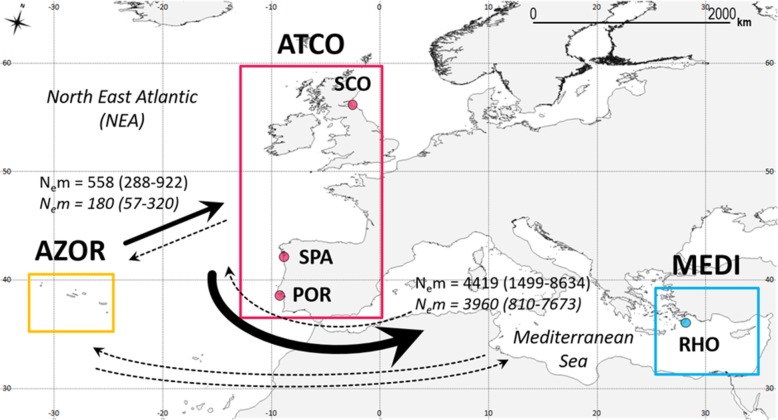
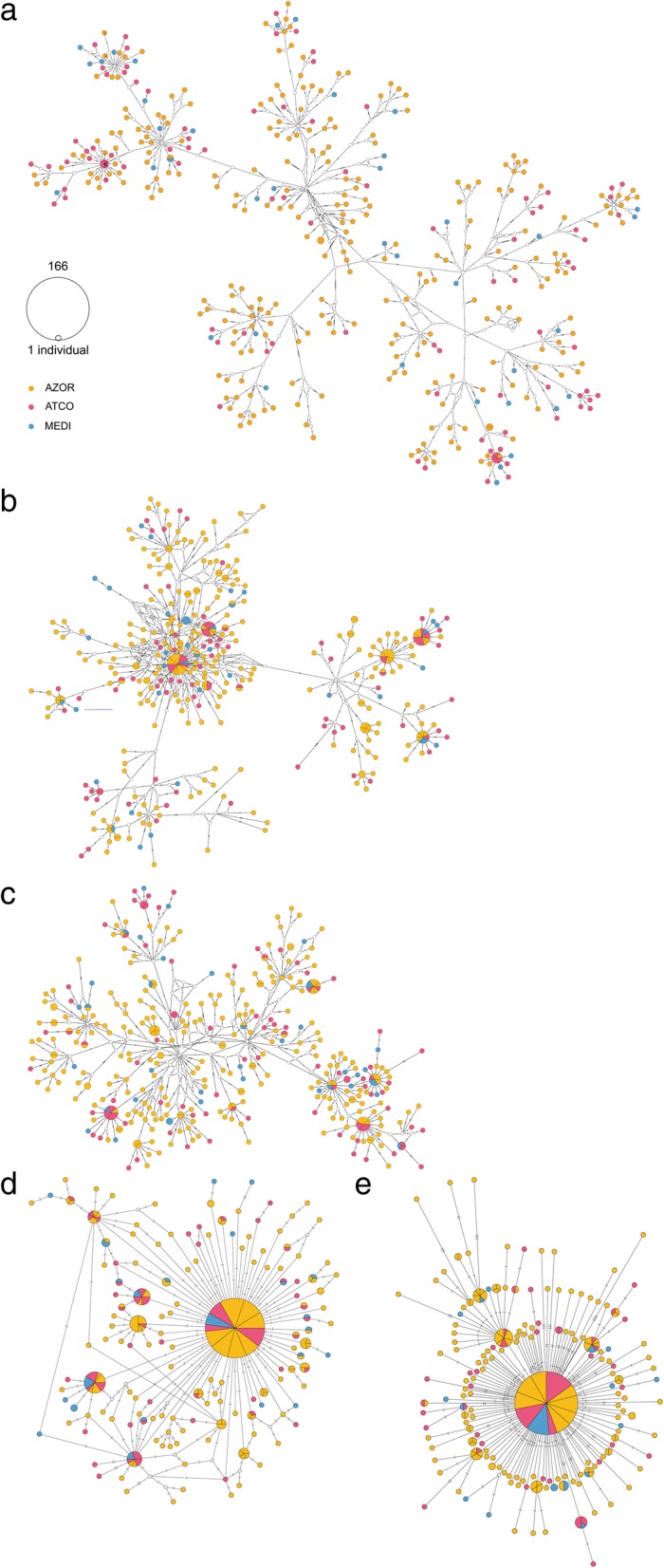
mtDNA variation surveyed throughout the NEA showed that nearly all M. neritoides specimens had haplotypes private to populations, suggesting at first glance a lack of gene flow and thus a strong population genetic differentiation. Yet, the bush-like haplotype network, though visually misleading, showed no signs of phylogeographic or other haplotype structuring. Coalescent-based gene flow estimates were high throughout the NEA, irrespective of whether or not mtDNA hyperdiversity was reduced by removing hypervariable sites.
Melarhaphe neritoides seems to be panmictic over the entire NEA, which is consistent with its long-lived pelagic larval stage. With hyperdiverse mtDNA, the apparent lack of shared haplotypes among populations does not necessarily reflect a lack of gene flow and/or population genetic differentiation by fixation of alternative haplotypes (D ≈ 1 does not a fortiori imply φ ≈ 1), but may be due to (1) a too low sampling effort to detect shared haplotypes and/or (2) a very high mutation rate that may conceal the signal of gene flow. Hyperdiverse mtDNA can be used to assess connectivity by coalescent-based methods. Yet, the combined use of φ and D can provide a reasonable inference of connectivity patterns from hyperdiverse mtDNA, too.
具有超过 5%可变同义核苷酸位点的高度多样化 mtDNA 可能导致对群体遗传分化模式和参数(φ、D)的错误解释。我们通过使用高度多样化的 mtDNA 标记来推断 NE 大西洋(NEA)腹足纲贝类 Melarhaphe neritoides 的种群遗传分化和连通性,来说明这一点。该贝类具有较高的扩散能力。我们还提供了一个最近的文献示例,说明 mtDNA 高度多样化如何可能误导了对螃蟹 Opecarcinus hypostegus 遗传连通性的解释。
在整个 NEA 调查的 mtDNA 变异表明,几乎所有 M. neritoides 标本都具有种群特有的单倍型,这表明乍一看没有基因流动,因此种群遗传分化很强。然而,尽管看起来有误导性,但树状单倍型网络没有表现出任何地理或其他单倍型结构的迹象。整个 NEA 的基于合并的基因流动估计值都很高,无论是否通过去除高度可变的位点来减少 mtDNA 高度多样性。
Melarhaphe neritoides 似乎在整个 NEA 范围内是泛生的,这与其长寿命的浮游幼虫阶段一致。由于 mtDNA 高度多样化,种群之间缺乏共享单倍型并不一定反映缺乏基因流动和/或替代单倍型固定的种群遗传分化(D≈1 不一定意味着 φ≈1),但可能是由于(1)样本量过低无法检测到共享单倍型,和/或(2)非常高的突变率可能掩盖了基因流动的信号。基于合并的方法可以使用高度多样化的 mtDNA 来评估连通性。然而,φ 和 D 的组合也可以合理推断高度多样化的 mtDNA 的连通性模式。