Kiran Swathi, Thompson Cynthia K
Sargent College of Health and Rehabilitation Sciences, Boston University, Boston, MA, United States.
Department of Communication Sciences and Disorders, Northwestern University, Evanston, IL, United States.
Front Neurol. 2019 Apr 2;10:295. doi: 10.3389/fneur.2019.00295. eCollection 2019.
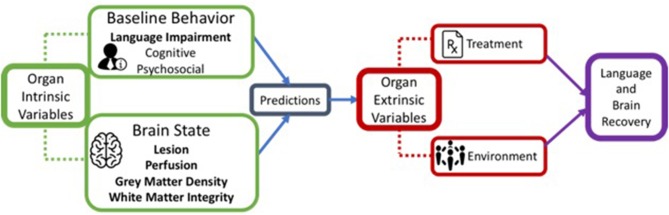
Researchers have sought to understand how language is processed in the brain, how brain damage affects language abilities, and what can be expected during the recovery period since the early 19th century. In this review, we first discuss mechanisms of damage and plasticity in the post-stroke brain, both in the acute and the chronic phase of recovery. We then review factors that are associated with recovery. First, we review organism intrinsic variables such as age, lesion volume and location and structural integrity that influence language recovery. Next, we review organism extrinsic factors such as treatment that influence language recovery. Here, we discuss recent advances in our understanding of language recovery and highlight recent work that emphasizes a network perspective of language recovery. Finally, we propose our interpretation of the principles of neuroplasticity, originally proposed by Kleim and Jones (1) in the context of extant literature in aphasia recovery and rehabilitation. Ultimately, we encourage researchers to propose sophisticated intervention studies that bring us closer to the goal of providing precision treatment for patients with aphasia and a better understanding of the neural mechanisms that underlie successful neuroplasticity.
自19世纪初以来,研究人员一直试图了解大脑如何处理语言、脑损伤如何影响语言能力以及恢复期会出现什么情况。在这篇综述中,我们首先讨论中风后脑损伤和可塑性的机制,包括恢复的急性期和慢性期。然后,我们回顾与恢复相关的因素。首先,我们回顾机体内在变量,如年龄、病变体积和位置以及影响语言恢复的结构完整性。接下来,我们回顾机体外在因素,如影响语言恢复的治疗方法。在此,我们讨论在语言恢复理解方面的最新进展,并强调最近强调语言恢复网络视角的研究工作。最后,我们根据克莱姆和琼斯(1)最初在失语症恢复和康复现有文献背景下提出的神经可塑性原理,给出我们的解释。最终,我们鼓励研究人员开展精密的干预研究,使我们更接近为失语症患者提供精准治疗的目标,并更好地理解成功的神经可塑性背后的神经机制。