Esa A, Connolly K D, Williams R, Archer C W
School of Bioscience, Cardiff University, Cardiff, United Kingdom.
Swansea University Medical School, Swansea University, Swansea, United Kingdom.
Malays Orthop J. 2019 Mar;13(1):1-7. doi: 10.5704/MOJ.1903.012.
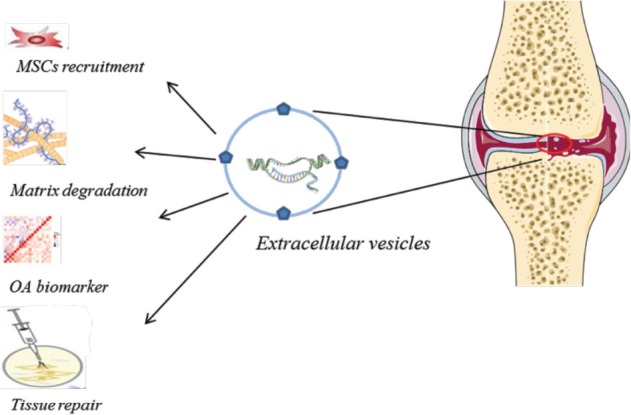
The role of extracellular vesicles (EV) in osteoarthritis has become the focus of much research. These vesicles were isolated from several cell types found in synovial joint including chondrocytes and synovium. As articular cartilage is an avascular tissue surrounded by synovial fluid, it is believed that EV might play a crucial role in the homeostasis of cartilage and also could hold key information in the pathogenesis of osteoarthritis. This is thought to be due to activation of pro-inflammatory factors leading to a catabolic state and degradation of cartilage. In addition, due to the nature of articular cartilage lacking neuronal innervation, knowledge of EV can contribute to identification of novel biomarkers in this debilitating condition. This can be either directly isolated from aspirate of synovial fluid or from peripheral blood. Finally, EVs are known to shuttle important signalling molecules which can be utilised as unique modality in transferring therapeutic compounds in a cell free manner.
细胞外囊泡(EV)在骨关节炎中的作用已成为众多研究的焦点。这些囊泡是从滑膜关节中发现的几种细胞类型中分离出来的,包括软骨细胞和滑膜。由于关节软骨是一种被滑液包围的无血管组织,人们认为EV可能在软骨的稳态中发挥关键作用,并且在骨关节炎的发病机制中可能包含关键信息。这被认为是由于促炎因子的激活导致分解代谢状态和软骨降解。此外,由于关节软骨缺乏神经支配的特性,对EV的了解有助于在这种使人衰弱的疾病中识别新的生物标志物。这可以直接从滑液抽吸物或外周血中分离出来。最后,已知EV能穿梭重要的信号分子,这些分子可作为一种独特的方式以无细胞方式传递治疗化合物。