Shin Da Jeong, Yoo Sung-Je, Hong Jeum Kyu, Weon Hang-Yeon, Song Jaekyeong, Sang Mee Kyung
Division of Agricultural Microbiology, National Institute of Agricultural Science, Rural Development Administration, Wanju 55365, Korea.
Department of Agbiotechnology and Natural Resources, Gyeongsang National University, Jinju 52828, Korea.
Plant Pathol J. 2019 Apr;35(2):178-187. doi: 10.5423/PPJ.NT.08.2018.0159. Epub 2019 Apr 1.
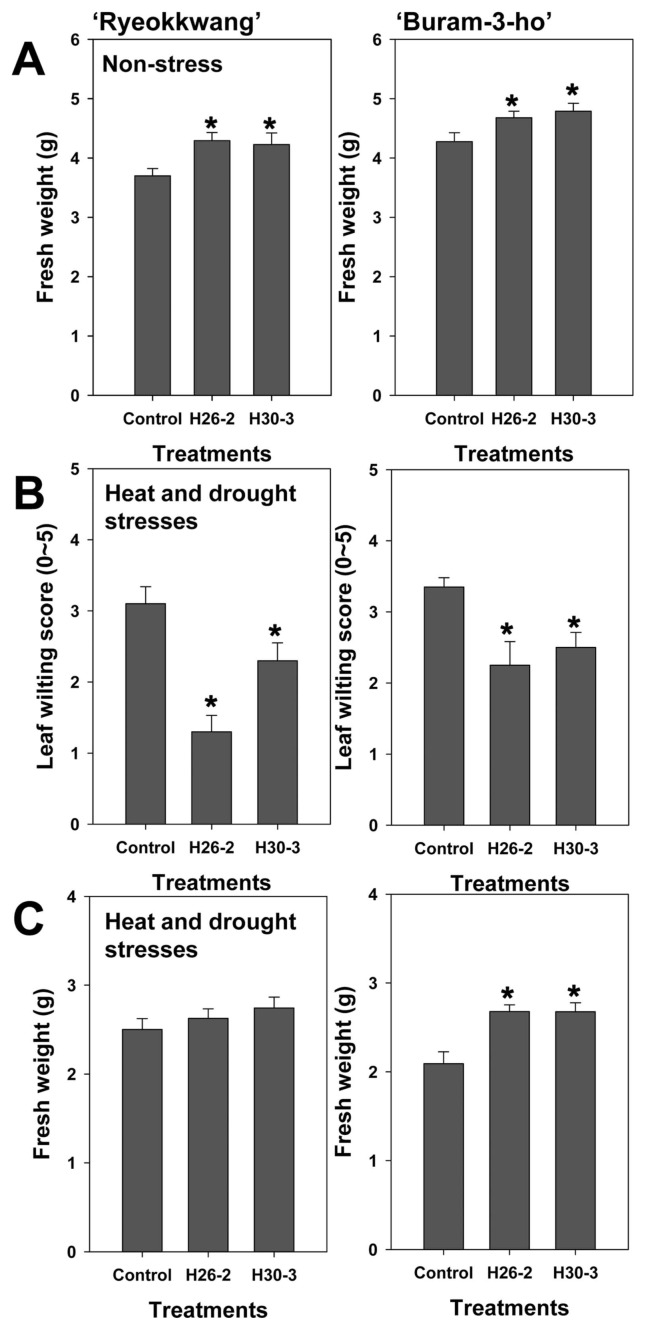
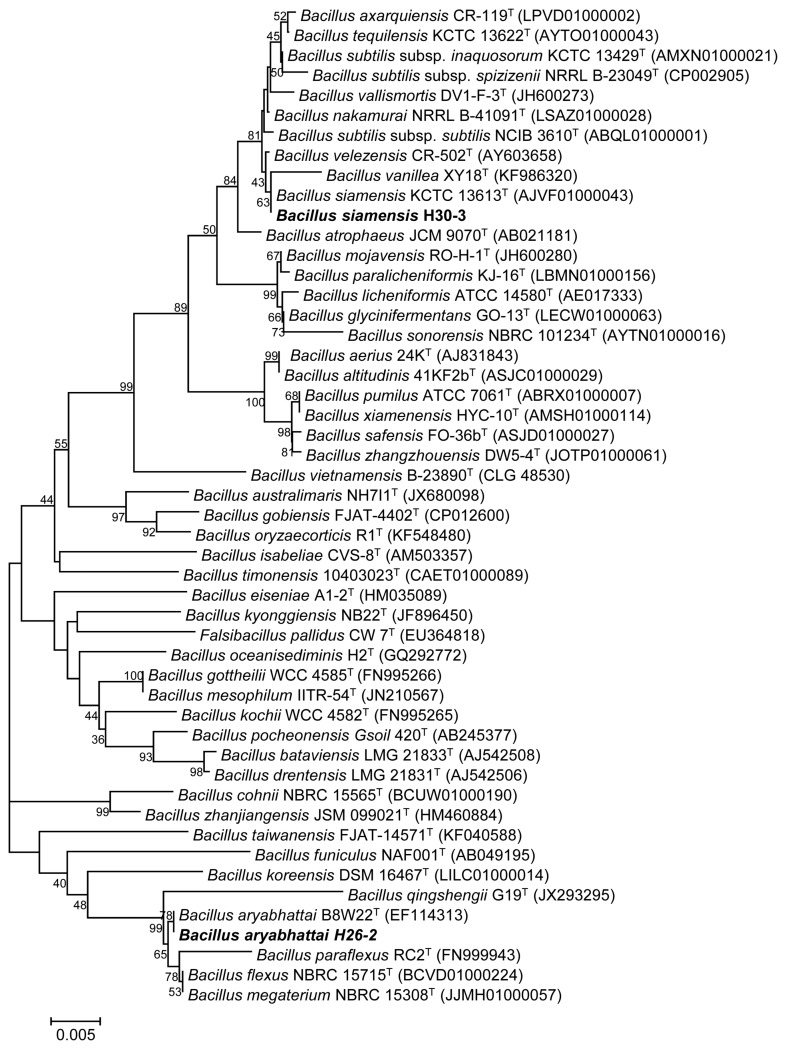
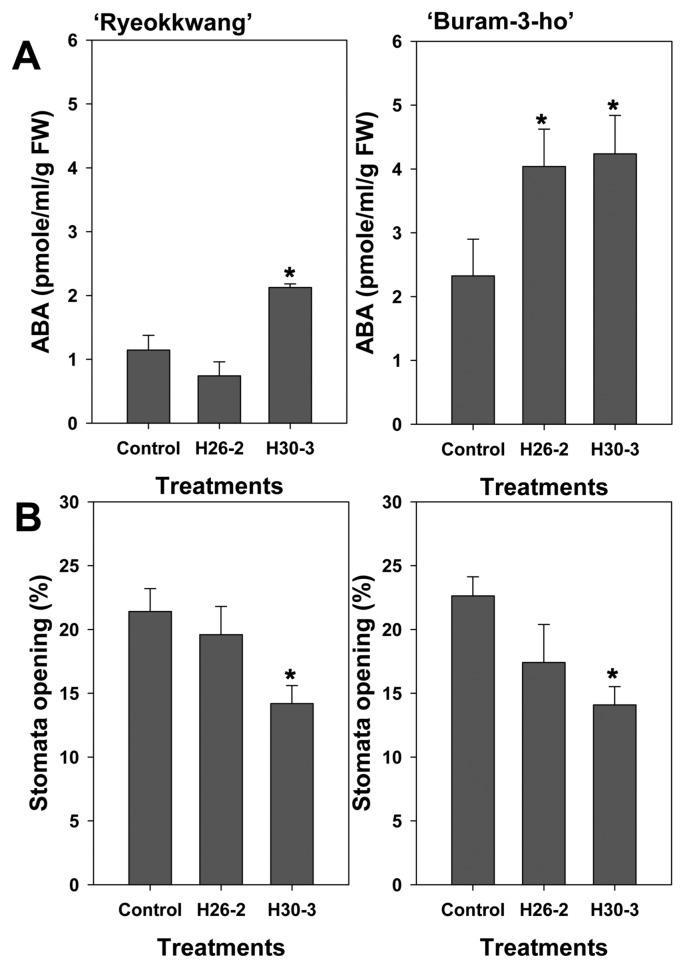
Plants are exposed to biotic stresses caused by pathogen attack and complex abiotic stresses including heat and drought by dynamic climate changes. To alleviate these stresses, we investigated two bacterial stains, H26-2 and H30-3 in two cultivars ('Ryeokkwang' and 'Buram-3-ho') of Chinese cabbage in plastic pots in a greenhouse. We evaluated effects of bacterial strains on plant growth-promotion and mitigation of heat and drought stresses; the role of exopolysaccharides as one of bacterial determinants on alleviating stresses; biocontrol activity against soft rot caused by subsp. PCC21. Strains H26-2 and H30-3 significantly increased fresh weights compared to a MgSO solution; reduced leaf wilting and promoted recovery after re-watering under heat and drought stresses. Chinese cabbages treated with H26-2 and H30-3 increased leaf abscisic acid (ABA) content and reduced stomatal opening after stresses treatments, in addition, these strains stably colonized and maintained their populations in rhizosphere during heat and drought stresses. As well as tested bacterial cells, exopolysaccharides (EPS) of H30-3 could be one of bacterial determinants for alleviation of tested stresses in Chinese cabbages, however, the effects were different to cultivars of Chinese cabbages. In addition to bacterial activity to abiotic stresses, H30-3 could suppress incidence (%) of soft rot in 'Buram-3-ho'. The tested strains were identified as H26-2 and H30-3 based on 16S rRNA gene sequence analysis. Taken together, H26-2 and H30-3 could be candidates for both plant growth promotion and mitigation of heat and drought stresses in Chinese cabbage.
由于动态气候变化,植物会遭受病原体攻击引起的生物胁迫以及包括高温和干旱在内的复杂非生物胁迫。为了缓解这些胁迫,我们在温室中的塑料盆里,对两个大白菜品种(‘Ryeokkwang’和‘Buram-3-ho’)接种了两种细菌菌株H26-2和H30-3进行研究。我们评估了细菌菌株对植物生长促进以及对高温和干旱胁迫的缓解作用;胞外多糖作为细菌缓解胁迫的决定因素之一的作用;对由胡萝卜软腐果胶杆菌胡萝卜软腐致病亚种PCC21引起的软腐病的生物防治活性。与MgSO溶液相比,菌株H26-2和H30-3显著增加了鲜重;在高温和干旱胁迫下减少了叶片萎蔫,并促进了重新浇水后的恢复。用H26-2和H30-3处理的大白菜在胁迫处理后增加了叶片脱落酸(ABA)含量并减少了气孔开度,此外,这些菌株在高温和干旱胁迫期间在根际稳定定殖并维持其种群数量。与测试的细菌细胞一样,H30-3的胞外多糖(EPS)可能是缓解大白菜测试胁迫的细菌决定因素之一,然而,其效果因大白菜品种而异。除了对非生物胁迫的细菌活性外,H30-3还可以抑制‘Buram-3-ho’中软腐病的发病率(%)。基于16S rRNA基因序列分析,将测试菌株鉴定为H26-2和H30-3。综上所述,H26-2和H30-3可能是促进大白菜生长以及缓解高温和干旱胁迫的候选菌株。