Liu Jianping, Li Jianhua, Tian Peigang, Guli Bahaer, Weng Guopeng, Li Lei, Cheng Qinghong
Department of Critical Care Medicine, Medical School of Shihezi University, Shihezi, Xinjiang 832008, P.R. China.
Department of Critical Care Medicine, The First Affiliated Hospital, School of Medicine, Shihezi University, Shihezi, Xinjiang 832008, P.R. China.
Exp Ther Med. 2019 May;17(5):4064-4072. doi: 10.3892/etm.2019.7440. Epub 2019 Mar 26.
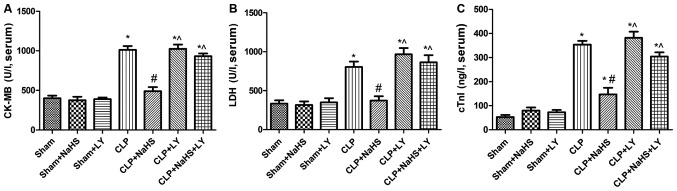
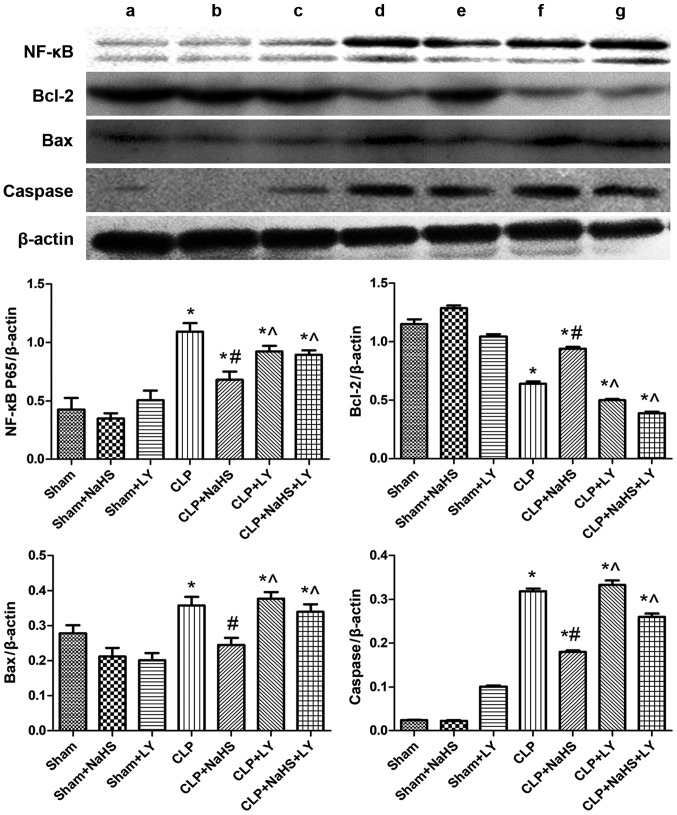
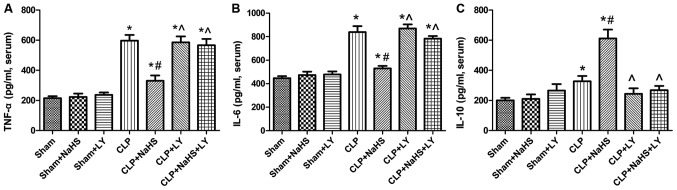
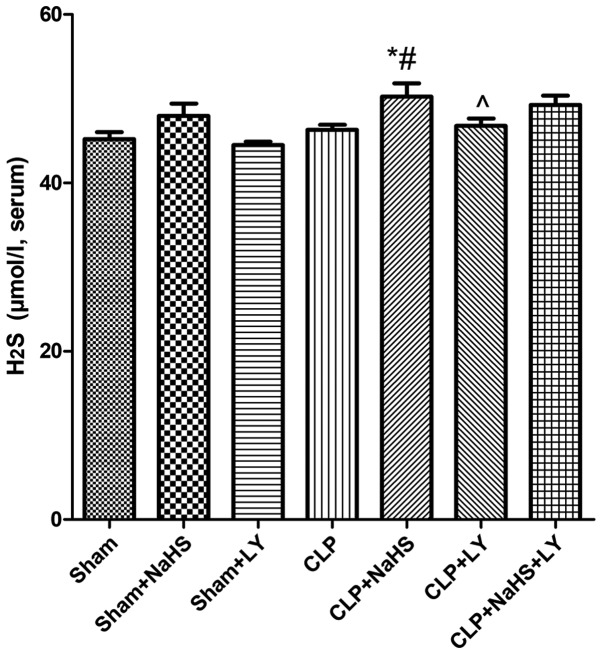
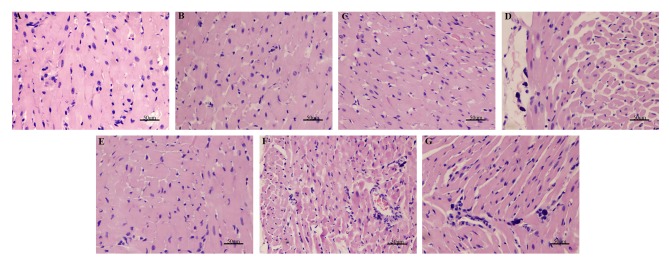
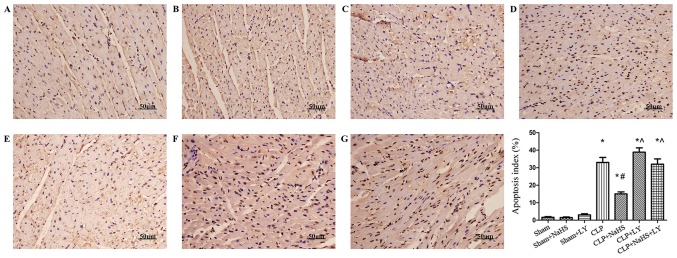
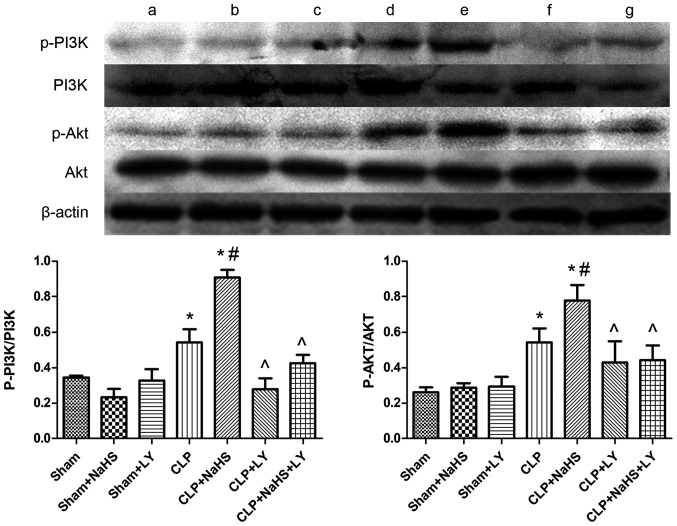
The heart is the most vulnerable target organ in sepsis, and it has been previously reported that hydrogen sulfide (HS) has a protective role in heart dysfunction caused by sepsis. Additionally, studies have demonstrated that the phosphatidylinositol-3-kinase (PI3K)/protein kinase B (Akt) signaling pathway has a protective function during sepsis. However, the potential association between HS and PI3K/Akt in sepsis-induced cardiac dysfunction is unclear. Therefore, the PI3K inhibitor LY294002 was used to investigate the role of PI3K/Akt signaling in the protective effects of HS during sepsis-induced myocardial injury. A rat sepsis model was established using cecal ligation and puncture (CLP) surgery. Sodium hydrosulfide, a HS donor, was administered intraperitoneally (8.9 µmol/kg), and serum myocardial enzyme levels, inflammatory cytokine levels, cardiac histology and cardiomyocyte apoptosis were assessed to determine the extent of myocardial damage. The results demonstrated that exogenous HS reduced serum myocardial enzyme levels, decreased the levels of the inflammatory factors tumor necrosis factor (TNF)-α and interleukin (IL)-6, and increased the level of anti-inflammatory IL-10 following CLP. Staining of histological sections demonstrated that myocardial damage and cardiomyocyte apoptosis were alleviated by the administration of exogenous HS. Western blot analysis was used to detect phosphorylated and total PI3K and Akt levels, as well as NF-κB, B-cell lymphoma-2, Bcl-2-associated X protein (Bax) and caspase levels, and the results demonstrated that HS significantly increased PI3K and Akt phosphorylation. This indicated that the PI3K/Akt signaling pathway was activated by HS. Additionally, HS reduced Bax and caspase expression, indicating that apoptosis was inhibited, and decreased NF-κB levels, indicating that inflammation was reduced. Furthermore, the PI3K inhibitor LY294002 eliminated the protective effects of HS. In conclusion, the results of the current study suggest that exogenous HS activates PI3K/Akt signaling to attenuate myocardial damage in sepsis.
心脏是脓毒症中最易受损的靶器官,此前有报道称硫化氢(HS)对脓毒症所致心脏功能障碍具有保护作用。此外,研究表明磷脂酰肌醇-3-激酶(PI3K)/蛋白激酶B(Akt)信号通路在脓毒症期间具有保护功能。然而,HS与PI3K/Akt在脓毒症诱导的心脏功能障碍中的潜在关联尚不清楚。因此,使用PI3K抑制剂LY294002来研究PI3K/Akt信号在HS对脓毒症诱导的心肌损伤的保护作用中的作用。采用盲肠结扎和穿刺(CLP)手术建立大鼠脓毒症模型。腹腔注射HS供体氢硫化钠(8.9 µmol/kg),并评估血清心肌酶水平、炎性细胞因子水平、心脏组织学和心肌细胞凋亡情况,以确定心肌损伤程度。结果表明,外源性HS降低了CLP后的血清心肌酶水平,降低了炎性因子肿瘤坏死因子(TNF)-α和白细胞介素(IL)-6的水平,并提高了抗炎性IL-10的水平。组织学切片染色显示,外源性HS给药减轻了心肌损伤和心肌细胞凋亡。采用蛋白质印迹分析检测磷酸化和总PI3K、Akt水平以及核因子κB(NF-κB)、B细胞淋巴瘤-2(Bcl-2)、Bcl-2相关X蛋白(Bax)和半胱天冬酶水平,结果表明HS显著增加了PI3K和Akt的磷酸化。这表明PI3K/Akt信号通路被HS激活。此外,HS降低了Bax和半胱天冬酶表达,表明细胞凋亡受到抑制,并且降低了NF-κB水平,表明炎症减轻。此外,PI3K抑制剂LY294002消除了HS的保护作用。总之,本研究结果表明,外源性HS激活PI3K/Akt信号通路以减轻脓毒症中的心肌损伤。