Vega-Páez J David, Rivas Ricardo E, Dussán-Garzón Jenny
Microbiological Research Center (CIMIC), Department of Biological Sciences, Universidad de Los Andes, Bogotá 111711, Colombia.
Department of Chemistry, Universidad de Los Andes, Bogotá 111711, Colombia.
Materials (Basel). 2019 Apr 19;12(8):1296. doi: 10.3390/ma12081296.
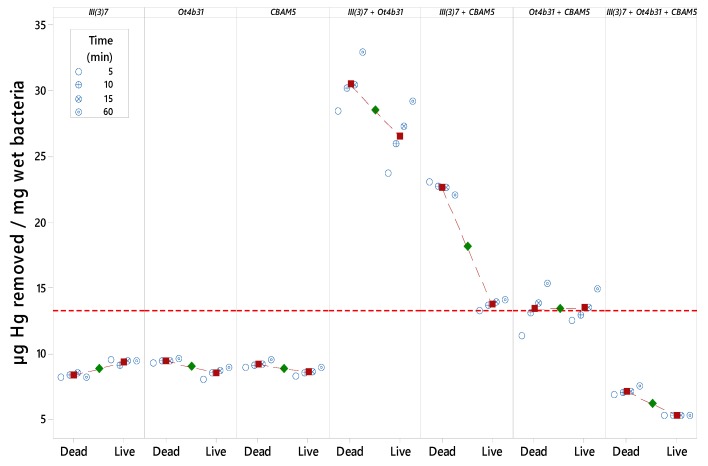
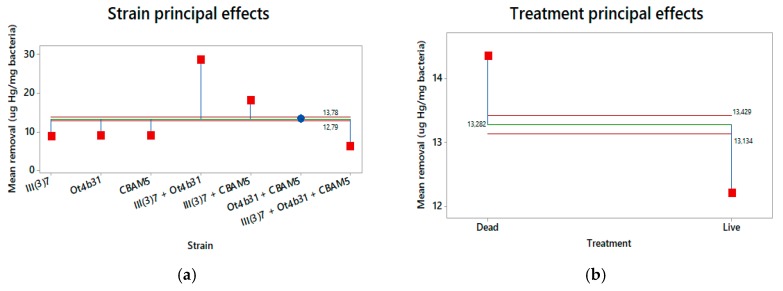
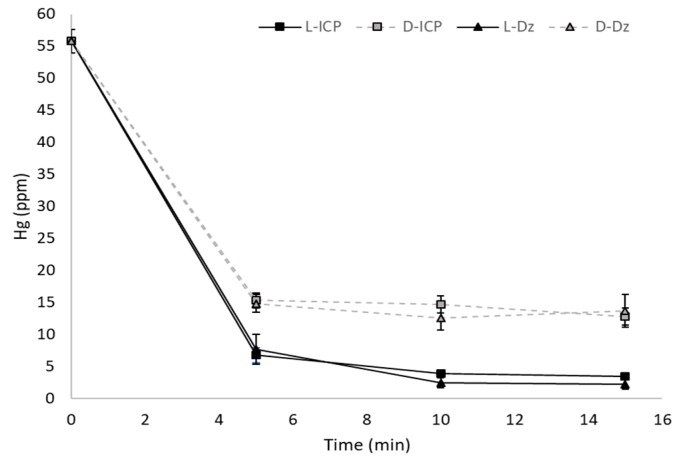
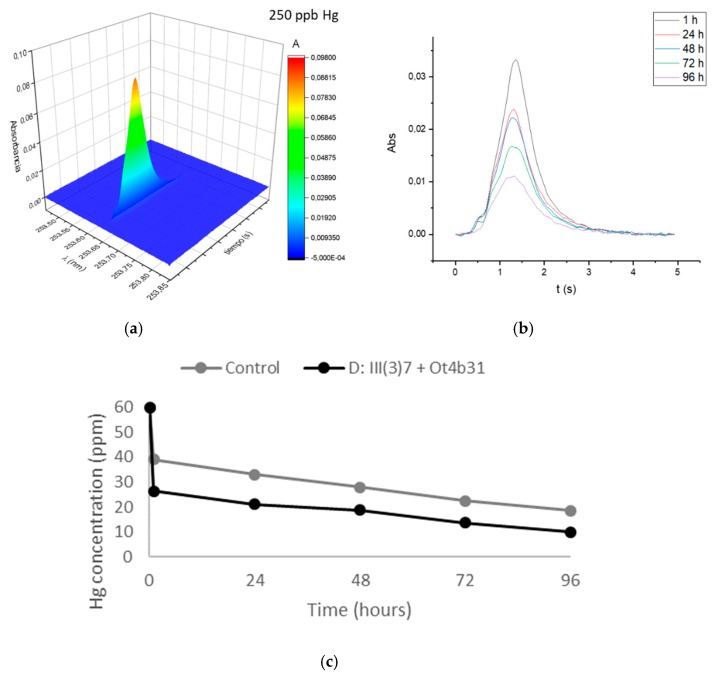
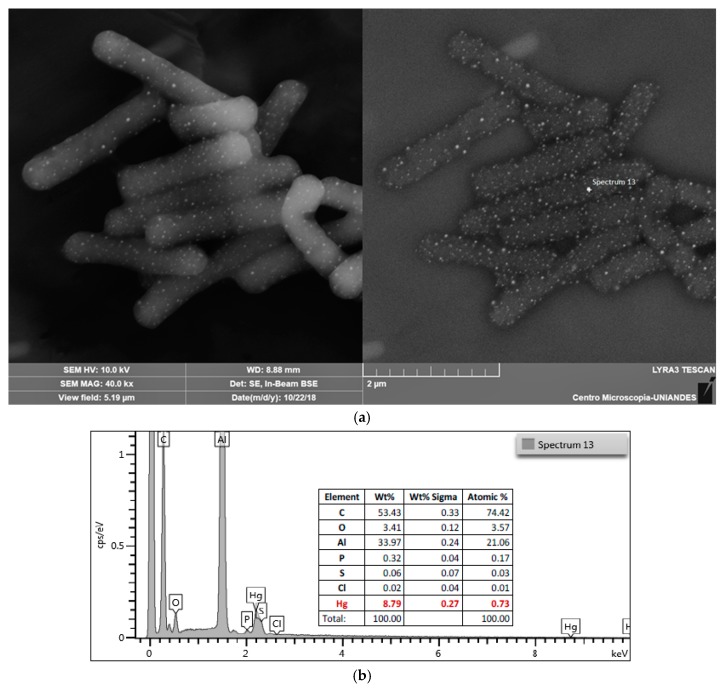
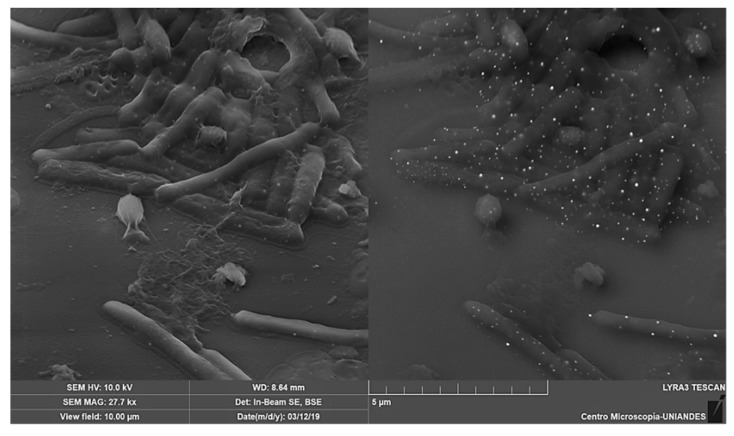
Mercury (Hg) is a toxic metal frequently used in illegal and artisanal extraction of gold and silver which makes it a cause of environmental poisoning. Since biosorption of other heavy metals has been reported for several strains, this study investigates Hg removal. Three strains previously reported as metal tolerant (CBAM5, Ot4b31, and III(3)7) were assessed with mercury chloride (HgCl). Bacteria were characterized by scanning electron microscopy coupled with energy dispersive spectroscopy (EDS-SEM). Sorption was evaluated in live and dead bacterial biomass by free and immobilized cells assays. Hg quantification was achieved through spectrophotometry at 508 nm by reaction of Hg supernatants with dithizone prepared in Triton X-114 and by graphite furnace atomic absorption spectroscopy (GF-AAS). Bacteria grew up to 60 ppm of HgCl. Non-immobilized dead cell mixture of strains III(3)7 and Ot4b31 showed a maximum sorption efficiency of 28.4 µg Hg/mg bacteria during the first 5 min of contact with HgCl, removing over 95% of Hg. This process was escalated in a semi-batch bubbling fluidized bed reactor (BFB) using rice husk as the immobilization matrix leading to a similar level of efficiency. EDS-SEM analysis showed that all strains can adsorb Hg as particles of nanometric scale that can be related to the presence of S-layer metal binding proteins as shown in previous studies. These results suggest that could be used as a novel biological method of mercury removal from polluted wastewater.
汞(Hg)是一种有毒金属,常用于非法和手工金矿及银矿开采,这使其成为环境中毒的一个原因。由于已有报道称几种菌株对其他重金属具有生物吸附作用,本研究对汞的去除进行了调查。使用氯化汞(HgCl)对先前报道的三种耐金属菌株(CBAM5、Ot4b31和III(3)7)进行了评估。通过扫描电子显微镜结合能量色散光谱(EDS-SEM)对细菌进行了表征。通过游离细胞和固定化细胞试验评估了活细菌和死细菌生物量中的吸附情况。通过Hg上清液与在Triton X-114中制备的双硫腙反应,在508 nm处进行分光光度法测定,并通过石墨炉原子吸收光谱法(GF-AAS)实现Hg定量。细菌在高达60 ppm的HgCl中生长。菌株III(3)7和Ot4b31的非固定化死细胞混合物在与HgCl接触的前5分钟内显示出最大吸附效率为28.4 µg Hg/mg细菌,去除了超过95%的Hg。在以稻壳为固定化基质的半间歇鼓泡流化床反应器(BFB)中,这一过程的效率得到了提高,达到了类似的水平。EDS-SEM分析表明,所有菌株都能吸附纳米级颗粒形式的Hg这可能与先前研究中显示的S层金属结合蛋白的存在有关。这些结果表明,这可以用作从污染废水中去除汞 的一种新型生物方法。