Bustos María Camila, Ibarra Humberto, Dussán Jenny
Microbiological Research Center (CIMIC), Department of Biological Sciences, Universidad de los Andes, Bogotá 111711, Colombia.
Microscopy Center, Universidad de los Andes, Bogotá 111711, Colombia.
Materials (Basel). 2018 Sep 2;11(9):1587. doi: 10.3390/ma11091587.
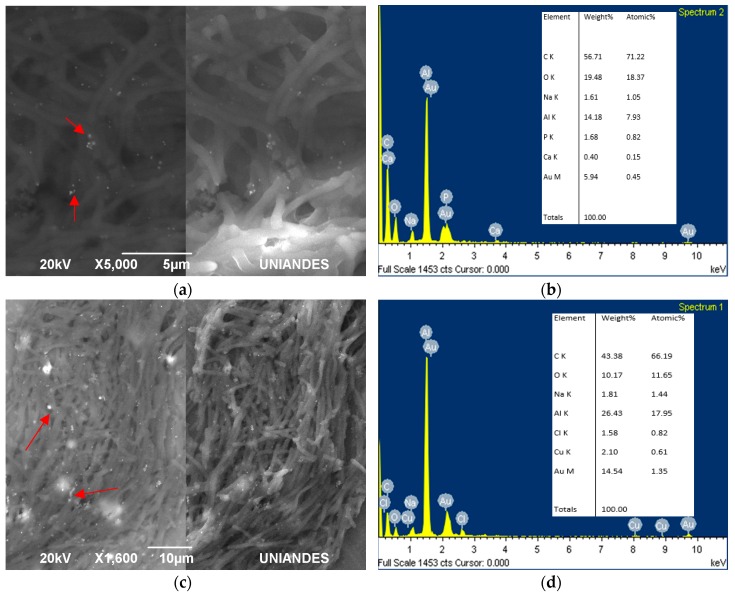
Power struggles surrounding the increasing economic development of gold mining give rise to severe environmental and social problems. Two new strains of were isolated from an area of active alluvial gold mining exploitation at El Bagre, Antioquia. The absorption capacity of these strains and some of the Microbiological Research Center (CIMIC) collection (CBAM5, OT4b.31, III(3)7) were evaluated by spectrophotometry according to a calibration gold curve of HAuCl₄ with concentrations between 0 µg/mL and 100 µg/mL. Bioassays with living biomass were carried out with an initial gold concentration of 60 µg/mL. Their sorption capacity was evident, reaching percentages of gold removal between 25% and 85% in the first 2 h and 75% to 95% after 48 h. Biosynthesis of possible gold nanoparticles (AuNPs) in assays with living biomass was also observed. Metal sorption was evaluated using scanning electron microscopy and energy-dispersive X-ray spectroscopy (EDS) analysis. The sorption and fabrication capacity exhibited by the evaluated strains of converts this microorganism into a potential alternative for biomining processes, especially those related to gold extraction.
围绕金矿开采不断增长的经济发展所产生的权力斗争引发了严重的环境和社会问题。从安蒂奥基亚省埃尔巴格雷一处活跃的砂金开采区分离出了两种新菌株。根据浓度在0 µg/mL至100 µg/mL之间的氯金酸校准金曲线,通过分光光度法评估了这些菌株以及微生物研究中心(CIMIC)收集的一些菌株(CBAM5、OT4b.31、III(3)7)的吸收能力。使用初始金浓度为60 µg/mL的活生物质进行生物测定。它们的吸附能力很明显,在最初2小时内金去除率达到25%至85%,48小时后达到75%至95%。在活生物质测定中还观察到了可能的金纳米颗粒(AuNPs)的生物合成。使用扫描电子显微镜和能量色散X射线光谱(EDS)分析评估了金属吸附。所评估的菌株表现出的吸附和制造能力使这种微生物成为生物采矿过程的潜在替代方案,特别是那些与金提取相关的过程。