College of Veterinary Medicine and Biomedical Science, Texas A&M University, College Station, TX, 77843-4475, USA.
BMC Med Res Methodol. 2019 Apr 23;19(1):82. doi: 10.1186/s12874-019-0720-1.
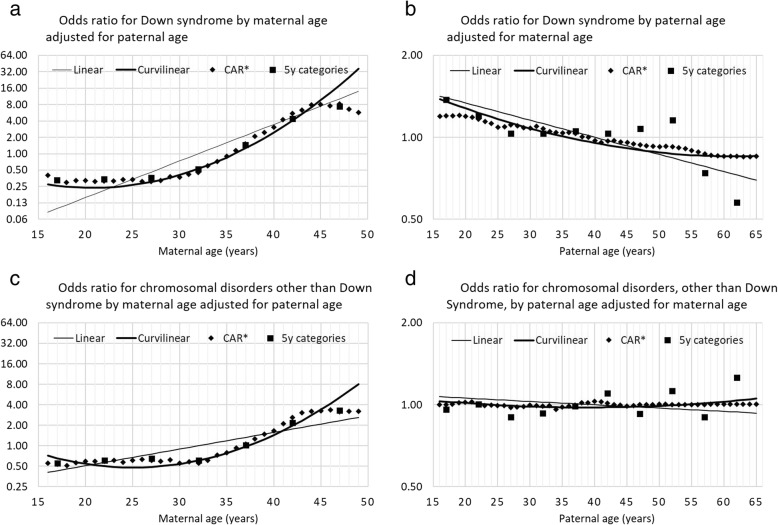
Multiple neonatal and pediatric disorders have been linked to older paternal ages. Combining these findings with the evidence that many men are having children at much later ages generates considerable public health concern. The risk of paternal age has been difficult to estimate and interpret because children often have parents whose ages are similar and likely to be confounded. Epidemiologic studies often model the conditional effects of paternal age using regression models that typically treat maternal age as linear, curvilinear or as age-band categories. Each of these approaches has limitations. As an alternative, the current study measures age to the nearest year, and fits a Bayesian model in which each parent's age is given a conditional autoregressive prior (CAR).
Data containing approximately 12,000,000 birth records were obtained from the United States Natality database for the years 2014 to 2016. Date were cross-tabulated for maternal ages 15-49 years and for paternal ages 15-65 years. A Bayesian logistic model was implemented using conditional autoregressive priors for both maternal and paternal ages modeled separately and jointly for both Down syndrome and chromosomal disorders other than Down syndrome.
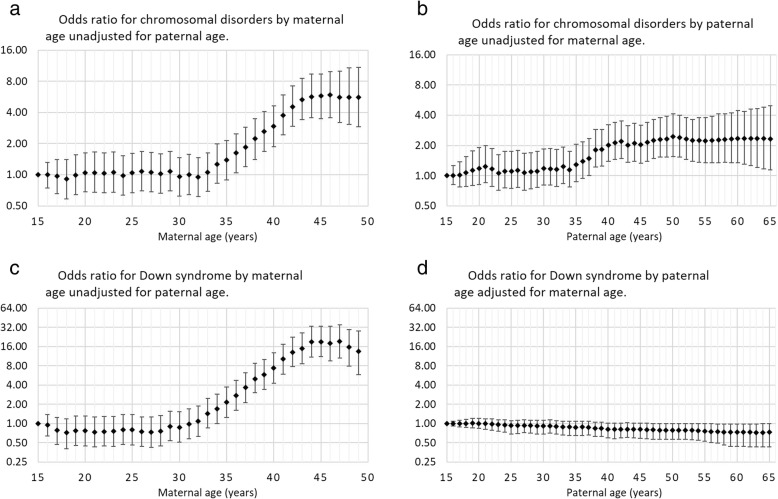
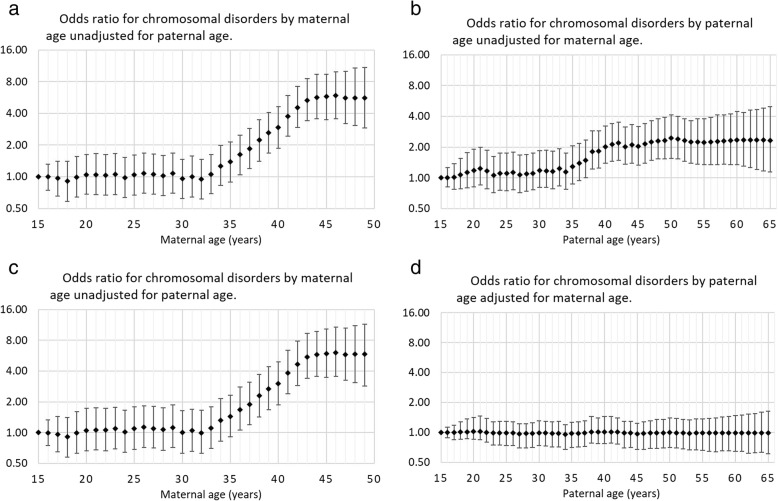
Models with maternal and paternal ages given CAR priors were judged to be better fitting than traditional models. For Down syndrome, the approach attributed a very large risk to advancing maternal age with the effect of advancing paternal age having a very small sparing effect on birth prevalence. Maternal age was also related to the birth prevalence of chromosomal disorders other than Down syndrome while paternal age was not.
Advancing paternal age was not associated with an increase in risk for either Down syndrome or chromosomal disorders other than Down syndrome.
许多新生儿和儿科疾病都与父亲年龄较大有关。将这些发现与许多男性晚育的证据结合起来,引起了相当大的公共卫生关注。由于孩子的父母年龄往往相似,且可能存在混杂因素,因此很难估计和解释父亲年龄的风险。流行病学研究通常使用回归模型来模拟父亲年龄的条件效应,这些模型通常将母亲年龄视为线性、曲线或年龄带类别。这些方法都有其局限性。作为替代方法,本研究以最近的年份测量年龄,并拟合贝叶斯模型,其中每个父母的年龄都有条件自回归先验(CAR)。
从美国出生率数据库中获取了包含大约 1200 万份出生记录的数据集,用于 2014 年至 2016 年。将母亲年龄为 15-49 岁和父亲年龄为 15-65 岁的数据进行交叉制表。使用条件自回归先验对母亲和父亲年龄分别进行贝叶斯逻辑模型拟合,并分别和共同对唐氏综合征和唐氏综合征以外的染色体疾病进行拟合。
与传统模型相比,给予母亲和父亲年龄 CAR 先验的模型被认为更适合。对于唐氏综合征,该方法认为母亲年龄的增加与非常大的风险相关,而父亲年龄的增加对出生患病率的影响非常小。母亲年龄也与唐氏综合征以外的染色体疾病的出生患病率有关,而父亲年龄则没有。
父亲年龄的增加与唐氏综合征或唐氏综合征以外的染色体疾病的风险增加无关。