
体力活动对 HIV/AIDS 患者免疫功能、骨密度和生活质量的影响:系统评价与荟萃分析。
Impact of physical exercises on immune function, bone mineral density, and quality of life in people living with HIV/AIDS: a systematic review with meta-analysis.
机构信息
Department of Medical Rehabilitation, Faculty of Health Sciences, University of Nigeria, Enugu Campus, Enugu, Nigeria.
Clinical Trial Consortium University of Nigeria, Nsukka, Nigeria.
出版信息
BMC Infect Dis. 2019 Apr 24;19(1):340. doi: 10.1186/s12879-019-3916-4.
BACKGROUND
Compromised immune function, associated with human immune deficiency virus(HIV) infection, is improved by antiretroviral therapy(ART) which also decreases bone mineral density(BMD), and possibly the quality of life(QoL). However, physical(aerobic/resistance) exercises, were reported to induce reverse effects in uninfected individuals and were appraised in the literature for evidence of similar benefits in people living with HIV/AIDS(PLWHA). The main study objective was to evaluate the impact of physical (aerobic and resistance) exercises on CD count, BMD and QoL in PLWHA.
METHODS
A systematic review was conducted using the Cochrane Collaboration protocol. Searching databases, up to June 2017, only randomized control trials investigating the effects of either aerobic, resistance or a combination of both exercise types with a control/other intervention(s) for a period of at least 4 weeks among adults living with HIV, were included. Two independent reviewers determined the eligibility of the studies. Data were extracted and risk of bias(ROB) was assessed with the Cochrane Collaboration ROB tool. Meta-analyses were conducted using random effect models using the Review Manager(RevMan) computer software.
RESULTS
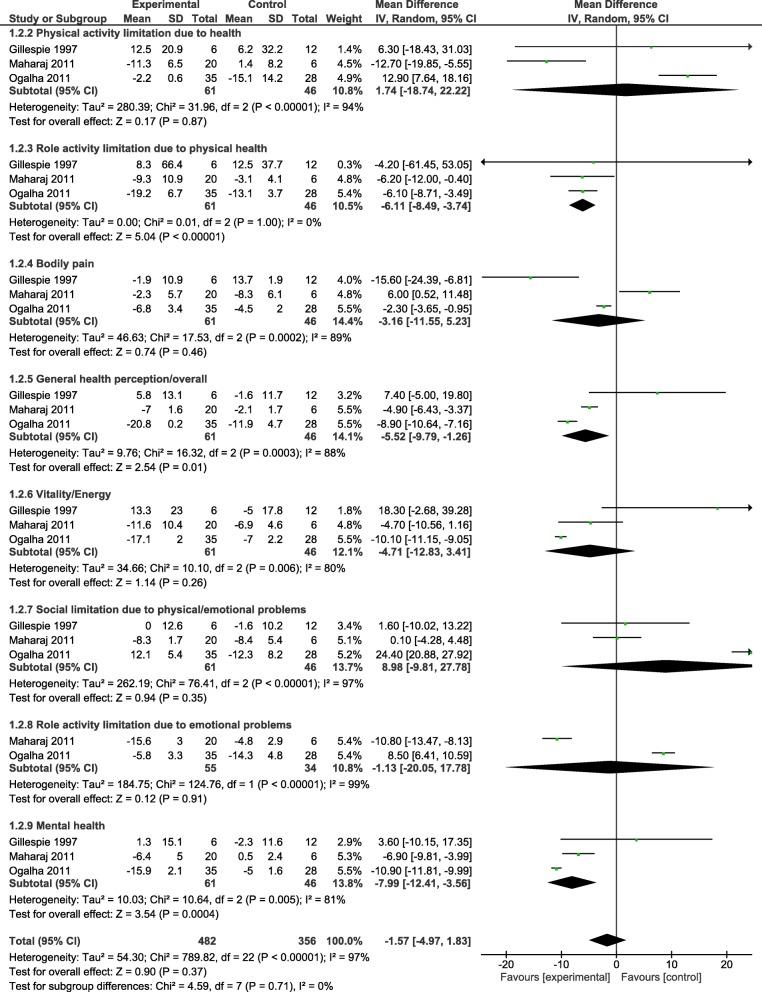
Nineteen studies met inclusion criteria(n = 491 participants at study completion) comprising male and female with age range 22-66 years. Two meta-analyses across 13 sub-group comparisons were performed. However, there were no RCTs on the impact of physical exercises on BMD in PLWHA. The result showed no significant change in CD count unlike a significant effect of 5.04 point(95%CI:-8.49,-3.74,p = 0.00001) for role activity limitation due to physical health(QoL sub-domain). Overall, the GRADE evidence for this review was of moderate quality.
CONCLUSIONS
There was evidence that engaging in moderate intensity aerobic exercises (55-85% Maximum heart rate-MHR), for 30-60 min, two to five times/week for 6-24 weeks significantly improves role activity limitation due to physical health problems, otherwise physical(aerobic or/and resistance) exercises have no significant effects on CD4 count and other domains of QoL. Also, there is lack of evidence on the impact of exercises on BMD in PLWHA due to the paucity of RCTs. The moderate grade evidence for this review suggests that further research may likely have an important impact on our confidence in the estimate of effects and may change the estimate.
背景
人类免疫缺陷病毒(HIV)感染导致免疫功能受损,抗逆转录病毒疗法(ART)可改善这种情况,同时还会降低骨密度(BMD),并可能降低生活质量(QoL)。然而,有报道称,有氧运动和抗阻力运动可在未感染人群中产生逆转作用,文献中也评估了这些运动对 HIV/AIDS 患者(PLWHA)的类似益处。本主要研究目的是评估有氧运动(有氧和抗阻力)和运动对 PLWHA 的 CD 计数、BMD 和 QoL 的影响。
方法
采用 Cochrane 协作组方案进行系统评价。检索数据库,截至 2017 年 6 月,仅纳入了至少持续 4 周、针对成年人 HIV 感染者的有氧、抗阻力或两者结合运动类型与对照/其他干预措施的随机对照试验,同时纳入了评估单一或联合运动对 CD 计数、BMD 和 QoL 影响的研究。两名独立审查员确定了研究的合格性。使用 Cochrane 协作组 ROB 工具提取数据并评估偏倚风险(ROB)。使用 Review Manager(RevMan)计算机软件进行随机效应模型的荟萃分析。
结果
纳入了 19 项研究(研究完成时共有 491 名参与者),包括男性和女性,年龄 22-66 岁。对 13 项亚组比较进行了 2 项荟萃分析。然而,目前尚无 RCT 研究评估运动对 PLWHA 骨密度的影响。结果显示,CD 计数无显著变化,而身体状况导致的角色活动受限(QoL 亚领域)的 5.04 分(95%CI:-8.49,-3.74,p=0.00001)的影响具有统计学意义。总的来说,本研究的 GRADE 证据质量为中等。
结论
有证据表明,中等强度的有氧运动(最大心率的 55-85%),每周 2-5 次,每次 30-60 分钟,持续 6-24 周,可显著改善身体状况导致的角色活动受限,否则,有氧运动(有氧或/和抗阻力)对 CD4 计数和 QoL 的其他领域没有显著影响。此外,由于 RCT 较少,目前尚无运动对 PLWHA 骨密度影响的证据。本研究的中等质量证据表明,进一步的研究可能会对我们对影响估计的信心产生重要影响,并可能改变估计。

 Zotero 插件