Infectious Diseases Research Collaboration, 2C Nakasero Hill Road, Kampala, Uganda.
Makerere University College of Health Sciences, Kampala, Uganda.
Malar J. 2019 Apr 23;18(1):144. doi: 10.1186/s12936-019-2779-x.
Malaria in pregnancy is a major public health challenge, but its risk factors remain poorly understood in some settings. This study assessed the association between household and maternal characteristics and malaria among pregnant women in a high transmission area of Uganda.
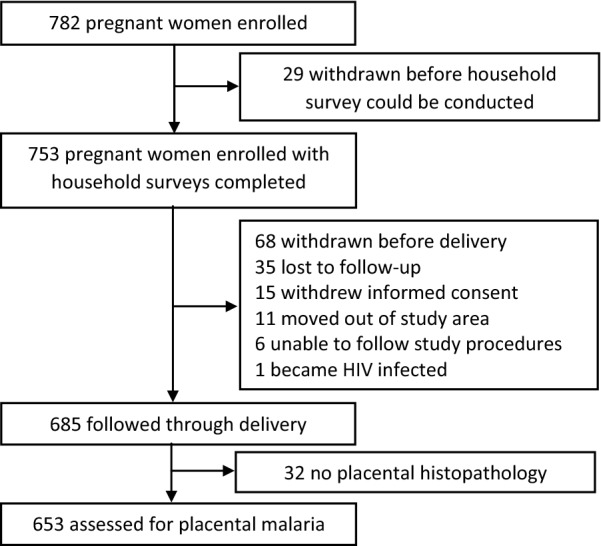
A nested prospective study was conducted between 6th September 2016 and 5th December 2017 in Busia district. 782 HIV uninfected women were enrolled in the parent study with convenience sampling. Socioeconomic and house construction data were collected via a household survey after enrolment. Homes were classified as modern (plaster or cement walls, metal or wooden roof and closed eaves) or traditional (all other homes). Maternal and household risk factors were evaluated for three outcomes: (1) malaria parasitaemia at enrolment, measured by thick blood smear and qPCR, (2) malaria parasitaemia during pregnancy following initiation of IPTp, measured by thick blood smear and qPCR and (3) placental malaria measured by histopathology.
A total of 753 of 782 women were included in the analysis. Most women had no or primary education (75%) and lived in traditional houses (77%). At enrolment, microscopic or sub-microscopic parasitaemia was associated with house type (traditional versus modern: adjusted risk ratio (aRR) 1.29, 95% confidence intervals 1.15-1.45, p < 0.001), level of education (primary or no education versus O-level or beyond: aRR 1.13, 95% confidence interval 1.02-1.24, p = 0.02), and gravidity (primigravida versus multigravida: aRR 1.10, 95% confidence interval 1.02-1.18, p = 0.009). After initiation of IPTp, microscopic or sub-microscopic parasitaemia was associated with wealth index (poorest versus least poor: aRR 1.24, 95% CI 1.10-1.39, p < 0.001), house type (aRR 1.14, 95% CI 1.01-1.28, p = 0.03), education level (aRR 1.19, 95% CI 1.06-1.34, p = 0.002) and gravidity (aRR 1.32, 95% CI 1.20-1.45, p < 0.001). Placental malaria was associated with gravidity (aRR 2.87, 95% CI 2.39-3.45, p < 0.001), but not with household characteristics.
In an area of high malaria transmission, primigravid women and those belonging to the poorest households, living in traditional homes and with the least education had the greatest risk of malaria during pregnancy.
妊娠疟疾是一个主要的公共卫生挑战,但在某些环境中,其风险因素仍了解甚少。本研究评估了乌干达一个高传播地区孕妇中家庭和产妇特征与疟疾之间的关系。
2016 年 9 月 6 日至 2017 年 12 月 5 日在布西亚区进行了一项嵌套前瞻性研究。在母研究中,通过方便抽样招募了 782 名未感染艾滋病毒的妇女。在登记后,通过家庭调查收集了社会经济和房屋建筑数据。房屋被分类为现代(石膏或水泥墙、金属或木制屋顶和封闭的屋檐)或传统(所有其他房屋)。评估了产妇和家庭的危险因素,以评估以下三个结局:(1)登记时的疟疾寄生虫血症,通过厚血涂片和 qPCR 测量;(2)启动 IPTp 后妊娠期间的疟疾寄生虫血症,通过厚血涂片和 qPCR 测量;(3)胎盘疟疾通过组织病理学测量。
共有 782 名妇女中的 753 名纳入分析。大多数妇女没有或只有小学教育(75%),居住在传统房屋中(77%)。在登记时,显微镜或亚显微镜寄生虫血症与房屋类型(传统与现代:调整后的风险比(aRR)为 1.29,95%置信区间为 1.15-1.45,p<0.001)、教育程度(小学或无教育与 O 级或以上:aRR 为 1.13,95%置信区间为 1.02-1.24,p=0.02)和孕次(初产妇与多产妇:aRR 为 1.10,95%置信区间为 1.02-1.18,p=0.009)相关。在启动 IPTp 后,显微镜或亚显微镜寄生虫血症与财富指数(最贫困与最不贫困:aRR 为 1.24,95%置信区间为 1.10-1.39,p<0.001)、房屋类型(aRR 为 1.14,95%置信区间为 1.01-1.28,p=0.03)、教育程度(aRR 为 1.19,95%置信区间为 1.06-1.34,p=0.002)和孕次(aRR 为 1.32,95%置信区间为 1.20-1.45,p<0.001)相关。胎盘疟疾与孕次(aRR 为 2.87,95%置信区间为 2.39-3.45,p<0.001)相关,但与家庭特征无关。
在疟疾高度传播地区,初产妇和最贫困家庭的妇女、居住在传统房屋且受教育程度最低的妇女,在妊娠期间患疟疾的风险最高。