Martin Jose Ignacio, Atilano Leire, Merino Josu, Gonzalez Igor, Iglesias Gotzon, Areizaga Luis, Bully Paola, Grandes Gonzalo, Andia Isabel
Interventional Sonography, Department of Radiology, Cruces University Hospital, Barakaldo, Spain.
Regenerative Medicine, BioCruces Health Research Institute, Cruces University Hospital, 48903, Barakaldo, Spain.
J Orthop Surg Res. 2019 Apr 23;14(1):109. doi: 10.1186/s13018-019-1153-6.
To determine the efficacy of platelet-rich plasma (PRP) compared to lidocaine as a tenotomy adjuvant for people with elbow tendinopathy.
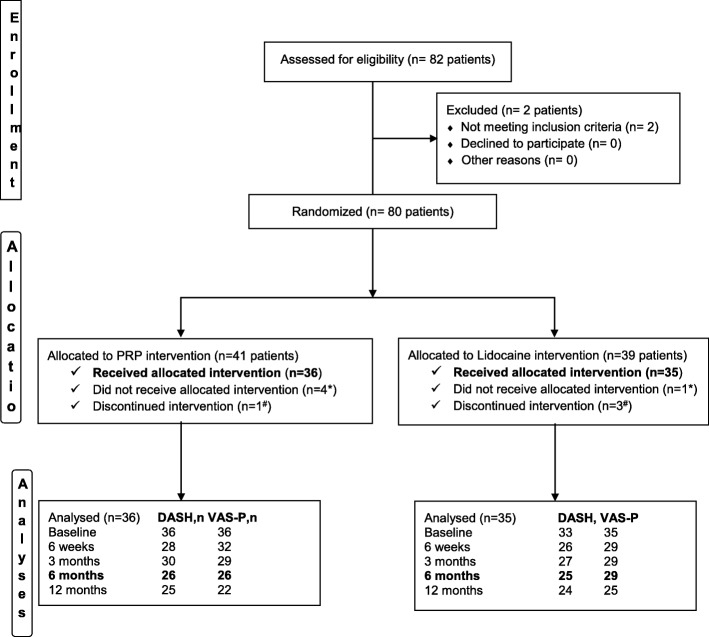
Our study was a parallel-group, double-blind, randomized trial involving 71 patients with recalcitrant elbow tendinopathy who received two sessions of ultrasound-guided tenotomy with either PRP or lidocaine in a tertiary public hospital. The primary end point was the percentage of patients with an improvement exceeding 25% reduction in disability (Spanish version of the Disabilities of the Arm, Shoulder and Hand questionnaires-DASH-E) at 6 and 12 months; the secondary outcome was the percentage of patients exceeding 25% reduction in pain (VAS-P).
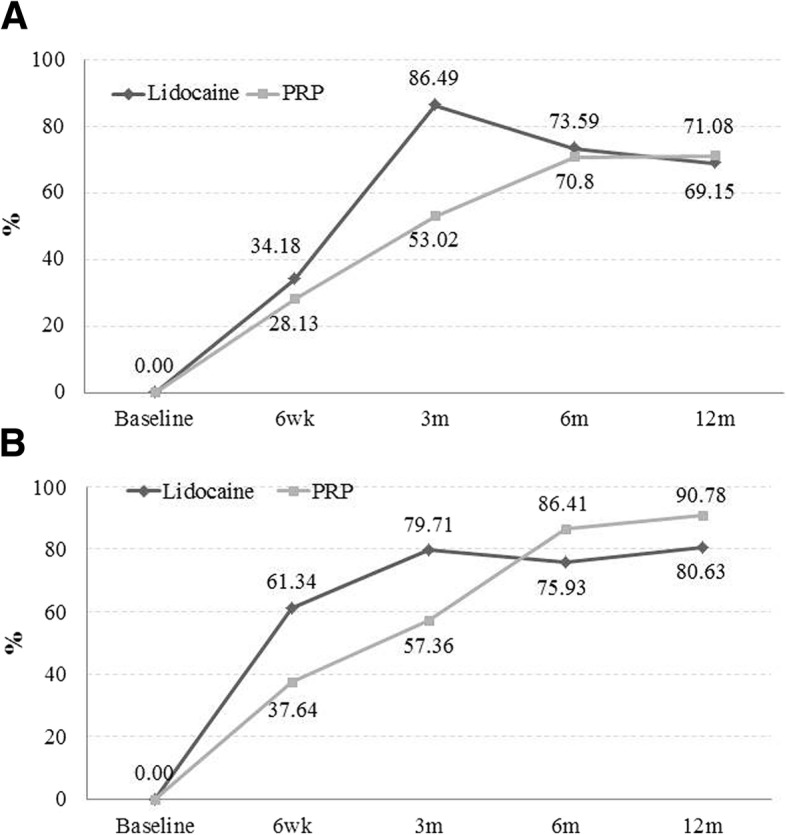
There was no evidence of significant differences in the proportion of patients who experienced clinically relevant improvements. After 6 months, 18 patients (78.59%) in the lidocaine group and 19 patients (73.08%) in the PRP group showed improved function above 25% (unadjusted odds ratio, 0.90; 95% confidence interval [CI], 0.90 (0.17 to 4.60)); 21 patients (72.21%) in the lidocaine group versus 22 patients (84.62%) in the PRP group achieved more than 25% pain reduction (unadjusted odds ratio, 0.48; 95% CI, 0.10 to 2.37). After 12 months, 17 patients (70.83%) in the lidocaine group versus 19 patients (76%) in the PRP group had improved function (unadjusted odds ratio, 0.71; 95% CI, 0.13 to 3.84), and 19 patients (76%) in the lidocaine group versus 20 patients (90.91%) in the PRP group had improved pain above 25% (unadjusted odds ratio, 0.35; 95% CI, 0.06 to 2.51). Hypercholesterolemia and baseline vascularization influenced outcomes. There were no differences between groups in the adjusted odds ratios.
PRP results in similar improvements to those obtained with lidocaine. Selecting patients according to their pretreatment status can improve treatment efficacy.
NCT01945528 , EudraCT 2013-000478-32. Registered 18 August 2013, enrolment of the first participant 10 March 2014.
比较富血小板血浆(PRP)与利多卡因作为肘部肌腱病患者肌腱切断辅助剂的疗效。
我们的研究是一项平行组、双盲、随机试验,纳入了71例难治性肘部肌腱病患者,在一家三级公立医院接受了两次超声引导下的肌腱切断术,分别注射PRP或利多卡因。主要终点是在6个月和12个月时残疾程度降低超过25%(西班牙语版手臂、肩部和手部残疾问卷-DASH-E)的患者百分比;次要结局是疼痛降低超过25%(视觉模拟评分法疼痛评分-VAS-P)的患者百分比。
没有证据表明在经历临床相关改善的患者比例上存在显著差异。6个月后,利多卡因组18例患者(78.59%)和PRP组19例患者(73.08%)的功能改善超过25%(未调整优势比,0.90;95%置信区间[CI],0.90(0.17至4.60));利多卡因组21例患者(72.21%)与PRP组22例患者(84.62%)的疼痛降低超过25%(未调整优势比,0.48;95%CI,0.10至2.37)。12个月后,利多卡因组17例患者(70.83%)与PRP组19例患者(76%)的功能得到改善(未调整优势比,0.71;95%CI,0.13至3.84),利多卡因组19例患者(76%)与PRP组20例患者(90.91%)的疼痛改善超过25%(未调整优势比,0.35;95%CI,0.06至2.51)。高胆固醇血症和基线血管形成影响结局。调整后的优势比在组间无差异。
PRP与利多卡因产生的改善效果相似。根据患者的治疗前状态进行选择可提高治疗效果。
NCT01945528,EudraCT 2013-000478-32。2013年8月18日注册,2014年3月10日招募第一名参与者。