White C Michael, Lee Ji-Young
UConn/Hartford Hospital HOPES Research Group; and Department of Pharmacy Practice, University of Connecticut. Storrs, CT (United States).
Departments of Nutritional Sciences, University of Connecticut. Storrs, CT (United States).
Pharm Pract (Granada). 2019 Jan-Mar;17(1):1350. doi: 10.18549/PharmPract.2019.1.1350. Epub 2019 Mar 4.
Turmeric and its curcumin extract have been evaluated in patients with nonalcoholic fatty liver disease (NAFLD), a common ailment that can lead to irreparable liver damage.
To identify the evidence supporting the use of turmeric or curcumin therapy in NAFLD.
We searched PubMed, EMBASE, and Cochrane Central from the earliest possible date to 12/17/18 including terms for turmeric, curcumin, and NAFLD. We assessed the impact of turmeric or its curcumin extract on alanine transaminase (ALT), aspartate transaminase (AST), and NAFLD severity via ultrasound.
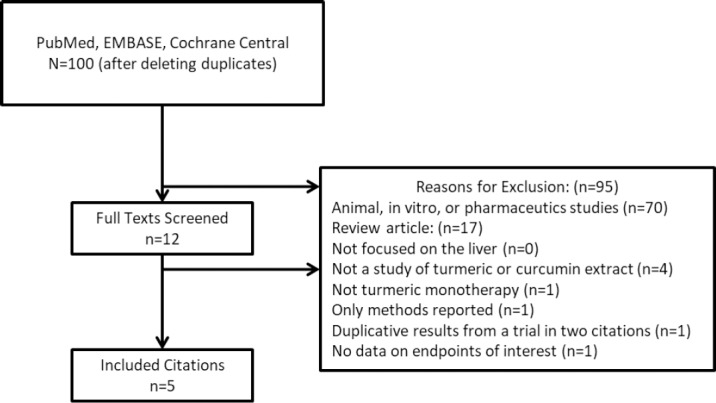
Five trials assessed the comparative efficacy of curcumin/turmeric in NAFLD. One trial was single armed with comparisons only versus baseline and another trial was only available in abstract form. All of the trials had small sample sizes, 4 of 5 trials had limited durations of follow-up, and all trials had methodological limitations that negatively impacted the strength and applicability of evidence. Clinical and methodological heterogeneity precluded statistical pooling. Three of the 4 trials with evaluable data for turmeric or curcumin versus their own baseline demonstrated significant reductions in ALT, AST, and NAFLD severity grade. Two of the 4 placebo controlled trials had significant mean difference reductions in ALT and AST for turmeric or curcumin versus placebo while 2 of 3 of these trials found significant reductions in NAFLD severity grade. Among these trials, only one used turmeric instead of a curcumin extract and this turmeric trial did not demonstrate any differences in ALT, AST, or NAFLD severity between the turmeric and placebo groups.
Curcumin extract is a promising, but not proven, treatment for NAFLD while the role for turmeric is less clear. The general findings are that ALT, AST and NAFLD severity are reduced with the use of curcumin.
姜黄及其姜黄素提取物已在非酒精性脂肪性肝病(NAFLD)患者中进行了评估,NAFLD是一种常见疾病,可导致不可修复的肝损伤。
确定支持在NAFLD中使用姜黄或姜黄素治疗的证据。
我们检索了PubMed、EMBASE和Cochrane Central,检索时间从最早到2018年12月17日,检索词包括姜黄、姜黄素和NAFLD。我们通过超声评估姜黄或其姜黄素提取物对丙氨酸转氨酶(ALT)、天冬氨酸转氨酶(AST)和NAFLD严重程度的影响。
五项试验评估了姜黄素/姜黄在NAFLD中的比较疗效。一项试验为单臂试验,仅与基线进行比较,另一项试验仅以摘要形式提供。所有试验的样本量都很小,五项试验中有四项随访时间有限,所有试验都存在方法学局限性,对证据的强度和适用性产生了负面影响。临床和方法学异质性妨碍了统计合并。在四项对姜黄或姜黄素与自身基线进行可评估数据的试验中,有三项试验显示ALT、AST和NAFLD严重程度分级显著降低。四项安慰剂对照试验中有两项试验显示,姜黄或姜黄素与安慰剂相比,ALT和AST的平均差异显著降低,而这些试验中有三项试验中的两项试验发现NAFLD严重程度分级显著降低。在这些试验中,只有一项试验使用了姜黄而不是姜黄素提取物,并且这项姜黄试验未显示姜黄组和安慰剂组之间在ALT、AST或NAFLD严重程度上有任何差异。
姜黄素提取物是一种有前景但未经证实的NAFLD治疗方法,而姜黄的作用尚不清楚。总体研究结果是,使用姜黄素可降低ALT、AST和NAFLD严重程度。