Khoramian Daryoush, Sistani Soroush, Firouzjah Razzagh Abedi
MSc graduate, independent researcher, Tehran, Iran.
MSc in medical physics, Student Research Committee, Faculty of Medicine, Semnan University of Medical Sciences, Semnan, Iran.
Pol J Radiol. 2019 Jan 23;84:e61-e67. doi: 10.5114/pjr.2019.82743. eCollection 2019.
To assess and compare radiation dose and image quality from non-contrast head and neck computed tomography (CT) examinations from four different multi-detector CT (MDCT) scanners.
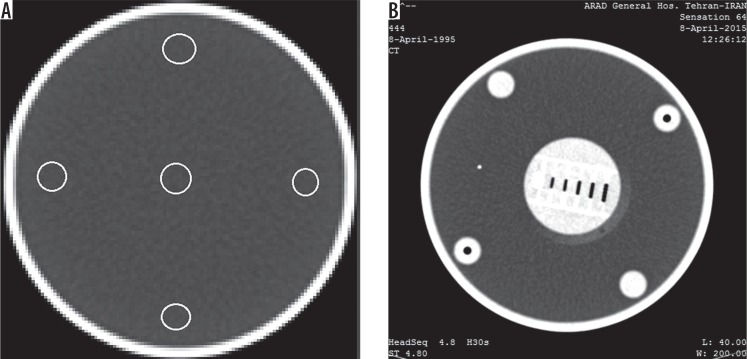
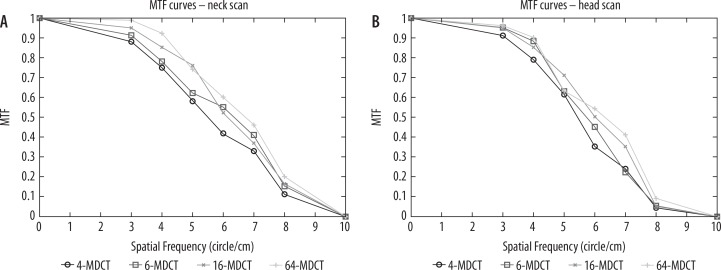
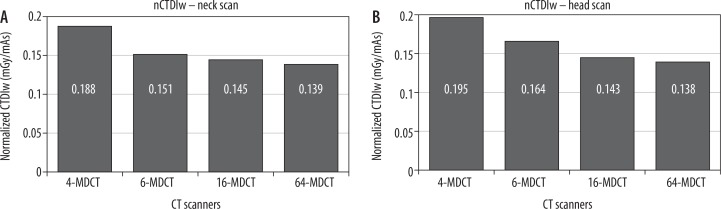
Four CT scanners with different numbers of detector rows including one 4-MDCT, a 6-MDCT, a 16-MDCT, and a 64-MDCT were investigated. Common CT dose descriptors including volumetric CT dose index (CTDIv), dose length product (DLP), and the effective dose (ED), and image quality parameters include image noise, uniformity, and spatial resolution (SR) were estimated for each CT scanner with standard tools and methods. To have a precise comparison between CT scanners and related doses and image quality parameters, the ImPACT Q-factor was used.
Minimum and maximum CTDIv, DLP, and ED in the head scan were 18 ± 3 and 49 ± 4 mGy, 242 ± 28 and 692 ± 173 mGy × cm, 0.46 ± 0.4 and 1.31 ± 0.33 mSv for 16-MDCT and 64-MDCT, respectively. And 16 ± 2 to 27 ± 3, 286 ± 127 to 645 ± 79 and 1.46 ± 0.65 to 3.29 ± 0.40 for neck scan, respectively. The Q-factor in head scan was 2.4, 3.3, 4.4 and 5.6 for 4-MDCT, 6-MDCT, 16-MDCT and 64-MDCT, respectively. The Q-factor in neck scan was 3.4, 4.6, 4.7 and 6.0 for 4-MDCT, 6-MDCT, 16-MDCT and 64-MDCT, respectively.
The results clearly indicate an increasing trend in the Q-factor from 4-MDCT to 64-MDCT units in both head and neck examinations. This increasing trend is due to a better SR and less noise of images taken and/or fewer doses in 64-MDCT.
评估并比较来自四种不同多排螺旋CT(MDCT)扫描仪的非增强头颈部计算机断层扫描(CT)检查的辐射剂量和图像质量。
研究了四台具有不同探测器排数的CT扫描仪,包括一台4排MDCT、一台6排MDCT、一台16排MDCT和一台64排MDCT。使用标准工具和方法,对每台CT扫描仪估算了常见的CT剂量描述指标,包括容积CT剂量指数(CTDIv)、剂量长度乘积(DLP)和有效剂量(ED),以及图像质量参数,包括图像噪声、均匀性和空间分辨率(SR)。为了在CT扫描仪以及相关剂量和图像质量参数之间进行精确比较,使用了ImPACT Q因子。
头部扫描中,16排MDCT和64排MDCT的最小和最大CTDIv、DLP和ED分别为18±3和49±4 mGy、242±28和692±173 mGy×cm、0.46±0.4和1.31±0.33 mSv。颈部扫描中,分别为16±2至27±3、286±127至645±79以及1.46±0.65至3.29±0.40。4排MDCT、6排MDCT、16排MDCT和64排MDCT头部扫描的Q因子分别为2.4、3.3、4.4和5.6。4排MDCT、6排MDCT、16排MDCT和64排MDCT颈部扫描的Q因子分别为3.4、4.6、4.7和6.0。
结果清楚地表明,在头颈部检查中,从4排MDCT到64排MDCT,Q因子呈上升趋势。这种上升趋势归因于64排MDCT拍摄的图像具有更好的空间分辨率、更少的噪声和/或更低的剂量。