Žatkuliaková Veronika, Števík Martin, Vorčák Martin, Sýkora Ján, Trabalková Zuzana, Broocks Gabriel, Meyer Lukas, Fiehler Jens, Zeleňák Kamil
Clinic of Radiology, Jessenius Faculty of Medicine in Martin, Comenius University in Bratislava, Martin University Hospital, Martin, Slovakia.
Department of Diagnostic and Interventional Neuroradiology, University Medical Center Hamburg-Eppendorf, Hamburg, Germany.
Heliyon. 2024 Aug 28;10(17):e37043. doi: 10.1016/j.heliyon.2024.e37043. eCollection 2024 Sep 15.
Medical devices based on X-ray imaging, such as computed tomography, are considered notable sources of artificial radiation. The aim of this study was to compare the computed tomography dose volume index, the dose length product, and the effective dose of the brain non-contrast enhanced examination on two CT scanners to determine the current state in terms of radiation doses, compare doses to the reference values, and possibly optimize the examination.
Data from January 2020 to the second half of 2021 were retrospectively obtained by accessing dose reports from the Picture Archiving and Communication System (PACS). Data were collected and analyzed in Microsoft Excel. The effective dose was estimated using the dose-length product parameter and the normalized conversion factor for a given anatomical region. For statistical analysis, a two-sample -test was used.
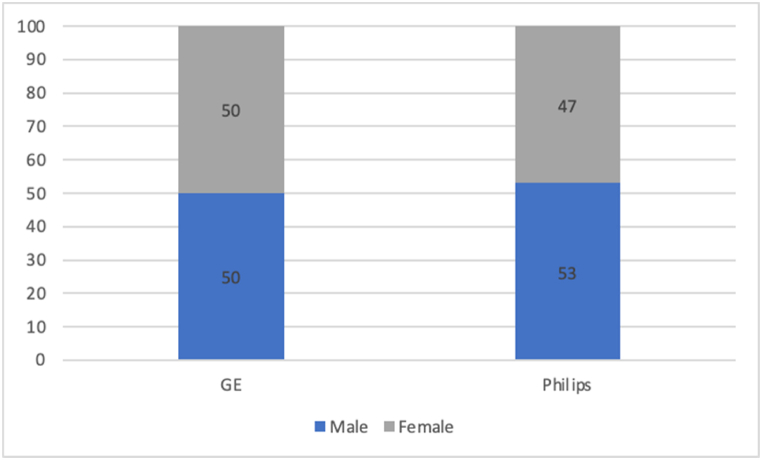
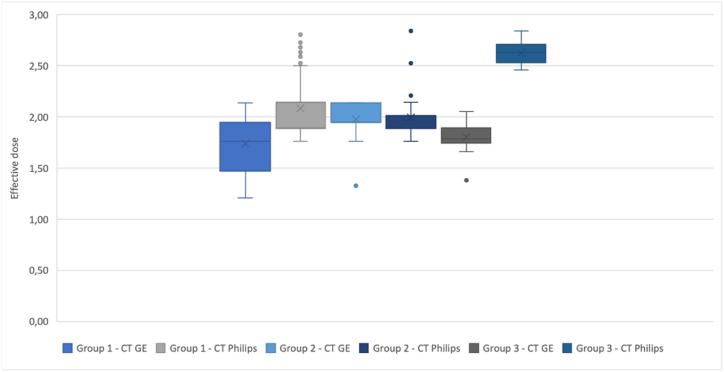
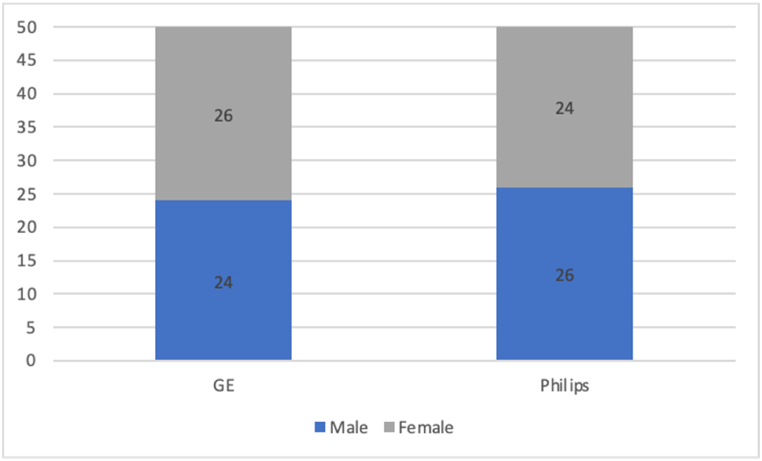
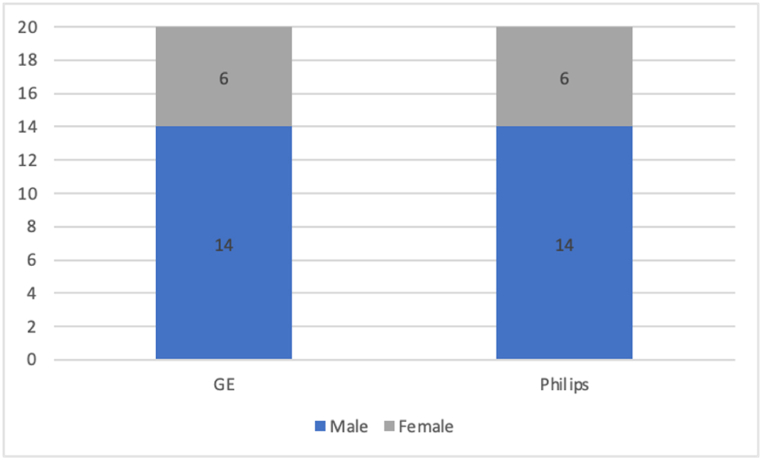
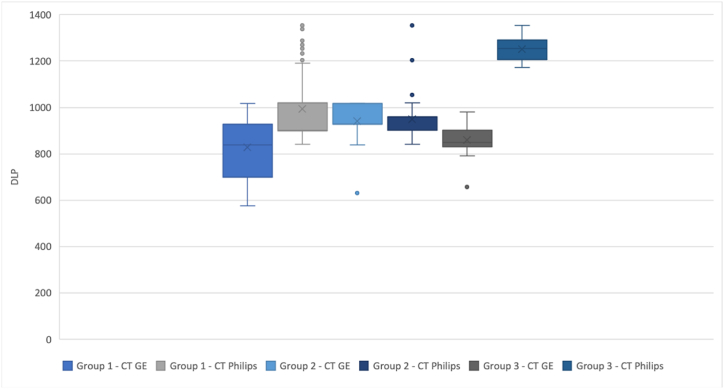
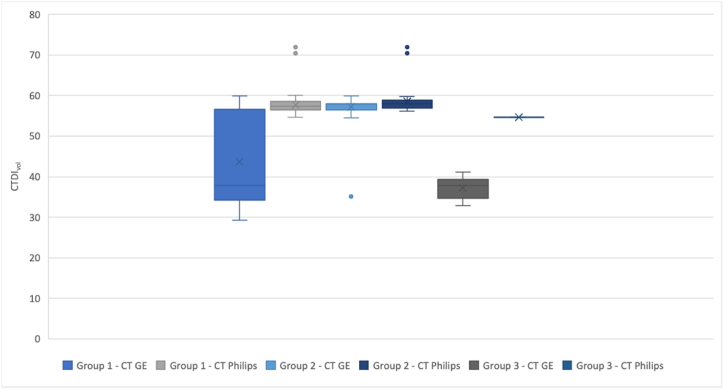
The first data set consists of 200 patients (100 and 100 for older and newer CT scanners) regardless of the scan technique; the average CTDI and DLP for the older CT scanner were 57.61 ± 2.89 mGy and 993.28 ± 146.18 mGy cm, and for the newer CT scanner, 43.66 ± 11.15 mGy and 828.14 ± 130.06 mGy cm. The second data set consists of 100 patients (50 for the older CT scanner and 50 for the newer CT scanner) for a sequential scan; the average CTDI and DLP for the older CT scanner were 58.63 ± 3.33 mGy and 949.42 ± 80.87 mGy.cm, and for the newer CT, 57.25 ± 3.4 mGy and 942.13 ± 73.05 mGy cm. The third data set consists of 40 patients (20 and 20 for older and newer CT scanners) for the helical scan - the average CTDI and DLP for the older CT scanner were 54.6 ± 0 mGy and 1252.2 ± 52.11 mGy.cm, and for the newer CT, 37.18 ± 2.52 mGy and 859.66 ± 72.04 mGy cm. The difference between the older and newer CT scanners in terms of dose reduction was approximately 30 % in favor of the newer scanner for noncontrast enhanced brain examinations performed using the helical scan technique.
A non-contrast enhanced brain examination scanned with newer CT equipment was associated with a lower radiation burden on the patient.
基于X射线成像的医疗设备,如计算机断层扫描,被认为是人工辐射的重要来源。本研究的目的是比较两台CT扫描仪上脑非增强检查的计算机断层扫描剂量体积指数、剂量长度乘积和有效剂量,以确定辐射剂量方面的现状,将剂量与参考值进行比较,并可能优化检查。
通过访问图像存档与通信系统(PACS)的剂量报告,回顾性获取2020年1月至2021年下半年的数据。在Microsoft Excel中收集和分析数据。使用剂量长度乘积参数和给定解剖区域的归一化转换因子估计有效剂量。为进行统计分析,采用双样本t检验。
第一个数据集由200名患者组成(旧CT扫描仪和新CT扫描仪各100名),不考虑扫描技术;旧CT扫描仪的平均CTDI和DLP分别为57.61±2.89 mGy和993.28±146.18 mGy·cm,新CT扫描仪的平均CTDI和DLP分别为43.66±11.15 mGy和828.14±130.06 mGy·cm。第二个数据集由100名患者组成(旧CT扫描仪和新CT扫描仪各50名)进行序列扫描;旧CT扫描仪的平均CTDI和DLP分别为58.63±3.33 mGy和949.42±80.87 mGy·cm,新CT扫描仪的平均CTDI和DLP分别为57.25±3.4 mGy和942.13±73.05 mGy·cm。第三个数据集由40名患者组成(旧CT扫描仪和新CT扫描仪各20名)进行螺旋扫描——旧CT扫描仪的平均CTDI和DLP分别为54.6±0 mGy和1252.2±52.11 mGy·cm,新CT扫描仪的平均CTDI和DLP分别为37.18±2.52 mGy和859.66±72.04 mGy·cm。对于使用螺旋扫描技术进行的脑非增强检查,旧CT扫描仪和新CT扫描仪在剂量降低方面的差异约为30%,有利于新扫描仪。
使用更新的CT设备进行的脑非增强检查对患者的辐射负担较低。