Ganger Michael T, Hiles Rachel, Hallowell Haley, Cooper Lauren, McAllister Nicole, Youngdahl Doug, Alfieri Jeremy, Ewing Sarah J
Department of Biology, Gannon University, Erie, PA, USA.
Department of Botany and Plant Pathology, Purdue University, West Lafayette, IN, USA.
AoB Plants. 2019 Mar 14;11(2):plz012. doi: 10.1093/aobpla/plz012. eCollection 2019 Apr.
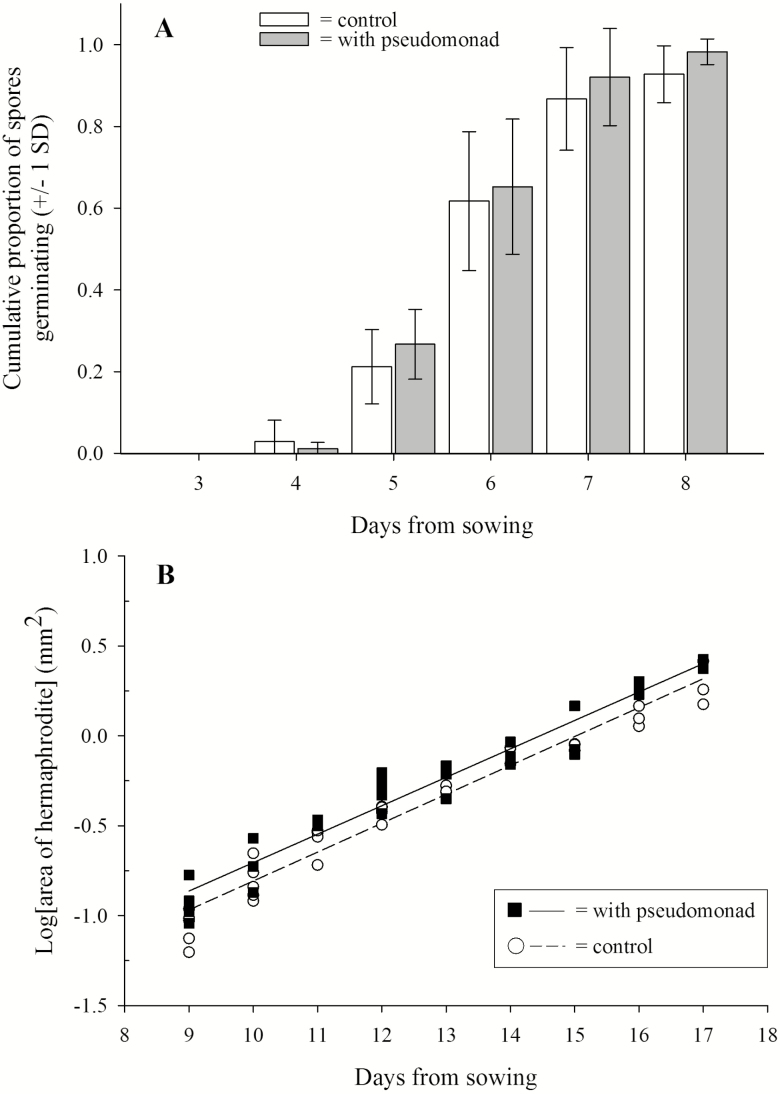
Gametophytes of the fern develop into either hermaphrodites or males. As hermaphrodites develop, they secrete antheridiogen, or A, into the environment, inducing male development in undifferentiated gametophytes. Hermaphrodites are composed of archegonia, antheridia, rhizoids and a notch meristem, while males consist of antheridia and rhizoids. Much of the research on sexual and morphological development concerns gametophytes grown in sterile environments. Using biochemical and molecular techniques we identify a soil bacterium and explore its effects on sexual and rhizoid development. Hermaphrodite and male gametophytes were exposed to this bacterium and the effects on sexual development, rhizoid length and rhizoid number were explored. The bacterium was identified as a pseudomonad, . Gametophytes grown in the presence of the pseudomonad were more likely to develop into hermaphrodites across all gametophyte densities. Across all gametophyte sizes, hermaphrodites had rhizoids that were 2.95× longer in the presence of the pseudomonad while males had rhizoids that were 2.72× longer in the presence of the pseudomonad. Both hermaphrodite and male gametophytes developed fewer rhizoids in the presence of the pseudomonad. Control hermaphrodites produced 1.23× more rhizoids across all gametophyte sizes. For male gametophytes grown in the absence of the pseudomonad, the rate of increase in the number of rhizoids was greater with increasing size in the control than the rate of increase in males grown in the presence of the pseudomonad. The pseudomonad may be acting on gametophyte sexual development via several potential mechanisms: degradation of A, changes in nutrient availability or phytohormone production. The pseudomonad may also increase rhizoid number through production of phytohormones or changes in nutrient availability.
蕨类植物的配子体发育成雌雄同体或雄性。随着雌雄同体的发育,它们会向环境中分泌成雄素(或A),诱导未分化的配子体发育成雄性。雌雄同体由颈卵器、精子器、假根和切口分生组织组成,而雄性则由精子器和假根组成。许多关于性发育和形态发育的研究都涉及在无菌环境中生长的配子体。我们使用生化和分子技术鉴定了一种土壤细菌,并探究了其对性发育和假根发育的影响。将雌雄同体和雄性配子体暴露于这种细菌中,探究其对性发育、假根长度和假根数量的影响。该细菌被鉴定为假单胞菌。在所有配子体密度下,在假单胞菌存在的情况下生长的配子体更有可能发育成雌雄同体。在所有配子体大小中,在假单胞菌存在的情况下,雌雄同体的假根长度长2.95倍,而雄性的假根长度长2.72倍。在假单胞菌存在的情况下,雌雄同体和雄性配子体发育出的假根都较少。在所有配子体大小中,对照雌雄同体产生的假根数量多1.23倍。对于在没有假单胞菌的情况下生长的雄性配子体,对照中随着大小增加假根数量的增加速率比在有假单胞菌存在的情况下生长的雄性的增加速率更大。假单胞菌可能通过几种潜在机制影响配子体的性发育:A的降解、养分可利用性的变化或植物激素的产生。假单胞菌也可能通过植物激素的产生或养分可利用性的变化增加假根数量。