Center for Integrative Genomics and School of Biological Sciences, Georgia Institute of Technology, Atlanta, Georgia, United States of America.
PLoS Genet. 2019 Apr 25;15(4):e1008060. doi: 10.1371/journal.pgen.1008060. eCollection 2019 Apr.
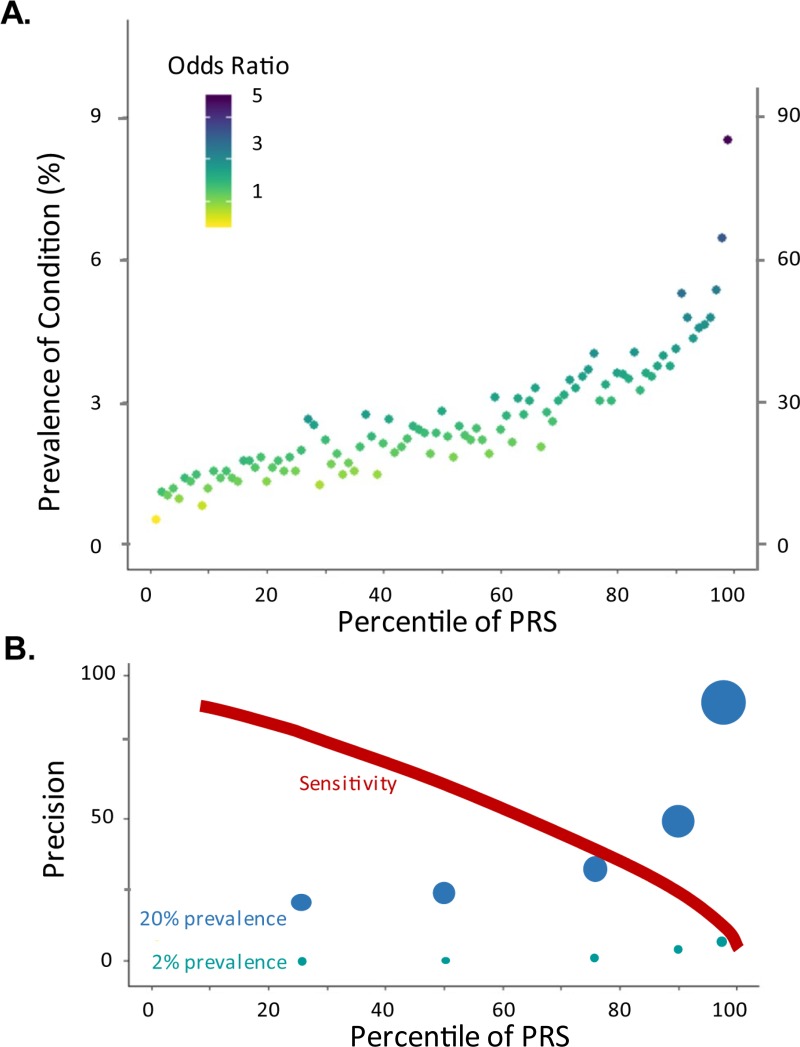
The promise of personalized genomic medicine is that knowledge of a person's gene sequences and activity will facilitate more appropriate medical interventions, particularly drug prescriptions, to reduce the burden of disease. Early successes in oncology and pediatrics have affirmed the power of positive diagnosis and are mostly based on detection of one or a few mutations that drive the specific pathology. However, genetically more complex diseases require the development of polygenic risk scores (PRSs) that have variable accuracy. The rarity of events often means that they have necessarily low precision: many called positives are actually not at risk, and only a fraction of cases are prevented by targeted therapy. In some situations, negative prediction may better define the population at low risk. Here, I review five conditions across a broad spectrum of chronic disease (opioid pain medication, hypertension, type 2 diabetes, major depression, and osteoporotic bone fracture), considering in each case how genetic prediction might be used to target drug prescription. This leads to a call for more research designed to evaluate genetic likelihood of response to therapy and a call for evaluation of PRS, not just in terms of sensitivity and specificity but also with respect to potential clinical efficacy.
个性化基因组医学的承诺是,了解一个人的基因序列和活性将有助于更恰当地进行医疗干预,特别是药物处方,以减轻疾病负担。肿瘤学和儿科学的早期成功肯定了积极诊断的力量,并且主要基于检测驱动特定病理的一个或几个突变。然而,遗传上更复杂的疾病需要开发多基因风险评分 (PRS),这些评分的准确性各不相同。事件的罕见性通常意味着它们的精度必然较低:许多被称为阳性的实际上没有风险,只有一小部分病例可以通过靶向治疗预防。在某些情况下,阴性预测可能更好地定义低风险人群。在这里,我回顾了五种广泛存在的慢性疾病(阿片类止痛药、高血压、2 型糖尿病、重度抑郁症和骨质疏松性骨折),考虑了在每种情况下如何利用遗传预测来靶向药物处方。这导致呼吁进行更多旨在评估治疗反应遗传可能性的研究,并呼吁评估 PRS,不仅要评估敏感性和特异性,还要评估潜在的临床疗效。