School of Journalism and Communication, The Chinese University of Hong Kong, Hong Kong, Hong Kong.
Journalism and Media Studies Centre, The University of Hong Kong, Hong Kong, Hong Kong.
BMC Public Health. 2019 Apr 25;19(1):438. doi: 10.1186/s12889-019-6747-8.
Information and emotions towards public health issues could spread widely through online social networks. Although aggregate metrics on the volume of information diffusion are available, we know little about how information spreads on online social networks. Health information could be transmitted from one to many (i.e. broadcasting) or from a chain of individual to individual (i.e. viral spreading). The aim of this study is to examine the spreading pattern of Ebola information on Twitter and identify influential users regarding Ebola messages.
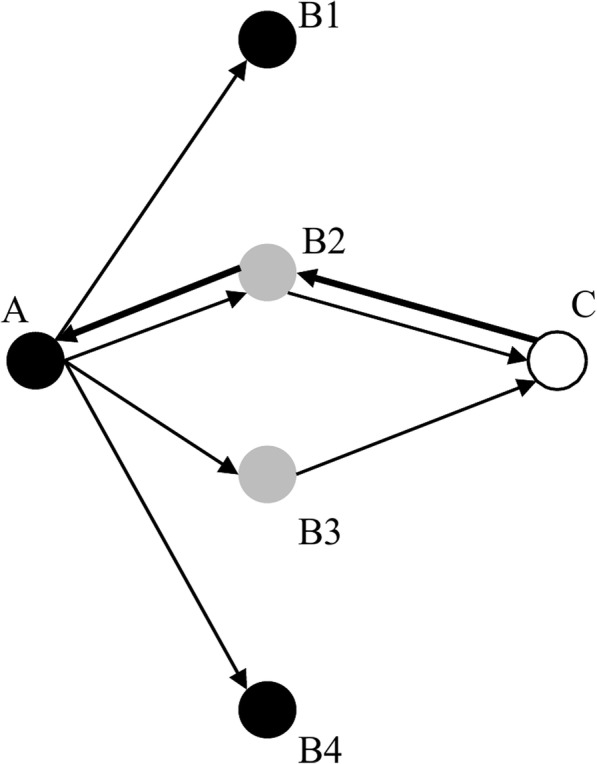
Our data was purchased from GNIP. We obtained all Ebola-related tweets posted globally from March 23, 2014 to May 31, 2015. We reconstructed Ebola-related retweeting paths based on Twitter content and the follower-followee relationships. Social network analysis was performed to investigate retweeting patterns. In addition to describing the diffusion structures, we classify users in the network into four categories (i.e., influential user, hidden influential user, disseminator, common user) based on following and retweeting patterns.
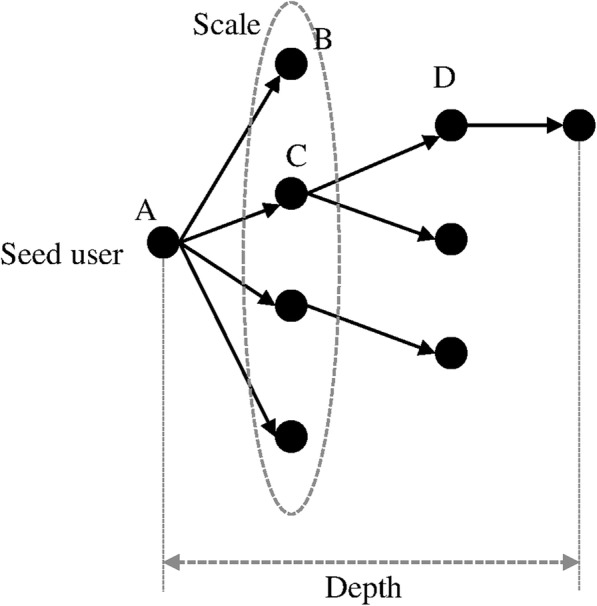
On average, 91% of the retweets were directly retweeted from the initial message. Moreover, 47.5% of the retweeting paths of the original tweets had a depth of 1 (i.e., from the seed user to its immediate followers). These observations suggested that the broadcasting was more pervasive than viral spreading. We found that influential users and hidden influential users triggered more retweets than disseminators and common users. Disseminators and common users relied more on the viral model for spreading information beyond their immediate followers via influential and hidden influential users.
Broadcasting was the dominant mechanism of information diffusion of a major health event on Twitter. It suggests that public health communicators can work beneficially with influential and hidden influential users to get the message across, because influential and hidden influential users can reach more people that are not following the public health Twitter accounts. Although both influential users and hidden influential users can trigger many retweets, recognizing and using the hidden influential users as the source of information could potentially be a cost-effective communication strategy for public health promotion. However, challenges remain due to uncertain credibility of these hidden influential users.
公共卫生问题的信息和情绪可以通过在线社交网络广泛传播。尽管可以获得关于信息扩散量的综合指标,但我们对信息在在线社交网络上的传播方式知之甚少。健康信息可以从一个人传播到多个人(即广播),也可以从一个人到另一个人的链条传播(即病毒式传播)。本研究旨在检查 Twitter 上埃博拉信息的传播模式,并确定与埃博拉信息相关的有影响力的用户。
我们的数据是从 GNIP 购买的。我们从 2014 年 3 月 23 日至 2015 年 5 月 31 日获得了全球发布的所有与埃博拉相关的推文。我们基于 Twitter 内容和关注者-被关注者关系重建了与埃博拉相关的转发路径。我们进行了社交网络分析以研究转发模式。除了描述扩散结构外,我们还根据关注和转发模式将网络中的用户分为四类(即有影响力的用户、隐藏的有影响力的用户、传播者、普通用户)。
平均而言,91%的转发是直接从初始消息转发的。此外,原始推文的转发路径中有 47.5%的深度为 1(即从种子用户到其直接关注者)。这些观察结果表明,广播比病毒式传播更为普遍。我们发现有影响力的用户和隐藏的有影响力的用户比传播者和普通用户触发了更多的转发。传播者和普通用户通过有影响力和隐藏的有影响力的用户,更多地依赖病毒模型将信息传播到其直接关注者之外。
广播是 Twitter 上重大健康事件信息扩散的主要机制。这表明公共卫生传播者可以与有影响力和隐藏的有影响力的用户合作,有益地传播信息,因为有影响力和隐藏的有影响力的用户可以接触到更多没有关注公共卫生 Twitter 账户的人。尽管有影响力的用户和隐藏的有影响力的用户都可以触发很多转发,但识别和利用隐藏的有影响力的用户作为信息源可能是一种具有成本效益的公共卫生促进传播策略。然而,由于这些隐藏的有影响力的用户的可信度不确定,挑战仍然存在。