VectorBase, Department of Biological Sciences, University of Notre Dame, Notre Dame, IN, USA.
Global Biodiversity Information Facility (GBIF) Secretariat, Copenhagen, Denmark.
Sci Data. 2019 Apr 25;6(1):40. doi: 10.1038/s41597-019-0042-5.
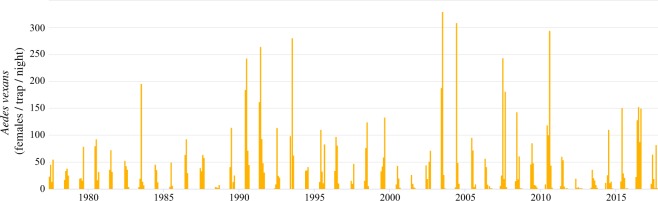
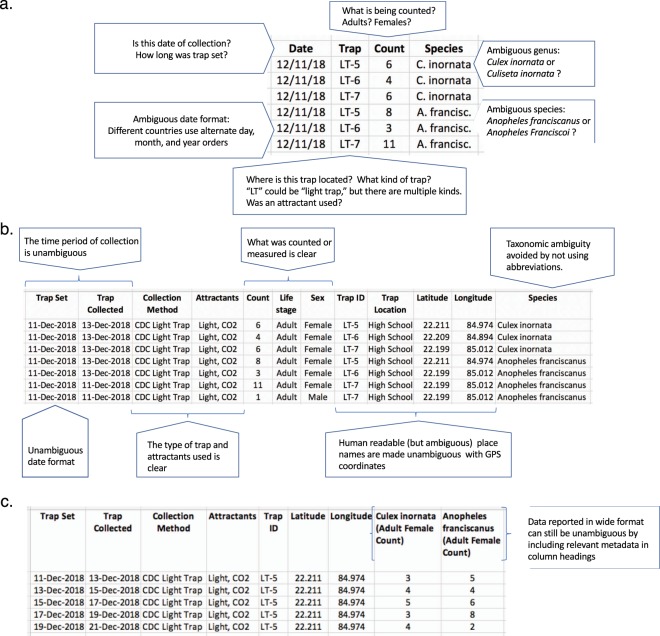
Arthropods play a dominant role in natural and human-modified terrestrial ecosystem dynamics. Spatially-explicit arthropod population time-series data are crucial for statistical or mathematical models of these dynamics and assessment of their veterinary, medical, agricultural, and ecological impacts. Such data have been collected world-wide for over a century, but remain scattered and largely inaccessible. In particular, with the ever-present and growing threat of arthropod pests and vectors of infectious diseases, there are numerous historical and ongoing surveillance efforts, but the data are not reported in consistent formats and typically lack sufficient metadata to make reuse and re-analysis possible. Here, we present the first-ever minimum information standard for arthropod abundance, Minimum Information for Reusable Arthropod Abundance Data (MIReAD). Developed with broad stakeholder collaboration, it balances sufficiency for reuse with the practicality of preparing the data for submission. It is designed to optimize data (re)usability from the "FAIR," (Findable, Accessible, Interoperable, and Reusable) principles of public data archiving (PDA). This standard will facilitate data unification across research initiatives and communities dedicated to surveillance for detection and control of vector-borne diseases and pests.
节肢动物在自然和人为改变的陆地生态系统动态中起着主导作用。明确的节肢动物种群时间序列数据对于这些动态的统计或数学模型以及评估其兽医、医学、农业和生态影响至关重要。这些数据在全球范围内已经收集了一个多世纪,但仍然分散且难以获取。特别是,随着节肢动物害虫和传染病媒介不断存在且日益严重的威胁,有许多历史和正在进行的监测工作,但这些数据没有以一致的格式报告,通常缺乏足够的元数据,使得重用和重新分析变得不可能。在这里,我们提出了第一个节肢动物丰度的最低信息标准,即可重复使用的节肢动物丰度数据最低信息(MIReAD)。它是在广泛的利益相关者合作下制定的,在为提交数据做准备的同时,平衡了可重用性和实用性。它旨在从公共数据存档(PDA)的“可发现性、可访问性、互操作性和可重复性”(FAIR)原则优化数据(重新)可用性。该标准将促进各研究计划和专门用于检测和控制病媒传播疾病和害虫的社区的数据统一。