Koyuncu Irmak Duygu, Kilinc Erkan, Tore Fatma
Department of Histology and Embryology, School of Medicine, Biruni University, Istanbul, Turkey.
Department of Physiology, School of Medicine, Bolu Abant İzzet Baysal University, Bolu, Turkey.
Front Cell Neurosci. 2019 Apr 5;13:136. doi: 10.3389/fncel.2019.00136. eCollection 2019.
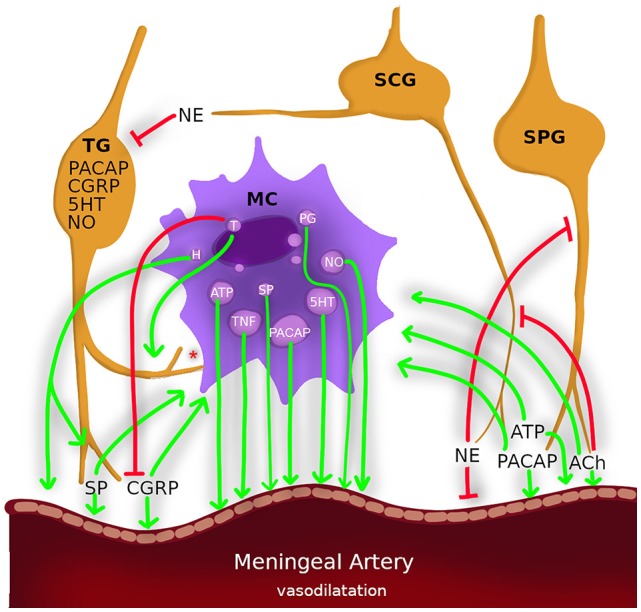
Migraine is a primary headache disorder which has complex neurogenic pathophysiological mechanisms still requiring full elucidation. The sensory nerves and meningeal mast cell couplings in the migraine target tissue are very effective interfaces between the central nervous system and the immune system. These couplings fall into three categories: intimacy, cross-talk and a shared fate. Acting as the immediate call-center of the neuroimmune system, mast cells play fundamental roles in migraine pathophysiology. Considerable evidence shows that neuroinflammation in the meninges is the key element resulting in the sensitization of trigeminal nociceptors. The successive events such as neuropeptide release, vasodilation, plasma protein extravasation, and mast cell degranulation that form the basic characteristics of the inflammation are believed to occur in this persistent pain state. In this regard, mast cells and sensory neurons represent both the target and source of the neuropeptides that play autocrine, paracrine, and neuro-endocrine roles during this inflammatory process. This review intends to contribute to a better understanding of the meningeal mast cell and sensory neuron bi-directional interactions from molecular, cellular, functional points of view. Considering the fact that mast cells play a role in expanding the opportunities for targeted new migraine therapies, it is of crucial importance to explore these multi-faceted interactions.
偏头痛是一种原发性头痛疾病,其复杂的神经源性病理生理机制仍有待充分阐明。偏头痛靶组织中的感觉神经与脑膜肥大细胞耦合是中枢神经系统和免疫系统之间非常有效的界面。这些耦合可分为三类:紧密连接、相互作用和共同命运。肥大细胞作为神经免疫系统的直接呼叫中心,在偏头痛病理生理学中发挥着重要作用。大量证据表明,脑膜中的神经炎症是导致三叉神经伤害感受器致敏的关键因素。形成炎症基本特征的一系列事件,如神经肽释放、血管舒张、血浆蛋白外渗和肥大细胞脱颗粒,被认为发生在这种持续性疼痛状态中。在这方面,肥大细胞和感觉神经元既是神经肽的靶标,也是神经肽的来源,这些神经肽在炎症过程中发挥自分泌、旁分泌和神经内分泌作用。本综述旨在从分子、细胞和功能角度,有助于更好地理解脑膜肥大细胞与感觉神经元的双向相互作用。鉴于肥大细胞在扩大偏头痛靶向新疗法机会方面发挥作用,探索这些多方面的相互作用至关重要。