Pan Yongming, Rong Yili, You Mengmeng, Ma Quanxin, Chen Minli, Hu Fuliang
College of Animal Sciences Zhejiang University Hangzhou China.
Comparative Medical Research Institute, Experimental Animal Research Center Zhejiang Chinese Medical University Hangzhou China.
Food Sci Nutr. 2019 Feb 17;7(4):1361-1370. doi: 10.1002/fsn3.970. eCollection 2019 Apr.
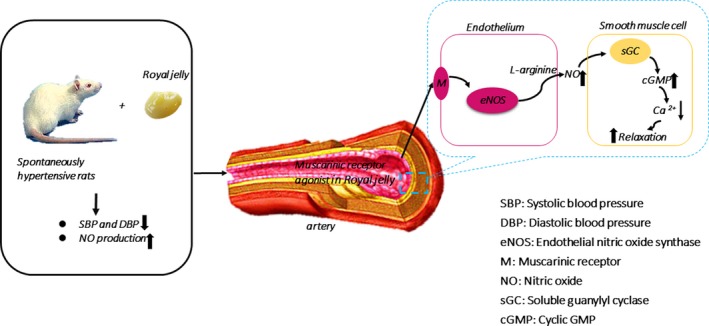
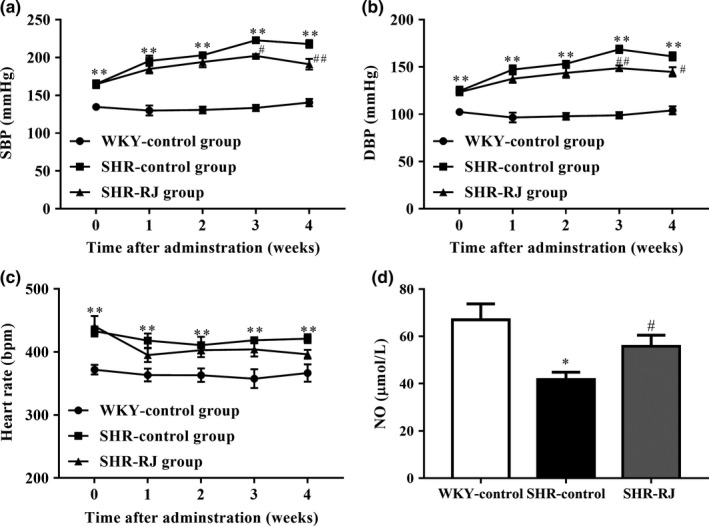
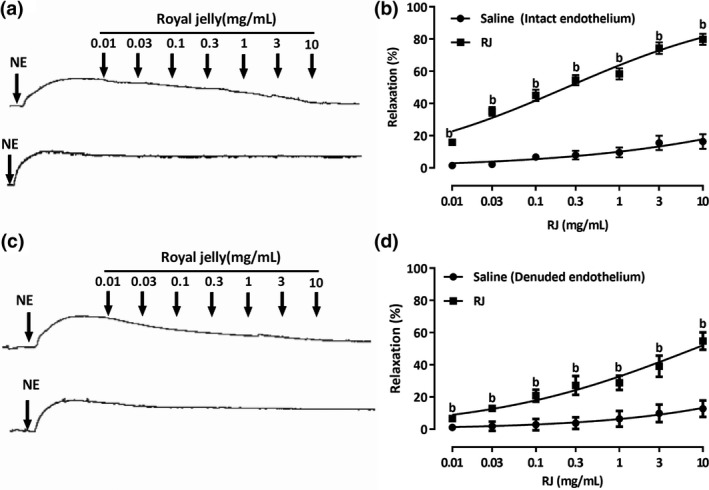
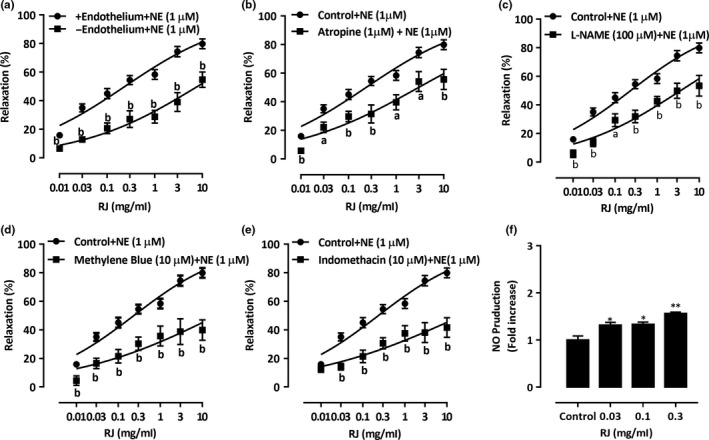
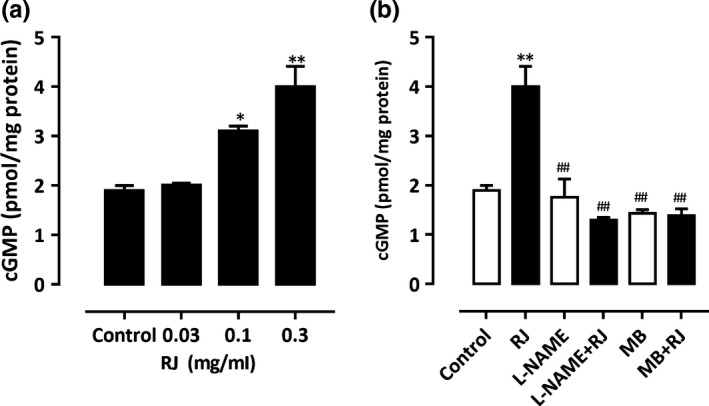
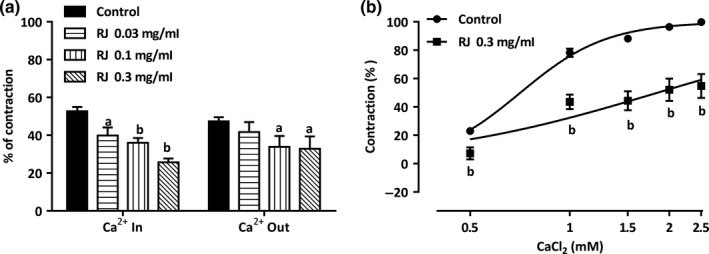
Among royal jelly's (RJ) various biological activities, its possible antihypertension and vasorelaxation effects deserve particular attention, but the underlying mechanisms of action remain unclear. Therefore, this study used the spontaneously hypertensive rats (SHR) hypertension model and the isolated rabbit thoracic aorta rings model to explore the mechanisms underlying the hypotension and vasorelaxation effects of RJ. Rats were divided into the following groups ( = 6): WKY-control group, SHR-control group, and SHR-RJ group. SHR-RJ group was received 1 g/kg of RJ via oral administration daily for 4 weeks. Systolic blood pressure (SBP), diastolic blood pressure (DBP), heart rate (HR), and nitric oxide (NO) level were detected. In addition, the mechanism of vasodilation of RJ was investigated using an isolated rabbit aortic ring technique. RJ significantly reduced SBP and DBP as well as increased NO levels of SHR in vivo. RJ caused vasorelaxation of the isolated aorta rings, and this effect was inhibited by atropine (M receptor blocker), L-NAME (nitric oxide synthase inhibitor), methylene blue (guanylate cyclase inhibitor), and indomethacin (cyclooxygenase inhibitor). Moreover, RJ could markedly suppress the NE-induced intracellular Ca releases and high K-induced extracellular Ca influx in denuded aortic rings. In addition, RJ can also increase cGMP levels and the production of NO in isolated aortic rings. The present study showed that RJ has antihypertensive effects and was associated with increased NO production. In addition, RJ contains muscarinic receptor agonist, possibly an acetylcholine-like substance, and induces vasodilation through NO/cGMP pathway and calcium channels.
在蜂王浆(RJ)的各种生物活性中,其可能的降压和血管舒张作用值得特别关注,但其潜在的作用机制仍不清楚。因此,本研究使用自发性高血压大鼠(SHR)高血压模型和离体兔胸主动脉环模型来探讨RJ降压和血管舒张作用的机制。将大鼠分为以下几组(每组n = 6):WKY对照组、SHR对照组和SHR-RJ组。SHR-RJ组每天经口给予1 g/kg的RJ,持续4周。检测收缩压(SBP)、舒张压(DBP)、心率(HR)和一氧化氮(NO)水平。此外,采用离体兔主动脉环技术研究RJ的血管舒张机制。RJ可显著降低SHR的SBP和DBP,并提高其体内NO水平。RJ可引起离体主动脉环舒张,且这种作用被阿托品(M受体阻滞剂)、L-NAME(一氧化氮合酶抑制剂)、亚甲蓝(鸟苷酸环化酶抑制剂)和吲哚美辛(环氧化酶抑制剂)抑制。此外,RJ可显著抑制去内皮主动脉环中去甲肾上腺素(NE)诱导的细胞内钙释放和高钾诱导的细胞外钙内流。此外,RJ还可提高离体主动脉环中cGMP水平和NO的生成。本研究表明,RJ具有降压作用,且与NO生成增加有关。此外,RJ含有毒蕈碱受体激动剂,可能是一种乙酰胆碱样物质,并通过NO/cGMP途径和钙通道诱导血管舒张。